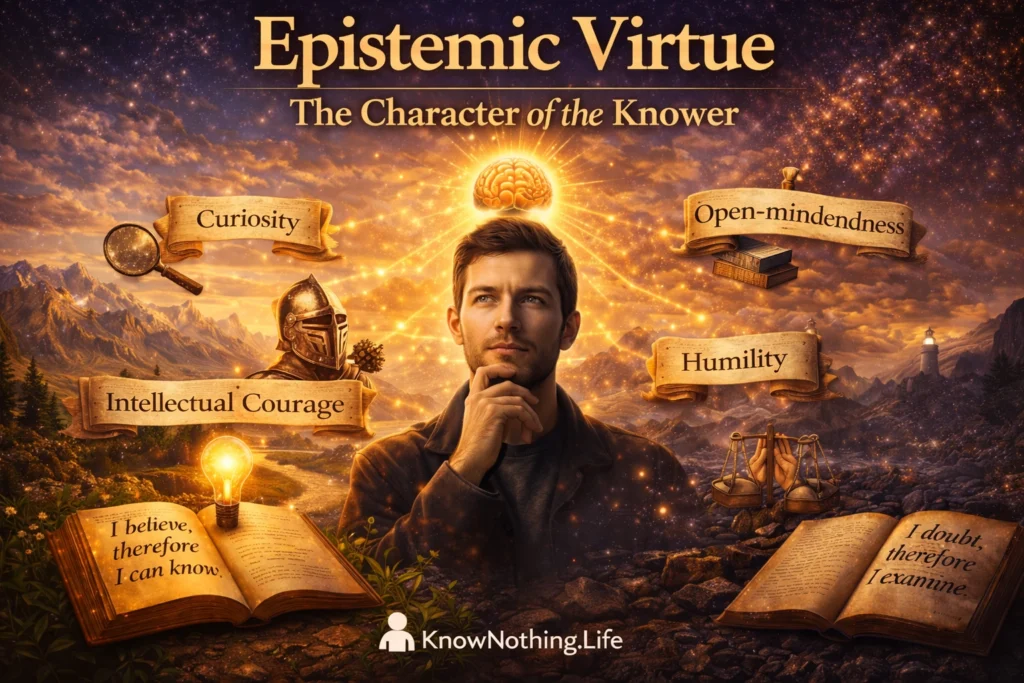
Epistemic virtue represents a shift in epistemology from focusing solely on beliefs and justification to examining the qualities of the person who holds those beliefs. Rather than asking only whether a belief is true or justified, virtue epistemology asks what kind of intellectual character produces knowledge. It emphasizes traits such as open-mindedness, intellectual humility, intellectual courage, and careful reasoning as essential to the pursuit of truth.
This approach draws inspiration from ancient virtue ethics, particularly the work of Aristotle, who argued in Nicomachean Ethics that virtue involves the cultivation of good habits and dispositions. Applied to epistemology, this idea suggests that knowledge is not merely a property of beliefs but an achievement of a well-functioning intellectual agent.
Modern philosophers such as Ernest Sosa and Linda Zagzebski have developed this perspective into a comprehensive theory of knowledge. By focusing on the character of the knower, epistemic virtue offers a more holistic understanding of knowledge that integrates cognitive abilities, ethical considerations, and practical reasoning.
The Roots of Epistemic Virtue
The concept of epistemic virtue has its origins in the broader tradition of virtue ethics. Aristotle’s account of intellectual virtues provides a foundation for understanding how character contributes to knowledge. In Nicomachean Ethics, Aristotle distinguishes between moral virtues, such as courage and temperance, and intellectual virtues, such as wisdom (sophia) and understanding (nous).
Aristotle’s emphasis on the development of intellectual virtues highlights the importance of habit and practice in acquiring knowledge. Knowledge is not simply a matter of possessing true beliefs, but of cultivating the skills and dispositions necessary to arrive at those beliefs. This perspective underscores the active role of the knower in the process of understanding.
In the modern era, epistemology largely shifted its focus to the analysis of belief and justification, often neglecting the role of character. The revival of virtue epistemology in the late 20th century represents a return to these earlier insights, integrating them into contemporary discussions of knowledge and justification.
Sosa and Virtue Reliabilism
Ernest Sosa is one of the leading figures in the development of virtue epistemology, particularly through his theory of virtue reliabilism. In works such as Knowledge in Perspective, Sosa argues that knowledge arises from the successful exercise of intellectual abilities.
According to Sosa, a belief qualifies as knowledge if it is true and produced by a reliable cognitive competence. He distinguishes between different levels of knowledge, including “animal knowledge,” which involves basic reliable belief, and “reflective knowledge,” which includes an awareness of the reliability of one’s cognitive processes. This distinction highlights the layered nature of epistemic achievement.
Sosa’s approach combines elements of reliabilism with a focus on intellectual virtues. By emphasizing the role of cognitive abilities, he provides a framework in which knowledge is understood as a kind of performance—an achievement that results from the proper functioning of intellectual faculties. This perspective bridges the gap between externalist and virtue-based accounts of knowledge.
Zagzebski and Virtue Responsibilism
While Sosa emphasizes cognitive abilities, Linda Zagzebski focuses on intellectual character traits in her version of virtue epistemology, often referred to as virtue responsibilism. In Virtues of the Mind, she argues that intellectual virtues are akin to moral virtues, involving both motivation and skill.
Zagzebski identifies traits such as intellectual honesty, fairness, and perseverance as essential to the pursuit of knowledge. These virtues guide the knower in seeking truth, evaluating evidence, and avoiding error. Unlike purely cognitive accounts, her approach emphasizes the ethical dimension of epistemology, suggesting that knowledge is deeply connected to character.
One of Zagzebski’s key insights is that knowledge involves not only getting things right but doing so in the right way. A belief that is true by accident does not count as knowledge; it must result from the exercise of intellectual virtue. This perspective reinforces the idea that knowledge is an achievement of the whole person, not just a property of isolated beliefs.
Epistemic Virtues and Intellectual Character
Epistemic virtues encompass a wide range of intellectual traits that contribute to the formation of knowledge. These include open-mindedness, which allows individuals to consider alternative perspectives; intellectual humility, which involves recognizing the limits of one’s knowledge; and intellectual courage, which enables individuals to pursue truth despite challenges or opposition.
These virtues play a crucial role in shaping how individuals engage with information and evidence. For example, open-mindedness encourages the evaluation of diverse viewpoints, while intellectual humility prevents overconfidence and dogmatism. Together, these traits foster a more balanced and reflective approach to knowledge.
The cultivation of epistemic virtues is not merely a theoretical concern but a practical one. In everyday life, individuals rely on these virtues to navigate complex information environments, make decisions, and engage in meaningful dialogue. By emphasizing character, virtue epistemology highlights the importance of personal development in the pursuit of knowledge.
Epistemic Virtue and Education
The concept of epistemic virtue has significant implications for education. Traditional approaches to education often focus on the transmission of information, but virtue epistemology suggests that the development of intellectual character is equally important. Educators are increasingly recognizing the value of fostering critical thinking, curiosity, and intellectual integrity in students.
By cultivating epistemic virtues, education can equip individuals with the tools needed to evaluate information, resist misinformation, and engage in thoughtful inquiry. This approach aligns with broader educational goals that emphasize lifelong learning and the development of responsible citizens.
Philosophers and educators alike have argued that epistemic virtues are essential for addressing contemporary challenges, such as the spread of misinformation and the erosion of trust in knowledge institutions. By promoting intellectual virtues, education can contribute to a more informed and reflective society.
Critiques and Challenges
Despite its strengths, virtue epistemology faces several challenges. One criticism is that it may be difficult to define and measure intellectual virtues. Unlike beliefs or processes, virtues are complex and context-dependent, making them harder to analyze and evaluate.
Another challenge concerns the relationship between virtue and truth. While epistemic virtues are intended to promote true beliefs, it is possible for virtuous individuals to hold false beliefs due to misleading evidence or circumstances. This raises questions about whether virtue alone is sufficient for knowledge.
Additionally, some critics argue that virtue epistemology may overlap with other theories, such as reliabilism, without offering a distinct account of justification. These debates highlight the need for further clarification and development of the theory.
Contemporary Relevance
In contemporary philosophy, epistemic virtue continues to be a vibrant area of research. It has been integrated into discussions of social epistemology, where the focus is on how individuals and communities produce and share knowledge. The emphasis on character is particularly relevant in addressing issues of trust, credibility, and expertise.
Epistemic virtue also intersects with cognitive science and psychology, which study how intellectual traits influence reasoning and decision-making. These interdisciplinary connections enrich our understanding of how virtues operate in practice and how they can be cultivated.
As the information landscape becomes increasingly complex, the importance of epistemic virtue grows. In a world of competing claims and uncertain information, the ability to think critically, evaluate evidence, and remain open to revision is more important than ever.
Conclusion
Epistemic virtue offers a powerful and human-centered approach to understanding knowledge. By focusing on the character of the knower, it shifts the emphasis from abstract theories of justification to the qualities that enable individuals to seek and attain truth.
From the foundational insights of Aristotle to the contemporary contributions of Ernest Sosa and Linda Zagzebski, virtue epistemology has enriched the philosophical landscape. It highlights the importance of intellectual virtues in shaping knowledge and underscores the role of personal development in the pursuit of truth.
As Aristotle observed, excellence is not an act but a habit. This insight captures the essence of epistemic virtue: knowledge is not merely something we possess, but something we cultivate through the ongoing development of our intellectual character.