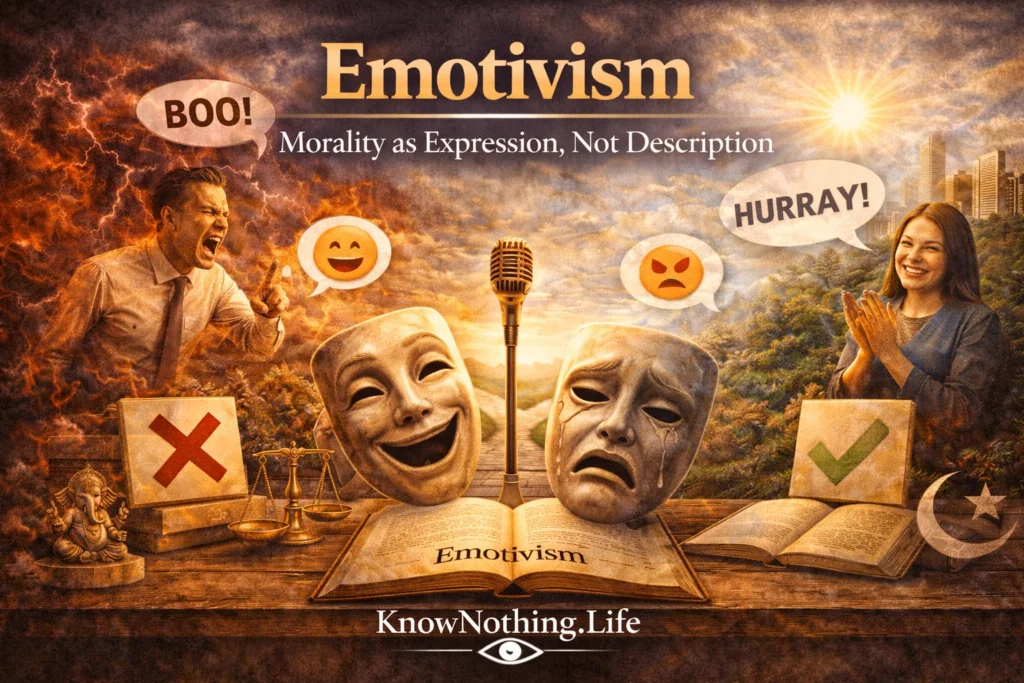
Emotivism is a metaethical theory that reinterprets moral language not as a vehicle for stating facts, but as an expression of emotion, attitude, or approval. According to emotivism, when we say “stealing is wrong,” we are not describing a property of stealing or asserting an objective truth. Instead, we are expressing a feeling—something closer to saying “boo to stealing” or “I disapprove of stealing.” This view challenges the traditional assumption that moral judgments are truth-apt and opens a radically different perspective on the nature of ethical discourse.
The theory emerged in the early 20th century, particularly within the analytic philosophy movement, where philosophers sought to clarify meaning through the analysis of language. Emotivism was heavily influenced by logical positivism, which held that meaningful statements must be either empirically verifiable or analytically true. Since moral statements do not meet these criteria, emotivists concluded that they do not convey factual information. Instead, they function to express and evoke emotions.
This reinterpretation of moral language has far-reaching implications. If moral statements are expressions of attitude rather than claims about the world, then moral disagreement is not about discovering truth but about influencing perspectives. Emotivism thus shifts the focus of ethics from knowledge and justification to communication, persuasion, and psychological response.
Historical Origins and Intellectual Context
The development of emotivism is closely tied to the rise of logical positivism in the early 20th century, particularly through the work of the Vienna Circle. Philosophers in this movement sought to eliminate metaphysical speculation and ground philosophy in empirical science and logical analysis. Within this framework, statements that could not be empirically verified—such as moral claims—were considered cognitively meaningless.
A. J. Ayer played a central role in articulating emotivism in his influential work Language, Truth and Logic. Ayer argued that moral statements are not propositions but expressions of emotion. When someone says “lying is wrong,” they are not stating a fact but expressing disapproval. “If I say to someone, ‘You acted wrongly in stealing that money,’” Ayer wrote, “I am not stating anything more than if I had simply said, ‘You stole that money,’ in a peculiar tone of horror.” This analysis reframes moral language as a form of emotional expression rather than factual discourse.
Another key figure in the development of emotivism is Charles L. Stevenson, whose work Ethics and Language expanded and refined the theory. Stevenson emphasized the persuasive function of moral language, arguing that ethical statements are used not only to express attitudes but also to influence others. He distinguished between descriptive meaning and emotive meaning, highlighting how moral language operates on both cognitive and emotional levels. This dual function underscores the complexity of ethical communication and the role of rhetoric in moral discourse.
Core Principles of Emotivism
At the heart of emotivism is the claim that moral statements are non-cognitive—they do not express beliefs that can be true or false. Instead, they express attitudes, emotions, or preferences. This distinguishes emotivism from cognitivist theories, which treat moral claims as propositions about the world. According to emotivists, ethical language functions more like a form of expression or command than a statement of fact.
One of the key implications of this view is that moral judgments are not subject to verification or falsification in the same way as empirical claims. There is no observable property of “wrongness” that can be detected or measured. Instead, moral evaluations reflect the speaker’s emotional response to a situation. This aligns with the broader positivist view that meaningful statements must be grounded in empirical observation or logical necessity.
Emotivism also emphasizes the motivational aspect of moral language. Unlike purely descriptive statements, moral judgments are inherently action-guiding. When someone expresses disapproval of an action, they are not merely reporting a feeling but also encouraging others to share that attitude. This gives moral language a performative dimension, where the act of speaking contributes to shaping social behavior and norms.
Moral Disagreement and Persuasion
One of the most significant contributions of emotivism is its account of moral disagreement. Traditional ethical theories often interpret disagreement as a conflict over facts or principles. Emotivism, however, views moral disputes as clashes of attitude rather than differences in belief. When two people disagree about a moral issue, they are not necessarily disputing a factual claim but expressing opposing emotional responses.
Charles L. Stevenson developed this idea by analyzing the role of persuasion in ethical discourse. In Ethics and Language, he argued that moral disagreements often involve attempts to influence others’ attitudes through rhetoric, reasoning, and emotional appeal. This explains why moral debates can be intense and difficult to resolve: they are not simply about evidence but about deeply held values and feelings.
This perspective also sheds light on the role of language in shaping moral communities. By expressing approval or disapproval, individuals contribute to the formation of shared norms and values. Moral language becomes a tool for coordination and social regulation, rather than a means of discovering objective truths. This functional view highlights the practical importance of ethical discourse, even if it lacks a factual basis.
Criticisms and Challenges
Despite its innovative approach, emotivism has faced substantial criticism. One of the primary objections is that it fails to account for the apparent objectivity of moral discourse. People often argue about moral issues as if there are correct answers, using reasons and evidence to support their positions. Critics argue that emotivism cannot adequately explain this aspect of ethical reasoning.
Philosophers such as G. E. Moore and R. M. Hare have challenged emotivism on these grounds. Moore’s non-naturalism maintains that moral properties are real and knowable, while Hare’s prescriptivism attempts to preserve the action-guiding nature of moral language without reducing it to mere emotion. Hare argued that moral statements function as universalizable prescriptions, providing a more structured account of ethical reasoning.
Another criticism is that emotivism may undermine the possibility of rational moral debate. If moral statements are simply expressions of attitude, then disagreements cannot be resolved through argument or evidence. This raises concerns about relativism and the potential erosion of ethical standards. Critics worry that emotivism reduces morality to subjective preference, making it difficult to justify moral claims or criticize harmful practices.
Emotivism in Contemporary Philosophy
While emotivism in its original form is less prominent today, its influence persists in contemporary metaethics and related fields. Many modern theories incorporate elements of emotivism, particularly in their recognition of the role of emotion and motivation in moral judgment. Research in psychology and neuroscience supports the idea that moral reasoning is closely linked to emotional processes, lending empirical support to some aspects of emotivist theory.
Philosophers have also developed more sophisticated versions of non-cognitivism that address some of emotivism’s limitations. These approaches seek to explain how moral language can be both expressive and rational, preserving the possibility of meaningful ethical discourse. By building on the insights of emotivism, contemporary theorists continue to explore the complex interplay between emotion, language, and morality.
In everyday life, emotivist insights can be seen in the way people use moral language to express values and influence others. Whether in political debates, social movements, or personal interactions, ethical statements often serve as tools for persuasion and identity formation. This reflects the enduring relevance of emotivism as a lens for understanding moral communication.
Conclusion
Emotivism offers a distinctive and provocative account of moral language, challenging the assumption that ethical statements describe objective facts. Through the work of A. J. Ayer and Charles L. Stevenson, it redefines morality as a domain of expression, emotion, and persuasion rather than truth and knowledge.
While it faces significant criticisms, particularly regarding objectivity and rational debate, emotivism provides valuable insights into the psychological and linguistic dimensions of ethics. It highlights the role of feeling in moral judgment and the importance of communication in shaping ethical life.
Ultimately, emotivism reminds us that morality is not only a matter of abstract principles but also of human experience. By examining how we express and respond to ethical values, it deepens our understanding of what it means to engage in moral discourse and to navigate the complexities of human interaction.