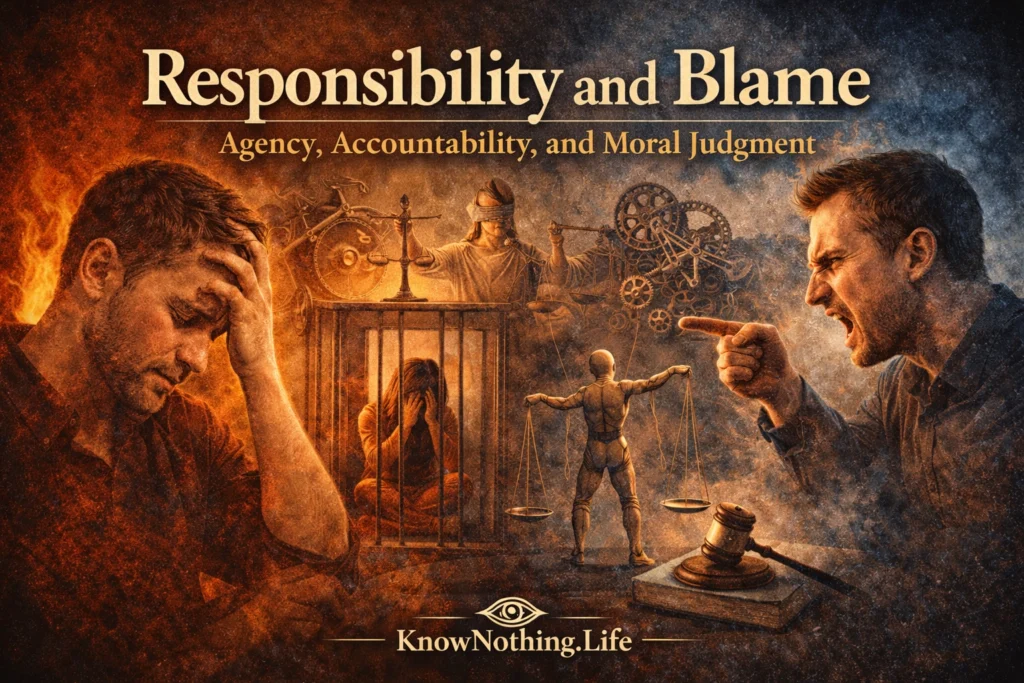
Responsibility and blame are central concepts in moral philosophy, shaping how individuals and societies evaluate actions, assign accountability, and respond to wrongdoing. To hold someone responsible is to regard them as an agent capable of making choices and answerable for the consequences of those choices. Blame, in turn, is the reactive response to perceived wrongdoing—an expression of moral disapproval that carries both emotional and social significance.
These concepts are deeply embedded in everyday life. Legal systems rely on notions of responsibility to determine guilt and punishment, while social relationships are structured around expectations of accountability and trust. Yet, philosophical reflection reveals that responsibility and blame are far from straightforward. Questions arise about free will, intention, knowledge, and control: under what conditions can someone truly be held responsible for their actions?
The study of responsibility and blame brings together insights from ethics, metaphysics, and psychology. It explores not only the conditions under which individuals are accountable but also the purpose and justification of blame. By examining these issues, philosophers seek to clarify how moral judgments are formed and how they should be applied in both personal and institutional contexts.
Free Will and Moral Responsibility
The concept of moral responsibility is closely tied to the idea of free will—the capacity to act freely and make choices independent of external constraints. If individuals lack free will, it becomes difficult to justify holding them responsible for their actions. This connection has made the free will debate one of the central concerns in discussions of responsibility.
Philosophers such as Immanuel Kant argued that moral responsibility requires autonomy, the ability to act according to rational principles rather than mere impulses or external influences. In Groundwork of the Metaphysics of Morals, Kant emphasized that individuals must be treated as rational agents capable of self-governance. Without this capacity, the very notion of moral obligation would lose its meaning.
Other philosophers have taken a more skeptical view. David Hume argued that free will is compatible with determinism, suggesting that responsibility does not require absolute freedom but rather the ability to act according to one’s character and motivations. This compatibilist perspective allows for moral responsibility even in a world governed by causal laws. The tension between these views continues to shape debates about the foundations of accountability.
Conditions of Responsibility: Intent, Knowledge, and Control
For an individual to be held morally responsible, certain conditions must typically be met. These include intention, knowledge, and control. Intent refers to the purpose behind an action—whether it was done deliberately or accidentally. Actions performed with malicious intent are generally considered more blameworthy than those resulting from negligence or ignorance.
Knowledge is another crucial factor. Individuals cannot be held fully responsible for consequences they could not reasonably foresee. If someone acts without awareness of the potential harm their actions may cause, their level of responsibility may be diminished. This raises questions about the role of ignorance and whether individuals have a duty to inform themselves about the consequences of their actions.
Control refers to the ability to act otherwise. If an individual is coerced or lacks the capacity to choose, their responsibility may be reduced or eliminated. Philosophers such as Aristotle, in Nicomachean Ethics, distinguished between voluntary and involuntary actions, arguing that only voluntary actions are subject to praise or blame. These conditions form the basis for assessing responsibility in both moral and legal contexts.
The Nature and Function of Blame
Blame is a complex moral response that involves both judgment and emotion. It is not merely a cognitive assessment of wrongdoing but also an expression of attitudes such as anger, resentment, or disappointment. Blame serves important social functions, including reinforcing norms, deterring harmful behavior, and maintaining trust within communities.
P. F. Strawson offered a significant account of blame in his essay “Freedom and Resentment.” He argued that moral responsibility is rooted in “reactive attitudes”—emotional responses that arise in interpersonal relationships. According to Strawson, feelings such as resentment and gratitude are central to our moral practices, and attempts to ground responsibility solely in abstract metaphysical theories overlook the importance of these human responses.
Blame also raises questions about fairness and proportionality. Excessive or misplaced blame can lead to injustice, while insufficient blame may fail to address wrongdoing. Understanding the appropriate role of blame requires balancing emotional responses with rational judgment, ensuring that moral evaluations are both just and constructive.
Blame, Forgiveness, and Moral Repair
While blame is an important aspect of moral life, it is not the end of the ethical process. Forgiveness and moral repair play equally significant roles in addressing wrongdoing and restoring relationships. Forgiveness involves letting go of resentment and offering the possibility of reconciliation, while moral repair focuses on actions such as apology, restitution, and efforts to make amends.
Philosophers have explored the conditions under which forgiveness is appropriate and its relationship to responsibility. Forgiveness does not necessarily absolve individuals of responsibility but can transform the moral significance of their actions. It allows for the possibility of growth and change, recognizing that individuals are capable of learning from their mistakes.
The process of moral repair highlights the relational nature of responsibility and blame. Ethical life is not only about assigning accountability but also about maintaining and repairing the social bonds that are essential for cooperation and trust. This perspective emphasizes the importance of empathy, understanding, and dialogue in navigating moral conflicts.
Structural Responsibility and Collective Blame
In addition to individual responsibility, contemporary discussions have increasingly focused on structural and collective forms of responsibility. Many social issues, such as inequality, environmental degradation, and systemic injustice, cannot be attributed to a single individual but arise from complex networks of actions and institutions.
Philosophers such as Iris Marion Young have argued that individuals can bear responsibility for structural injustices even if they did not directly cause them. In Responsibility for Justice, Young introduces the concept of “social connection,” emphasizing that individuals are part of systems that produce harm and therefore have obligations to address those harms.
Collective responsibility raises challenging questions about blame and accountability. How should responsibility be distributed among individuals within a group? Can groups themselves be blamed, or is blame always directed at individuals? These questions reflect the evolving nature of moral philosophy as it grapples with the complexities of modern social life.
Contemporary Perspectives and Psychological Insights
Recent research in psychology has provided new insights into how people perceive and assign responsibility and blame. Studies show that factors such as bias, emotion, and social context can influence moral judgments, sometimes leading to inconsistent or unfair outcomes. Understanding these influences is essential for improving ethical decision-making and promoting justice.
Philosophers and psychologists have also explored the role of moral luck—the idea that individuals are often judged based on factors beyond their control. This concept challenges traditional notions of responsibility by highlighting the influence of chance in shaping outcomes. It raises questions about whether it is fair to blame individuals for consequences that depend on circumstances they could not control.
These contemporary perspectives demonstrate that responsibility and blame are not static concepts but dynamic and context-dependent. They require ongoing reflection and adaptation to address new challenges and insights.
Conclusion
Responsibility and blame are fundamental to moral life, shaping how individuals and societies evaluate actions and respond to wrongdoing. Through the contributions of thinkers such as Immanuel Kant, David Hume, Aristotle, and P. F. Strawson, philosophy has developed a rich understanding of these concepts.
By examining the conditions of responsibility, the nature of blame, and the possibilities for forgiveness and repair, this field provides valuable insights into ethical judgment and human relationships. It highlights the importance of balancing accountability with compassion, ensuring that moral responses are both just and constructive.
Ultimately, the study of responsibility and blame reminds us that ethics is not only about evaluating actions but also about navigating relationships. It challenges us to hold others accountable while recognizing the complexities of human behavior, fostering a more thoughtful and humane approach to moral life.