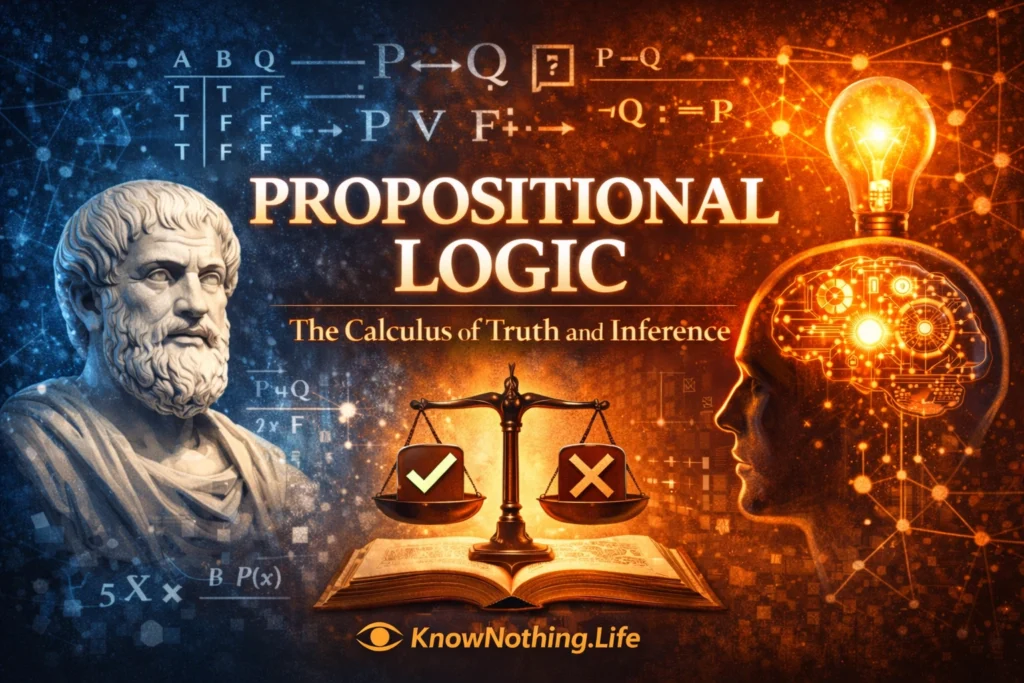
Propositional logic is the most fundamental branch of formal logic, concerned with the relationships between whole statements—propositions—and how their truth values combine through logical operators. At its core, it provides a framework for analyzing arguments by reducing them to their structural essence: statements that are either true or false, connected through operations such as “and,” “or,” “not,” and “if…then.” By abstracting away from the internal content of statements, propositional logic reveals the underlying patterns that govern valid reasoning across disciplines.
The development of propositional logic marks a pivotal moment in the history of logic, transforming it from a philosophical inquiry into a formal, mathematical system. While its roots can be traced back to Aristotle, the modern formulation owes much to thinkers such as George Boole, whose The Laws of Thought introduced algebraic methods for reasoning, and Gottlob Frege, whose symbolic language laid the groundwork for contemporary logic. Today, propositional logic serves as the entry point into formal reasoning, underpinning fields from philosophy to computer science.
The Nature of Propositions
A proposition is a declarative statement that is capable of being either true or false. This seemingly simple definition carries profound implications, as it allows reasoning to be formalized in terms of truth values rather than subjective interpretation. Statements such as “The sky is blue” or “2 + 2 = 4” qualify as propositions, while questions, commands, or ambiguous expressions do not. By focusing exclusively on truth-bearing statements, propositional logic establishes a clear domain for formal analysis.
The significance of this abstraction becomes evident when propositions are symbolized using variables such as p, q, and r. This symbolic representation allows arguments to be studied independently of their specific content. For example, the argument “If it rains, the ground gets wet; it is raining; therefore, the ground is wet” can be expressed in a purely formal way as “If p, then q; p; therefore, q.” This structure, known as modus ponens, is valid regardless of what p and q represent.
As Gottlob Frege emphasized in his Begriffsschrift, the goal of logic is to make reasoning transparent by expressing it in a precise symbolic language. Frege wrote, “I wished to make clear how far one can go in arithmetic by means of inferences alone,” highlighting the power of formalization. Propositional logic embodies this ambition by reducing reasoning to its simplest components: propositions and their truth values.
Logical Connectives and Truth Functions
The power of propositional logic lies in its use of logical connectives—operators that combine propositions into more complex statements. The primary connectives include conjunction (“and”), disjunction (“or”), negation (“not”), and implication (“if…then”). Each of these connectives corresponds to a truth function, meaning that the truth value of the resulting statement depends solely on the truth values of its components.
Truth tables provide a systematic way to analyze these relationships. For instance, the conjunction p ∧ q is true only when both p and q are true, while the disjunction p ∨ q is true when at least one of them is true. The conditional p → q introduces a more subtle relationship, being false only when p is true and q is false. These definitions may initially seem counterintuitive, particularly in the case of implication, but they ensure consistency and precision within the logical system.
The algebraic treatment of these connectives was pioneered by George Boole, who demonstrated that logical operations could be represented mathematically. In The Laws of Thought, Boole wrote, “The laws of thought are the laws of reason,” asserting that logical principles could be expressed with the same rigor as algebra. This insight not only advanced the study of logic but also laid the foundation for modern computing, where Boolean operations govern digital circuits.
Argument Forms and Validity
One of the central aims of propositional logic is to identify valid argument forms—patterns of reasoning that guarantee the truth of the conclusion if the premises are true. By abstracting arguments into symbolic form, propositional logic allows us to test their validity independently of their content. This approach reveals that many seemingly different arguments share the same underlying structure.
Classic valid forms such as modus ponens (“If p, then q; p; therefore, q”) and modus tollens (“If p, then q; not q; therefore, not p”) illustrate how logical inference operates within propositional systems. Conversely, invalid forms, such as affirming the consequent (“If p, then q; q; therefore, p”), demonstrate how reasoning can go wrong even when it appears superficially persuasive.
The study of argument forms was further developed by Bertrand Russell and Alfred North Whitehead in Principia Mathematica, where they sought to derive all of mathematics from logical principles. Russell famously remarked, “Logic is concerned with the real world just as truly as zoology, though with its more abstract and general features,” emphasizing that logical structures reflect fundamental aspects of reality. Propositional logic, as the simplest formal system, provides the foundation for this broader logical enterprise.
Formal Systems and Proof Techniques
Propositional logic can be formalized into systems that specify rules for deriving conclusions from premises. These systems include axiomatic approaches, natural deduction, and truth-functional methods such as truth tables. Each approach offers a different perspective on how logical reasoning can be carried out rigorously and systematically.
In axiomatic systems, a set of basic assumptions (axioms) is combined with rules of inference to derive theorems. Natural deduction systems, developed in part by Gerhard Gentzen, aim to mirror the intuitive processes of human reasoning while maintaining formal rigor. Truth tables, on the other hand, provide a mechanical procedure for determining the validity of arguments by examining all possible truth-value assignments.
The formalization of proof reflects a broader philosophical ambition: to eliminate ambiguity and ensure that reasoning can be verified step by step. As David Hilbert envisioned, mathematics and logic could be grounded in complete and consistent systems. Although later developments, particularly the work of Kurt Gödel, revealed limits to this program, propositional logic remains a domain in which such formalization is both achievable and instructive.
Applications in Computing and Philosophy
Propositional logic has found profound applications in computer science, where its principles underpin the design of digital systems. Boolean algebra, derived from the work of George Boole, forms the basis of logic gates and circuits, enabling computers to perform calculations and process information. Every modern computing device operates on binary logic, translating complex operations into combinations of true and false values.
In philosophy, propositional logic serves as a tool for clarifying arguments and analyzing reasoning. It allows philosophers to distinguish valid arguments from fallacious ones, providing a standard of rigor that transcends rhetorical persuasion. The analytic tradition, associated with figures such as Bertrand Russell, placed great emphasis on logical analysis as a method for resolving philosophical problems.
The influence of propositional logic extends into artificial intelligence, where it is used for knowledge representation and automated reasoning. Early AI systems relied heavily on logical inference, demonstrating how formal systems could simulate aspects of human thought. As John McCarthy observed, logic provides a framework for representing knowledge in a way that machines can manipulate, bridging the gap between human reasoning and computational processes.
Limitations and Extensions
Despite its elegance and utility, propositional logic has inherent limitations. Its primary constraint lies in its simplicity: by treating propositions as indivisible units, it cannot capture the internal structure of statements or the relationships between objects and properties. This limitation makes it insufficient for analyzing more complex forms of reasoning, such as those involving quantification or relational statements.
To address these shortcomings, logicians developed predicate logic, which extends propositional logic by introducing variables, quantifiers, and relations. This more expressive system allows for the representation of statements like “All humans are mortal,” which cannot be adequately captured within propositional frameworks. As Gottlob Frege demonstrated, the transition to predicate logic significantly expands the scope of formal reasoning.
Nevertheless, propositional logic remains indispensable as a foundational system. It provides the basic tools and concepts upon which more advanced logics are built. Even in complex systems, the principles of truth-functional reasoning continue to play a central role, illustrating the enduring relevance of propositional logic in both theory and application.
Conclusion
Propositional logic represents the simplest yet most essential form of formal reasoning, offering a clear and systematic method for analyzing arguments. By reducing statements to their truth values and examining their logical relationships, it reveals the fundamental structures that govern valid inference. From the pioneering work of George Boole to the formal systems of Bertrand Russell and beyond, propositional logic has shaped the development of modern thought.
Its influence extends far beyond philosophy, forming the basis of computer science, artificial intelligence, and mathematical logic. At the same time, its limitations highlight the need for more expressive systems, reminding us that no single framework can capture all aspects of reasoning. In this way, propositional logic serves both as a foundation and a starting point—a gateway into the broader and more complex landscape of formal logic.
Ultimately, propositional logic demonstrates that reasoning can be studied with precision and clarity, revealing patterns that transcend individual arguments. It shows that beneath the diversity of human thought lies a common structure, one that can be analyzed, understood, and applied across disciplines. As such, it remains a cornerstone of rational inquiry and a testament to the power of formal systems in illuminating the nature of truth and inference.