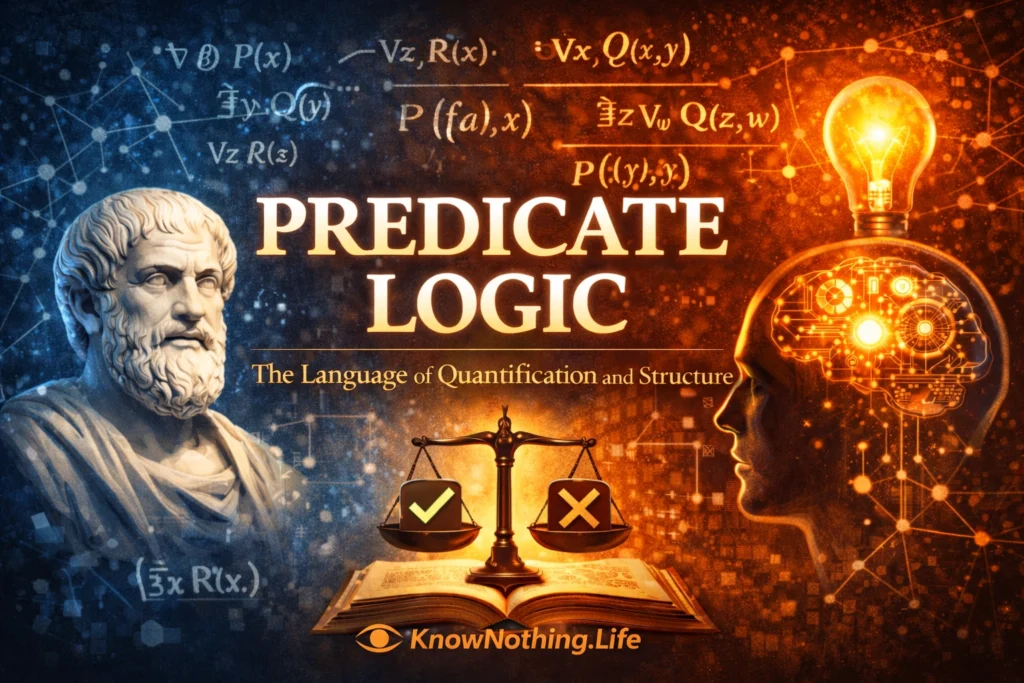
Predicate logic—also known as first-order logic—is a powerful extension of propositional logic that allows us to analyze the internal structure of statements rather than treating them as indivisible wholes. Where propositional logic operates on complete propositions, predicate logic introduces variables, predicates, and quantifiers, enabling the formal representation of statements about objects, properties, and relations. This shift transforms logic from a calculus of truth values into a language capable of expressing the complexity of mathematics, science, and natural language.
The emergence of predicate logic in the late 19th century marks one of the most significant turning points in intellectual history. It was pioneered by Gottlob Frege in his groundbreaking work Begriffsschrift (1879), where he introduced a formal system capable of representing quantified statements and relational structures. Frege’s innovations were later expanded by thinkers such as Bertrand Russell and Alfred North Whitehead in Principia Mathematica, as well as Alfred Tarski, whose work on semantics clarified the relationship between formal languages and truth. Predicate logic thus stands at the intersection of philosophy, mathematics, and linguistics, providing a universal framework for rigorous reasoning.
From Propositions to Predicates
The key innovation of predicate logic lies in its ability to break down propositions into their constituent parts. Instead of treating a statement like “All humans are mortal” as a single unit, predicate logic analyzes it in terms of a predicate (“is mortal”) applied to a variable (“x”), along with a quantifier (“for all”). This allows the statement to be expressed formally as ∀x (Human(x) → Mortal(x)), revealing its logical structure in a precise and generalizable way.
This decomposition enables predicate logic to capture patterns of reasoning that are invisible to propositional systems. For example, it can distinguish between statements such as “Everyone loves someone” and “Someone is loved by everyone,” which appear similar in natural language but differ significantly in logical structure. Such distinctions are crucial for both philosophical analysis and mathematical reasoning, where precision is essential.
Frege recognized the importance of this breakthrough, writing, “I was not satisfied with the expression of judgments in the traditional logic, since it did not suffice for the purposes of arithmetic.” His dissatisfaction with earlier systems led him to develop a formal language capable of representing complex relationships, laying the foundation for modern logic. Predicate logic, in this sense, represents a decisive move from surface-level reasoning to deep structural analysis.
Quantifiers and Variables
At the heart of predicate logic are quantifiers and variables, which allow for the expression of generality and existence. The universal quantifier (∀) asserts that a statement holds for all elements in a domain, while the existential quantifier (∃) asserts that there exists at least one element for which the statement is true. These tools enable predicate logic to represent a wide range of statements, from mathematical theorems to everyday assertions.
Variables serve as placeholders for objects within a domain, allowing predicates to be applied in a flexible and general manner. For instance, the statement ∃x (Cat(x) ∧ Black(x)) expresses the existence of at least one black cat, while ∀x (Cat(x) → Mammal(x)) expresses a universal property of cats. By combining quantifiers, variables, and predicates, predicate logic achieves a level of expressive power far beyond that of propositional logic.
The formal treatment of quantification was further developed by Bertrand Russell, who used logical analysis to address philosophical problems such as the nature of definite descriptions. In his essay “On Denoting,” Russell demonstrated how seemingly simple statements can conceal complex logical structures. As he observed, “The present King of France is bald” raises questions about existence and reference that can only be resolved through formal analysis. Predicate logic provides the tools needed to clarify such issues, revealing the hidden structure of language and thought.
Formal Systems and Logical Syntax
Predicate logic operates within formal systems that specify rules for constructing and manipulating expressions. These systems include a formal language, a set of axioms, and rules of inference that govern the derivation of conclusions. The syntax of predicate logic defines how symbols can be combined, ensuring that expressions are well-formed and unambiguous.
One of the key achievements in the development of predicate logic was the formalization of proof systems. Gerhard Gentzen introduced natural deduction and sequent calculus, providing frameworks for constructing proofs in a systematic way. These systems emphasize the structure of reasoning, allowing logicians to analyze how conclusions are derived from premises step by step.
The aspiration to formalize all of mathematics was championed by David Hilbert, who sought to establish a complete and consistent set of axioms for mathematical reasoning. Hilbert famously declared, “We must know—we will know,” expressing confidence in the power of formal systems. Predicate logic played a central role in this program, offering a language capable of expressing mathematical truths with precision and rigor.
Semantics and Truth
While syntax concerns the formal structure of expressions, semantics addresses their meaning and truth. In predicate logic, semantics is typically defined in terms of interpretations or models, which assign meaning to the symbols of the language. A statement is considered true in a model if it holds under the interpretation specified by that model.
The modern theory of semantics was developed by Alfred Tarski, who provided a formal definition of truth for logical languages. Tarski’s approach, known as the semantic theory of truth, defines truth in terms of satisfaction: a statement is true if it is satisfied by a given interpretation. As Tarski wrote, “The concept of truth… is to be defined in terms of satisfaction,” highlighting the precise relationship between language and reality.
Model theory, a branch of logic that studies the relationship between formal languages and their interpretations, has become a central area of research in predicate logic. It explores questions such as whether a set of statements has a model, whether different models are equivalent, and how properties of models relate to the structure of the language. This interplay between syntax and semantics is one of the defining features of predicate logic, providing a comprehensive framework for understanding logical systems.
Applications Across Disciplines
Predicate logic has had a profound impact on a wide range of disciplines, from mathematics and computer science to linguistics and philosophy. In mathematics, it provides the foundation for formal proofs and the axiomatization of theories. Systems such as set theory and number theory are expressed within the framework of predicate logic, demonstrating its central role in the foundations of mathematics.
In computer science, predicate logic is used for knowledge representation, database theory, and formal verification. Logical languages allow programmers to specify properties of systems and verify that they behave as intended. The influence of predicate logic can be seen in programming paradigms such as logic programming, where computation is based on logical inference.
Linguistics has also benefited from the tools of predicate logic, particularly in the study of formal semantics. Richard Montague showed that natural language could be analyzed using the same formal methods as logical systems, leading to a deeper understanding of meaning and interpretation. This interdisciplinary influence underscores the versatility of predicate logic as a universal language of structure and reasoning.
Limitations and Philosophical Challenges
Despite its expressive power, predicate logic is not without limitations. One of the most significant challenges arises from the work of Kurt Gödel, whose incompleteness theorems demonstrated that any sufficiently powerful formal system cannot be both complete and consistent. This result has profound implications for the foundations of mathematics and the limits of formal reasoning.
Philosophical critiques have also highlighted the limitations of predicate logic in capturing the full richness of natural language and human thought. Ludwig Wittgenstein argued that meaning is not determined solely by formal structure but by use within specific contexts. In Philosophical Investigations, he wrote, “The meaning of a word is its use in the language,” emphasizing the importance of context and practice.
Furthermore, extensions of predicate logic, such as higher-order logic and modal logic, have been developed to address phenomena that first-order systems cannot adequately capture. These developments reflect both the strength and the limitations of predicate logic, illustrating the ongoing evolution of formal reasoning in response to new challenges.
Conclusion
Predicate logic represents one of the most powerful tools for understanding the structure of reasoning. By introducing variables, predicates, and quantifiers, it extends the reach of formal logic beyond simple truth-functional relationships, enabling the precise analysis of complex statements about the world. From the pioneering work of Gottlob Frege to the semantic insights of Alfred Tarski and the philosophical contributions of Bertrand Russell, predicate logic has shaped the development of modern thought.
Its applications span multiple disciplines, influencing mathematics, computer science, linguistics, and philosophy. At the same time, its limitations remind us that formal systems, however powerful, cannot capture every aspect of human reasoning. Predicate logic thus stands as both a culmination of logical inquiry and a foundation for further exploration.
In revealing the deep structure of statements and arguments, predicate logic provides a lens through which we can better understand the nature of truth, meaning, and inference. It is not merely a technical tool but a profound intellectual achievement—one that continues to illuminate the architecture of thought itself.