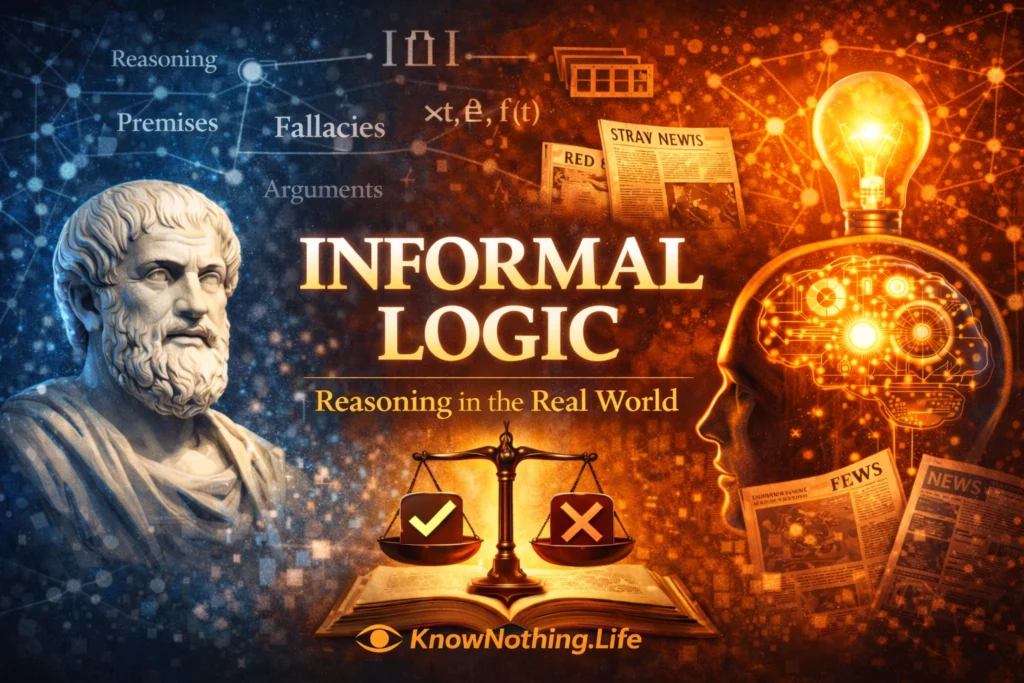
Informal logic is the study of reasoning as it actually occurs in everyday life—within conversations, debates, media, and decision-making. Unlike formal logic, which focuses on symbolic structures and abstract validity, informal logic examines arguments in natural language, paying close attention to context, meaning, persuasion, and practical effectiveness. It asks not only whether an argument is valid in a strict technical sense, but whether it is reasonable, relevant, and convincing within a real-world setting.
The emergence of informal logic in the 20th century reflects a growing recognition that human reasoning cannot be fully captured by formal systems alone. Philosophers such as Stephen Toulmin, Chaïm Perelman, and Douglas Walton sought to develop frameworks that account for how arguments function in practice. Their work shifted the focus from purely deductive validity to broader criteria such as plausibility, coherence, and audience engagement. Informal logic thus bridges philosophy, rhetoric, and critical thinking, offering tools for navigating the complexities of real-world reasoning.
The Nature of Informal Arguments
Informal arguments differ from formal ones in that they are embedded in natural language and shaped by context. They often involve implicit premises, rhetorical strategies, and varying standards of evidence. Rather than presenting neatly structured syllogisms, everyday arguments unfold dynamically, influenced by tone, intention, and audience interpretation.
This complexity requires a different approach to evaluation. Instead of asking whether an argument is strictly valid, informal logic considers whether it is strong, persuasive, or reasonable. Arguments may be inductive, drawing general conclusions from specific observations, or abductive, inferring the best explanation for a given set of facts. These forms of reasoning are essential in fields such as science, law, and journalism, where certainty is rare and conclusions must be drawn from incomplete information.
Stephen Toulmin played a pivotal role in redefining how arguments are understood. In The Uses of Argument, he criticized the dominance of formal logic, arguing that real-world reasoning operates according to different standards. Toulmin introduced a model of argumentation that includes components such as claims, data, warrants, backing, qualifiers, and rebuttals. As he observed, “The patterns of our arguments reveal the structure of our thought,” emphasizing that reasoning is deeply tied to practical contexts rather than abstract forms.
Fallacies and Errors in Reasoning
One of the central concerns of informal logic is the identification and analysis of fallacies—errors in reasoning that undermine the strength of an argument. Unlike formal fallacies, which involve invalid logical structures, informal fallacies often arise from misleading language, emotional appeals, or irrelevant considerations. Examples include ad hominem attacks, straw man arguments, false dilemmas, and appeals to authority.
These fallacies are particularly significant because they frequently appear in everyday discourse, shaping public opinion and decision-making. Recognizing them requires not only logical analysis but also an understanding of context and intention. For instance, an appeal to authority may be reasonable when the authority is relevant and credible, but fallacious when it is not. Informal logic thus emphasizes critical thinking skills that enable individuals to evaluate arguments in nuanced and context-sensitive ways.
Douglas Walton made substantial contributions to the study of fallacies, arguing that they should not be viewed simply as errors but as patterns of argument that can be reasonable or unreasonable depending on context. In works such as Informal Logic: A Pragmatic Approach, Walton emphasized the importance of dialogue and the role of argumentation in resolving disagreements. He wrote, “A fallacy is not just a mistake, but a failure of argument in a particular context,” highlighting the dynamic nature of reasoning in real-world situations.
Argumentation and Rhetoric
Informal logic is closely connected to rhetoric, the art of persuasion. While formal logic seeks certainty through valid inference, rhetoric acknowledges that persuasion often involves emotional appeal, credibility, and audience engagement. Informal logic does not reject these elements but seeks to understand how they contribute to effective reasoning.
The revival of rhetorical theory in the 20th century, particularly through the work of Chaïm Perelman and Lucie Olbrechts-Tyteca in The New Rhetoric, emphasized the role of audience in shaping arguments. They argued that reasoning is not merely a matter of formal validity but of securing adherence from an audience. As Perelman wrote, “The aim of argumentation is to gain the adherence of minds,” underscoring the persuasive dimension of reasoning.
This perspective broadens the scope of logic to include values, beliefs, and social contexts. Arguments are not evaluated solely on their internal structure but on their ability to resonate with an audience and address their concerns. Informal logic thus integrates logical analysis with rhetorical insight, providing a more comprehensive understanding of how arguments function in practice.
Critical Thinking and Everyday Reasoning
At its core, informal logic is deeply connected to critical thinking—the ability to analyze, evaluate, and construct arguments effectively. In an age of information overload, where individuals are constantly exposed to competing claims and perspectives, the skills cultivated by informal logic are more important than ever.
Critical thinking involves more than identifying fallacies; it requires assessing evidence, recognizing biases, and considering alternative viewpoints. Informal logic provides the tools needed to navigate these challenges, enabling individuals to make informed decisions and engage in meaningful dialogue. It encourages a reflective approach to reasoning, where arguments are not accepted at face value but examined carefully and thoughtfully.
Philosophers such as John Dewey emphasized the importance of reflective thinking in education and democratic society. In How We Think, Dewey described thinking as an active, inquiry-driven process: “Active, persistent, and careful consideration of any belief… in the light of the grounds that support it.” This vision aligns closely with the goals of informal logic, which seeks to cultivate habits of critical inquiry and reasoned judgment.
Context, Language, and Meaning
A defining feature of informal logic is its attention to language and context. Arguments are not isolated structures but part of broader communicative practices, shaped by cultural norms, linguistic conventions, and situational factors. Understanding an argument therefore requires more than analyzing its logical form; it involves interpreting its meaning within a specific context.
This emphasis on language connects informal logic to the later philosophy of Ludwig Wittgenstein, who argued that meaning arises from use within language games. In Philosophical Investigations, Wittgenstein rejected the idea that language has a fixed logical structure, instead highlighting its fluid and context-dependent nature. “The meaning of a word is its use in the language,” he wrote, suggesting that reasoning must be understood within the practices in which it occurs.
Informal logic builds on this insight by recognizing that arguments are embedded in real-world contexts where meaning is negotiated and interpreted. This perspective challenges the assumption that reasoning can be fully formalized, emphasizing instead the importance of flexibility and adaptability in understanding arguments.
The Limits of Formalization
The development of informal logic reflects a broader critique of the limitations of formal systems. While formal logic provides powerful tools for analyzing abstract reasoning, it often struggles to account for the complexity of everyday arguments. Informal logic addresses this gap by focusing on the practical dimensions of reasoning, where ambiguity, uncertainty, and context play central roles.
This does not mean that informal logic rejects formal methods; rather, it complements them. Together, formal and informal logic provide a more complete picture of reasoning, capturing both its structural and practical aspects. The interplay between these approaches highlights the richness of human thought, which cannot be reduced to a single framework.
Stephen Toulmin argued that the dominance of formal logic in philosophy had obscured the diversity of reasoning practices. By reintroducing context and practical judgment, informal logic restores a more balanced understanding of rationality. It recognizes that reasoning is not only about deriving conclusions from premises but also about engaging with others, evaluating evidence, and navigating complex situations.
Conclusion
Informal logic offers a vital perspective on reasoning, one that reflects the realities of everyday life. By focusing on arguments in natural language and emphasizing context, persuasion, and critical thinking, it provides tools for understanding and evaluating the kinds of reasoning that shape our beliefs and decisions.
From the contributions of Stephen Toulmin and Chaïm Perelman to the pragmatic insights of Douglas Walton, the field has developed a rich and nuanced approach to argumentation. It highlights the importance of flexibility, context, and audience in shaping reasoning, offering a counterbalance to the abstraction of formal logic.
In an increasingly complex and interconnected world, the skills cultivated by informal logic are indispensable. They enable individuals to navigate information critically, engage in constructive dialogue, and make reasoned decisions. Informal logic thus stands not only as a philosophical discipline but as a practical guide to thinking clearly and responsibly in the real world.