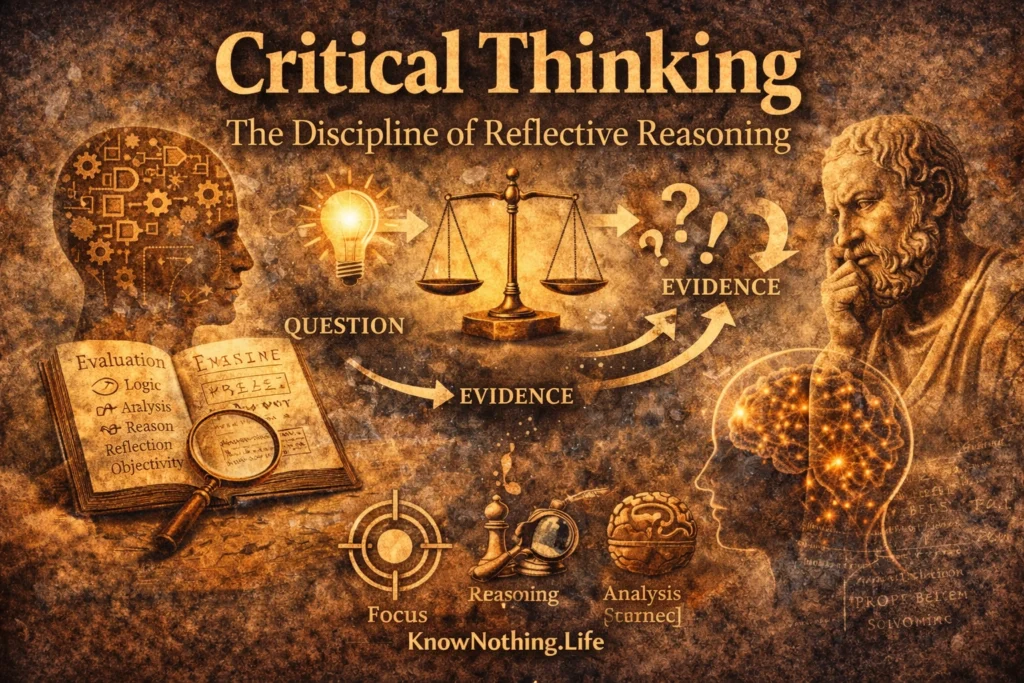
Critical thinking is the disciplined process of analyzing, evaluating, and constructing arguments in a clear, logical, and reflective manner. It involves questioning assumptions, assessing evidence, identifying biases, and drawing reasoned conclusions. More than a set of skills, critical thinking is a habit of mind—an intellectual posture that prioritizes clarity, coherence, and intellectual honesty over impulse and unexamined belief.
The roots of critical thinking extend deep into the history of philosophy, beginning with Socrates, whose method of questioning exposed contradictions and encouraged deeper understanding. In modern thought, figures such as John Dewey, Bertrand Russell, and Daniel Kahneman have contributed to our understanding of reasoning, judgment, and cognitive bias. Critical thinking thus stands at the intersection of logic, psychology, and education, offering a framework for navigating an increasingly complex world.
The Foundations of Critical Thinking
At its core, critical thinking is grounded in the ability to distinguish between strong and weak reasoning. This involves evaluating arguments based on their structure, evidence, and coherence, rather than accepting them at face value. Critical thinkers seek not only to understand what is being said but to assess whether it is justified, reliable, and logically sound.
The foundation of this approach lies in reflective inquiry. John Dewey described thinking as an active process of investigation, writing in How We Think, “Active, persistent, and careful consideration of any belief… in the light of the grounds that support it.” Dewey’s emphasis on reflection highlights the importance of questioning assumptions and examining the basis of our beliefs.
This reflective stance requires intellectual humility—the recognition that our knowledge is limited and subject to revision. It also demands intellectual courage, as critical thinking often involves challenging widely held beliefs or confronting uncomfortable truths. Together, these qualities form the ethical foundation of critical inquiry, guiding the pursuit of understanding.
Logic, Evidence, and Argument
Critical thinking relies heavily on the principles of logic and the careful evaluation of evidence. Logical reasoning provides the structure for analyzing arguments, while evidence supplies the content that supports or undermines claims. A critical thinker must be able to identify premises, evaluate their relevance and reliability, and determine whether they adequately support the conclusion.
The study of logic, particularly through the work of Aristotle, provides essential tools for this process. Aristotle’s analysis of syllogisms established the importance of valid inference, where conclusions follow necessarily from premises. While modern critical thinking extends beyond formal logic, these foundational principles remain central to evaluating arguments.
Equally important is the assessment of evidence. Not all evidence is created equal, and critical thinkers must consider factors such as credibility, relevance, and sufficiency. Carl Sagan famously emphasized the importance of evidence-based reasoning, stating, “Extraordinary claims require extraordinary evidence.” This principle underscores the need for proportionate justification, where stronger claims demand stronger support.
Cognitive Bias and Human Reasoning
One of the greatest challenges to critical thinking is the presence of cognitive biases—systematic patterns of thought that can distort judgment. These biases arise from the brain’s tendency to rely on heuristics, or mental shortcuts, which are efficient but not always accurate. As a result, individuals may make decisions based on incomplete or misleading information.
Daniel Kahneman explored these phenomena in Thinking, Fast and Slow, distinguishing between intuitive (fast) and analytical (slow) modes of thinking. He showed that while intuitive thinking is quick and automatic, it is also prone to errors such as confirmation bias, anchoring, and overconfidence. Kahneman wrote, “A reliable way to make people believe in falsehoods is frequent repetition,” highlighting how easily biases can shape belief.
Recognizing and mitigating these biases is a key component of critical thinking. It requires self-awareness and a willingness to question one’s own assumptions. By slowing down and engaging in deliberate analysis, individuals can counteract the influence of cognitive biases and make more informed decisions.
The Socratic Method and Questioning
The practice of critical thinking is closely associated with the Socrates method of questioning, which involves probing assumptions, clarifying concepts, and examining the implications of ideas. Socratic questioning encourages deeper understanding by challenging superficial answers and revealing underlying contradictions.
This method is not about winning arguments but about seeking truth through dialogue. By asking questions such as “What do you mean?” or “What evidence supports this claim?” critical thinkers can uncover weaknesses in reasoning and refine their understanding. Socratic questioning fosters intellectual engagement, promoting a culture of inquiry and open-mindedness.
Socrates himself exemplified this approach, famously declaring, “The unexamined life is not worth living.” This statement captures the essence of critical thinking as a lifelong process of reflection and self-examination. It emphasizes the importance of questioning not only external claims but also one’s own beliefs and values.
Critical Thinking in Education and Society
Critical thinking plays a central role in education, where it is seen as essential for developing independent and informed individuals. Rather than simply memorizing information, students are encouraged to analyze, evaluate, and apply knowledge in meaningful ways. This approach prepares them to navigate complex problems and engage with diverse perspectives.
John Dewey advocated for an educational model that emphasizes inquiry and problem-solving, arguing that learning should be an active process. He believed that critical thinking is not only an intellectual skill but a democratic necessity, enabling individuals to participate effectively in society.
In a broader social context, critical thinking is vital for evaluating information in an age of media saturation and misinformation. It empowers individuals to discern credible sources, identify misleading arguments, and make reasoned decisions. As Bertrand Russell observed, “Many people would sooner die than think; in fact, they do so,” highlighting the challenge of fostering critical engagement in society.
Building Critical Thinking Skills
Developing critical thinking requires practice and intentional effort. It involves cultivating habits such as questioning assumptions, seeking evidence, and considering alternative perspectives. These skills can be strengthened through activities such as analyzing arguments, engaging in debate, and reflecting on one’s own reasoning processes.
One effective approach is to adopt a structured method of analysis, breaking down arguments into their components and evaluating each part systematically. This includes identifying premises, assessing their validity, and determining whether the conclusion follows logically. By practicing this process, individuals can develop a more disciplined and rigorous approach to reasoning.
Critical thinking also benefits from exposure to diverse viewpoints. Engaging with different perspectives challenges assumptions and broadens understanding, fostering intellectual flexibility. John Stuart Mill emphasized this in On Liberty, arguing that exposure to opposing views is essential for discovering truth. He wrote, “He who knows only his own side of the case knows little of that,” underscoring the value of open dialogue.
Conclusion
Critical thinking is an essential skill for navigating the complexities of modern life, providing a framework for analyzing arguments, evaluating evidence, and making informed decisions. Rooted in the traditions of Socrates and developed through the insights of thinkers such as John Dewey and Daniel Kahneman, it represents a synthesis of logic, reflection, and self-awareness.
By cultivating critical thinking, individuals can move beyond passive acceptance of information and engage actively with the world around them. They can identify fallacies, challenge assumptions, and construct well-reasoned arguments, contributing to more thoughtful and informed discourse.
Ultimately, critical thinking is not merely a tool but a way of life—an ongoing commitment to clarity, reason, and intellectual integrity. In a world filled with uncertainty and competing claims, it serves as a guide, helping us navigate complexity with insight and discernment.