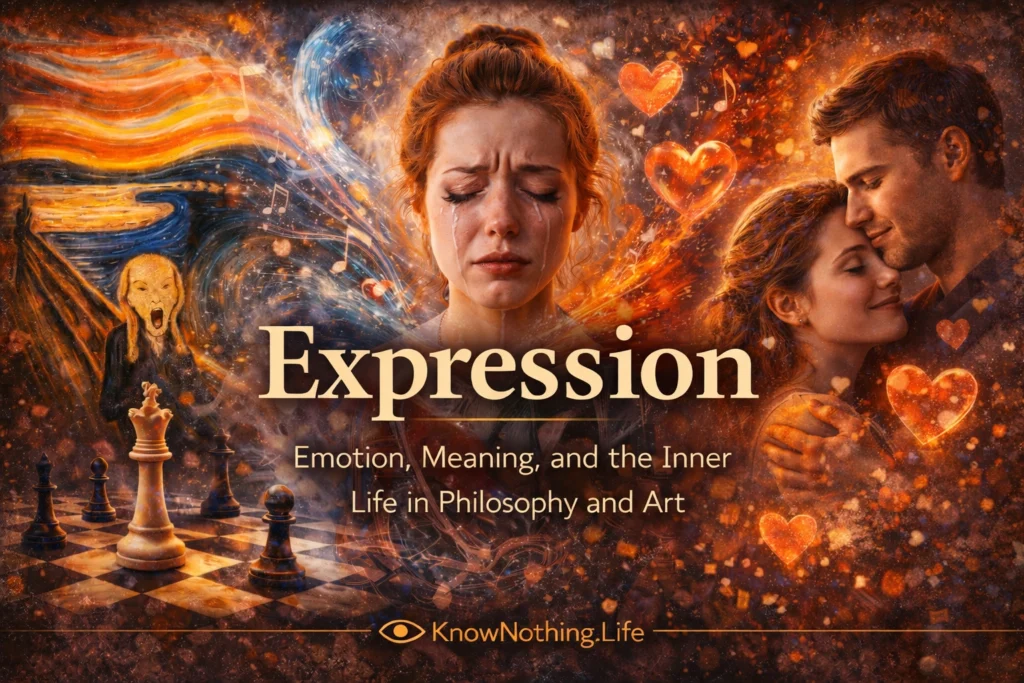
Expression is a central concept in philosophy, particularly in aesthetics, philosophy of mind, and philosophy of language. At its core, expression concerns how inner states—thoughts, emotions, intentions—are made outwardly visible or communicable. Whether through speech, gesture, music, or visual art, expression bridges the private world of experience and the shared world of meaning. Yet this seemingly intuitive process raises deep philosophical questions. How can something internal be expressed externally? Does expression reveal what we already feel, or does it shape and even create those feelings?
Philosophers have long debated whether expression is a passive reflection of inner states or an active process that gives them form. From Romantic theories of artistic genius to modern analyses of language and emotion, expression has been understood as both a psychological phenomenon and a cultural practice. It plays a crucial role in how individuals communicate identity, how artists convey meaning, and how societies construct shared understanding.
The study of expression reveals a fundamental tension: while emotions and thoughts are inherently subjective, expression makes them accessible to others. This transformation—from inner experience to external form—lies at the heart of human creativity and communication. To explore expression philosophically is to examine how meaning emerges from the interplay between mind, body, and world.
Classical and Early Modern Foundations
In ancient philosophy, expression was not always treated as a distinct concept, but it appeared implicitly in discussions of rhetoric, poetry, and emotion. Aristotle, in works such as Rhetoric and Poetics, explored how language and art evoke and communicate emotional states. He understood expression as a means of influencing audiences, emphasizing the role of emotional appeal (pathos) in persuasion. While Aristotle did not frame expression as the revelation of inner feeling in the modern sense, he recognized that speech and art could convey emotional content in powerful ways.
The transition to a more explicit focus on expression occurs in early modern philosophy, particularly with the rise of interest in subjectivity and inner experience. Thinkers began to treat emotions not merely as effects to be produced in others, but as states to be understood and articulated. This shift laid the groundwork for later theories that place expression at the center of artistic and linguistic activity.
In the 18th century, the growing emphasis on individual experience and sensibility led to new reflections on how feelings are communicated. Philosophers and writers began to explore the idea that expression is not simply a tool for persuasion but a fundamental aspect of human self-understanding. This development marks a turning point in the philosophy of expression, moving from external effects to internal origins.
Expression and the Romantic Tradition
The Romantic movement brought expression to the forefront of aesthetic theory, redefining art as the outward manifestation of inner emotion. William Wordsworth famously described poetry as “the spontaneous overflow of powerful feelings,” emphasizing the primacy of emotion in artistic creation. For Wordsworth and other Romantic thinkers, expression is not merely a technique but the essence of art itself.
This perspective elevates the role of the artist as a creator who channels personal experience into universal form. Expression becomes a process through which individual feeling is transformed into something communicable and meaningful. The authenticity of art, in this view, depends on the sincerity and depth of the emotions it conveys. Art is valued not for its adherence to formal rules but for its capacity to reveal the inner life of the artist.
Philosophers such as Friedrich Schleiermacher extend this idea by emphasizing the role of interpretation in understanding expression. For Schleiermacher, interpreting a work of art involves reconstructing the mental and emotional state of its creator. Expression thus becomes a dialogical process, connecting the inner world of the artist with the interpretive efforts of the audience. This relational dimension underscores the complexity of expression, highlighting its dependence on both creation and reception.
Expression in Aesthetic Theory
In modern aesthetic philosophy, expression is often treated as a defining feature of art. Leo Tolstoy offers one of the most influential accounts in What Is Art?, where he argues that art is fundamentally the communication of emotion. He writes that art “infects” the audience with the feelings experienced by the artist, creating a shared emotional experience. For Tolstoy, the value of art lies in its ability to unify individuals through this transmission of feeling.
This account emphasizes the social dimension of expression. Art is not merely self-expression but a form of communication that connects people across time and space. The success of a work of art depends on its capacity to evoke in others the same emotional state that motivated its creation. This perspective aligns expression with empathy, suggesting that art fosters understanding by allowing individuals to experience the feelings of others.
R. G. Collingwood develops a more nuanced theory in The Principles of Art. Collingwood argues that expression is not simply the externalization of pre-existing emotions but a process of clarifying and discovering them. According to him, artists often begin with vague or indistinct feelings, which become fully formed only through the act of expression. He writes, “The artist expresses emotions not by causing them, but by clarifying them.” This view challenges the idea that expression is merely a transfer of content, suggesting instead that it is a creative and transformative activity.
Language, Meaning, and Expression
Expression is not limited to art; it is also central to language and communication. Philosophers of language have explored how words express thoughts, intentions, and emotions, raising questions about the relationship between language and inner experience. Ludwig Wittgenstein offers a particularly influential account in Philosophical Investigations, where he challenges the idea that language functions primarily as a vehicle for expressing private mental states.
Wittgenstein argues that meaning arises from use within social contexts, rather than from a direct correspondence between words and inner experiences. He famously critiques the notion of a “private language,” suggesting that expression must be publicly accessible to be meaningful. When we express pain, for example, we do not simply report an internal state; we participate in a shared linguistic practice that gives that state its meaning.
This perspective shifts the focus from inner content to outward behavior, emphasizing the social nature of expression. Expression is not a one-way transmission from mind to world but a form of participation in communal practices. It is through these practices that thoughts and emotions become intelligible, highlighting the interplay between individual experience and collective meaning.
Expression, Identity, and Culture
In contemporary philosophy and cultural theory, expression is often examined in relation to identity and power. Expression is not only a means of communicating inner states but also a way of constructing and negotiating identity. Through language, art, and performance, individuals express who they are, shaping how they are perceived by others.
Philosophers such as Michel Foucault have explored how systems of expression are embedded within broader structures of power. Foucault argues that what can be expressed—and how it can be expressed—is shaped by social and institutional constraints. Expression is therefore not entirely free but conditioned by the norms and discourses of a given society.
At the same time, expression can serve as a form of resistance. Artistic and cultural practices often challenge dominant narratives, creating space for alternative voices and perspectives. This highlights the political dimension of expression, showing how it can both reinforce and contest existing structures. Expression, in this sense, is not merely a reflection of identity but an active process of its formation and transformation.
Conclusion
Expression is a multifaceted concept that spans philosophy, art, language, and culture. It involves the transformation of inner experience into outward form, enabling communication, creativity, and understanding. From the emotional theories of Leo Tolstoy to the linguistic insights of Ludwig Wittgenstein, philosophical accounts of expression reveal its complexity and significance.
What emerges from these perspectives is a recognition that expression is not merely a passive reflection of what we feel or think. It is an active process that shapes those very experiences, giving them structure and meaning. Through expression, vague feelings become articulate, private thoughts become shared, and individual identities become visible.
To understand expression is to understand how humans make themselves known to one another. It is a process that connects inner life with external reality, bridging the gap between subjectivity and communication. In exploring expression, philosophy uncovers the dynamic interplay between emotion, meaning, and the world we inhabit—revealing that to express is not only to communicate, but to create.