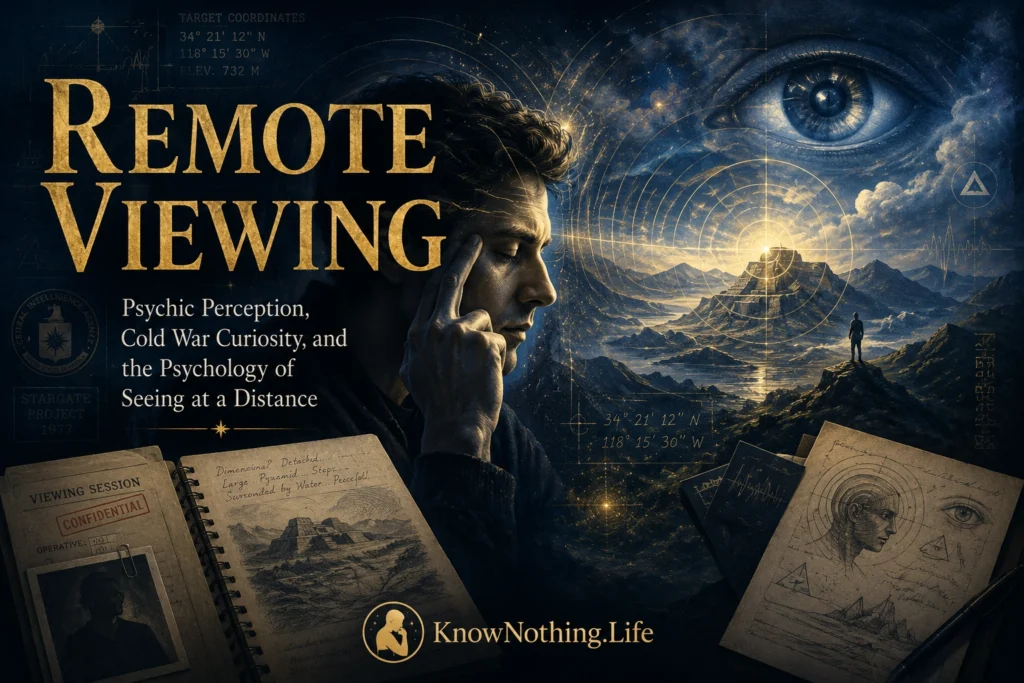
Remote viewing is the claimed ability to describe a distant or hidden target without using the ordinary senses. A person may be given only a coordinate, an envelope, a number, or a vague cue, then asked to report impressions of a location, object, person, or event they cannot physically see. Supporters describe remote viewing as a disciplined form of extrasensory perception, different from casual psychic guessing because it uses protocols, blind targets, written impressions, and later comparison with feedback. Skeptics argue that remote viewing has never produced reliable evidence strong enough to overturn ordinary scientific explanations such as chance, cueing, memory, selective interpretation, or statistical error.
The subject remains fascinating because it sits at the border between psychology, parapsychology, intelligence history, and philosophy of mind. If remote viewing were real in the strong sense its advocates claim, it would challenge ordinary assumptions about perception, distance, consciousness, and the limits of the self. If it is not real, it still reveals something important: the human mind is remarkably good at pattern-making, suggestion, intuition, imagination, and belief. Either way, remote viewing is not just a strange Cold War footnote. It is a case study in how people investigate the unknown when desire, secrecy, science, and uncertainty collide.
What Remote Viewing Claims to Be
Remote viewing is usually described as a structured attempt to perceive information about a target that is hidden from the viewer. In a typical session, the viewer does not know the target in advance. They may be asked to describe shapes, colors, textures, landscapes, structures, temperatures, emotions, motion, or symbolic impressions. The point is not necessarily to produce a perfect visual image, but to gather fragments that may later be matched against a real target.
Advocates often distinguish remote viewing from fortune-telling or mediumship. They present it as a trained perceptual method rather than a mystical performance. In theory, the viewer should avoid analysis at first and record raw impressions: “cold,” “metallic,” “arched,” “water,” “vertical,” “echoing,” “crowded,” or “bright.” Later interpretation may connect those fragments to a bridge, submarine, cathedral, industrial site, or natural landscape. This procedure attempts to reduce imagination, but it also creates a major interpretive problem: vague impressions can be matched to many things after the fact.
Early Experiments and SRI
Remote viewing entered modern public discussion largely through work at Stanford Research Institute, commonly called SRI, in the 1970s. Physicists Russell Targ and Harold Puthoff studied subjects such as Ingo Swann, Pat Price, and later others who claimed unusual perceptual abilities. Their experiments attracted attention because some reported results appeared striking, especially when viewers seemed to describe distant sites or hidden objects with unexpected detail. Targ and Puthoff published and promoted the idea that psychic functioning could be studied under laboratory-like conditions.
Ingo Swann became one of the most famous figures in the field. He helped develop coordinate remote viewing, a method in which a viewer receives numerical coordinates associated with a target. Swann’s role matters because remote viewing became not merely a claim of spontaneous psychic experience, but a proposed trainable skill. The language shifted from “psychic vision” toward “protocol,” “target,” “viewer,” “monitor,” and “feedback.” That scientific-sounding vocabulary made the subject more acceptable to some researchers and intelligence officials, even while mainstream science remained deeply skeptical.
The Stargate Project and Government Interest
Remote viewing became especially famous because of U.S. government interest during the Cold War. Intelligence agencies worried that the Soviet Union might be exploring psychic or “psychoenergetic” research for espionage or military purposes. Even a small chance that an enemy could gather information through paranormal means seemed worth investigating. This led to a series of U.S. programs over roughly two decades, eventually associated with the name Stargate. The program attempted to determine whether remote viewing could be used for intelligence gathering.
The government connection gave remote viewing a powerful cultural aura. It made the subject sound less like fringe mysticism and more like secret science. But secrecy also complicated evaluation. Classified environments make claims harder to verify, and intelligence work often relies on ambiguous fragments rather than clean laboratory proof. In 1995, an external review for the CIA evaluated the program and concluded that remote viewing had not provided intelligence value sufficient to justify continuation. Supporters argued that the review underestimated positive results; critics argued that the program’s end confirmed its unreliability.
The Philosophy of Mind and Distance
Remote viewing raises deep philosophical questions even if one remains skeptical. Ordinary perception depends on a relationship between a body and the world: light reaches the eyes, sound reaches the ears, touch reaches the skin. Remote viewing proposes that consciousness may access information without that ordinary sensory chain. If true, perception would not be limited to local contact. Mind would have some nonlocal relationship to information.
Philosophers have long debated whether consciousness is fully reducible to physical processes. René Descartes separated mind and body sharply, while later materialists argued that mental life is brain activity. Remote viewing appeals to those who suspect that consciousness may not fit neatly into materialist assumptions. However, philosophical possibility is not evidence. Many things are imaginable without being true. The philosophical interest of remote viewing is that it forces a hard question: what would count as proof that the mind can know something beyond the senses?
Psychological Explanations
Psychology offers several explanations for why remote viewing can seem convincing even without paranormal perception. One is pattern recognition. Human beings are skilled at finding meaning in incomplete information. If a viewer says “water, stone, vertical, echo, old,” those impressions might later be matched to a bridge, castle, well, harbor, cave, church, dam, or monument. The more flexible the interpretation, the easier it becomes to find a hit.
Another factor is confirmation bias. People remember striking matches and forget misses. They may also unconsciously reshape ambiguous statements after feedback. A vague sketch may be interpreted generously if the target looks somewhat similar. This does not mean every viewer is dishonest. It means human judgment is vulnerable to motivated interpretation. Remote viewing sessions often generate many impressions, and some will appear meaningful by chance. The mind is naturally drawn to the impressive match, not the long list of failures.
Belief, Intuition, and the Unconscious
Remote viewing also overlaps with ordinary intuition. Sometimes people know more than they realize from subtle cues, prior knowledge, probability, or unconscious inference. A person may make a surprisingly accurate guess and experience it as psychic because they are unaware of the mental steps that led there. Psychologists have long studied implicit perception, priming, and unconscious processing. The mind often works below awareness, producing feelings of knowing without clear explanation.
This helps explain why remote viewing is appealing. It gives a dramatic language to a real psychological experience: the sense that knowledge can arise from somewhere beneath conscious reasoning. William James, who took unusual states of consciousness seriously, argued in The Varieties of Religious Experience that ordinary waking consciousness is only one type of consciousness, while other forms may exist around it. James’s openness does not prove remote viewing, but it captures why the subject persists. People sense that the mind is stranger than everyday rationality admits.
Scientific Criticism and the Evidence Problem
The central scientific problem with remote viewing is reliability. Extraordinary claims require strong, repeatable evidence under carefully controlled conditions. A few impressive anecdotes are not enough because humans are vulnerable to error, fraud, sensory leakage, loose judging, selective reporting, and statistical artifacts. For remote viewing to gain broad scientific acceptance, it would need to produce consistent results that independent researchers can replicate under strict controls.
The 1995 CIA-sponsored evaluation remains one of the most important moments in the field’s public history. Statistician Jessica Utts argued that some laboratory results showed evidence of anomalous cognition, while psychologist Ray Hyman argued that methodological weaknesses and lack of reliable application prevented strong conclusions. This split captures the broader debate. Believers see a signal hidden inside noisy data. Skeptics see noise being overinterpreted as signal. The disagreement is not only about results, but about standards of evidence.
Remote Viewing in Popular Culture
Remote viewing became part of popular culture because it combines espionage, psychic mystery, secret files, and the dream of hidden human powers. Books, documentaries, podcasts, and online communities have kept the subject alive long after official programs ended. The declassification of documents made the field even more attractive because government paperwork appears to grant seriousness to unusual claims. For many people, the phrase “the CIA studied it” sounds like evidence that something real was found.
But government interest does not equal proof. Governments have studied many ideas because they were worried, curious, misled, or unwilling to ignore possible advantages. The more accurate conclusion is that remote viewing was considered worth investigating under Cold War uncertainty, not that it was proven. Its cultural power comes from ambiguity: enough documentation to feel real, enough controversy to remain unresolved, and enough mystery to invite imagination.
Final Thoughts on Remote Viewing
Remote viewing is a fascinating subject because it reveals two mysteries at once. The first is the claimed mystery: whether consciousness can perceive distant or hidden information beyond the ordinary senses. The second is the psychological mystery: why human beings are so drawn to the possibility. Remote viewing promises that the mind is larger than the body, that hidden knowledge can be reached, and that disciplined attention may cross boundaries ordinary perception cannot.
A responsible view must hold curiosity and skepticism together. The history of SRI, Ingo Swann, Russell Targ, Harold Puthoff, Pat Price, and the Stargate program shows that remote viewing was taken seriously enough to be tested, funded, debated, and eventually judged insufficient for intelligence use. That does not erase the cultural importance of the subject. It places it where it belongs: at the edge of science, belief, perception, and imagination. Remote viewing may never become accepted science, but it remains a powerful mirror of the human desire to see beyond the limits of the visible world.