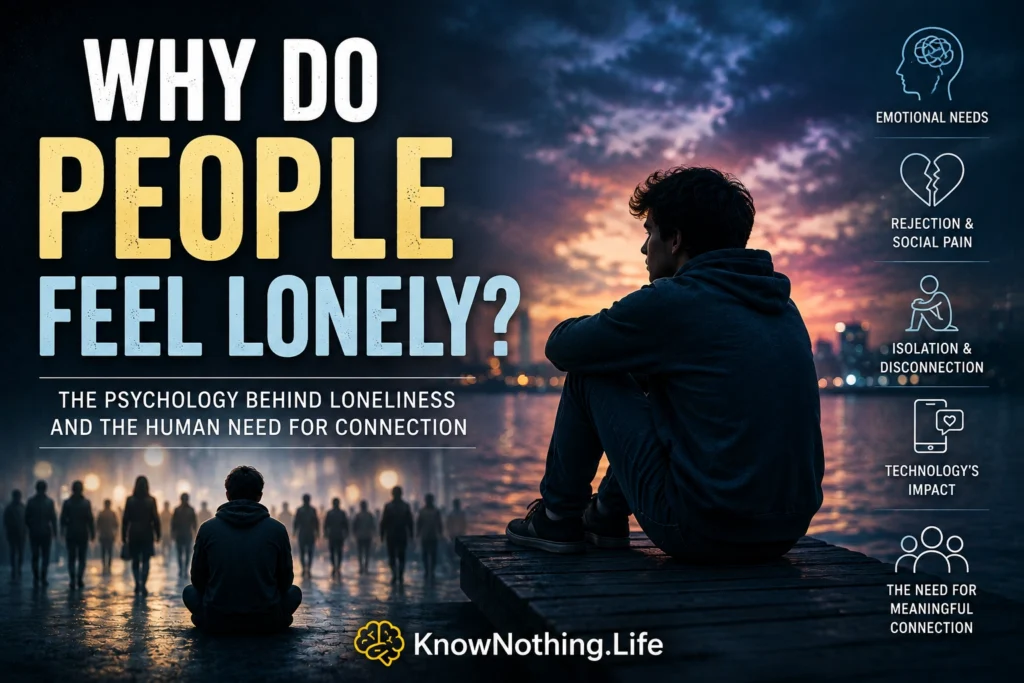
Loneliness is often mistaken for the simple condition of being alone, but the two experiences are not identical. A person can spend an entire day in solitude and feel peaceful, restored, or creatively engaged. Another person can sit among coworkers, relatives, or thousands of online contacts and feel profoundly unseen. Loneliness emerges when people perceive a painful gap between the relationships they have and the relationships they need. The gap may involve the number of social contacts in someone’s life, but it more often concerns intimacy, trust, belonging, or the feeling of being understood.
This emotional signal exists because human beings are deeply social. Throughout most of human history, belonging to a cooperative group improved access to protection, food, care, knowledge, and opportunities to raise children. Separation from dependable companions could carry serious consequences. Loneliness can therefore be understood as an internal alarm, comparable in some respects to hunger or physical pain, that alerts a person to a potentially important social need. The feeling is not evidence of personal failure. It is evidence that the mind is monitoring whether its relationships feel secure and sufficient.
Humans Have a Fundamental Need to Belong
In their influential 1995 paper “The Need to Belong,” psychologists Roy Baumeister and Mark Leary argued that people possess a pervasive motivation to form and maintain lasting, positive, and significant relationships. Human beings do not merely seek occasional interaction. They generally want recurring contact combined with a sense of mutual concern. A conversation with a stranger may be pleasant, but it does not necessarily satisfy the need to feel known, valued, and securely connected over time.
This helps explain why loneliness can persist even when a person is socially active. Someone may attend parties, work in a crowded office, or exchange messages throughout the day without experiencing genuine belonging. Relationships can feel conditional, competitive, superficial, or emotionally unsafe. Loneliness may also arise when a person believes that others know only a carefully managed version of them. Connection requires more than proximity; it requires enough trust for people to feel that their authentic experiences can be recognized without immediate rejection.
Loneliness Comes in Different Forms
Sociologist Robert Weiss distinguished between emotional loneliness and social loneliness in his landmark work Loneliness: The Experience of Emotional and Social Isolation. Emotional loneliness refers to the absence of a close attachment figure—a person who provides intimacy, reassurance, and a sense of deep personal significance. It is often experienced after bereavement, separation, or the deterioration of an important relationship. A person surrounded by supportive friends may still feel emotionally lonely if no relationship replaces the particular closeness that has been lost.
Social loneliness involves the absence of a satisfying network or community. A person may have a loving partner but still miss friendship, shared activities, workplace companionship, cultural belonging, or a wider sense of participation. The distinction matters because different forms of loneliness require different kinds of connection. Joining a club may expand a social network but may not replace a lost intimate bond. A close relationship may provide affection while leaving someone without a community in which they feel useful and included.
Life Changes Can Disrupt Connection
Loneliness frequently appears during transitions that reorganize a person’s social world. Moving to a new city, starting college, changing jobs, becoming a parent, retiring, divorcing, developing an illness, or losing a spouse can remove familiar routines and relationships. Even positive changes may produce loneliness because they place people in unfamiliar roles before new connections have had time to develop. Research on middle-aged and older adults has identified family and household changes—especially widowhood and divorce—as important predictors of transitions into loneliness.
These experiences can also disturb identity. A retired person may lose not only daily contact with coworkers but also a role that supplied recognition and purpose. A new parent may be surrounded by family yet feel separated from friends and from a previous sense of self. A student entering a new school may encounter many people while lacking the shared history that makes interaction feel effortless. Loneliness is therefore often a response to the disappearance of a social structure, not merely the absence of conversation.
Rejection Makes Disconnection Feel Painful
Language frequently treats rejection as physical injury: people describe broken hearts, wounded pride, and painful exclusion. Neuroscience research suggests that these metaphors reflect genuine links between systems involved in bodily threat and social distress. In a widely discussed experiment, Naomi Eisenberger and her colleagues used a virtual ball-tossing game to exclude participants while their brain activity was measured. Greater exclusion-related distress was associated with activity in regions involved in detecting conflict and distress, including the anterior cingulate cortex.
The relationship between physical and social pain is not a perfect one-to-one correspondence, and later reviews have cautioned against claiming that rejection simply activates an identical physical “pain matrix.” The broader evidence nevertheless indicates that social exclusion is treated by the brain as a serious threat deserving attention. This makes evolutionary sense: for a dependent child or a member of a cooperative group, losing attachment and protection could be dangerous. Loneliness hurts partly because its discomfort is designed to motivate reconnection rather than allow social separation to pass unnoticed.
Loneliness Can Create a Self-Reinforcing Cycle
The immediate function of loneliness may be to encourage connection, but chronic loneliness can produce the opposite effect. John Cacioppo and Louise Hawkley proposed that feeling socially isolated increases vigilance for interpersonal danger. A lonely person may become more attentive to signs of criticism, rejection, exclusion, or insincerity. This heightened sensitivity can be protective in an unsafe environment, but it can also make ambiguous interactions appear more threatening than they are.
A delayed reply may be interpreted as deliberate avoidance, a neutral facial expression as disapproval, and an awkward conversation as proof of being unlikeable. Anticipating rejection, the person may speak less, avoid invitations, conceal vulnerability, or act defensively. Others can then perceive distance and respond less warmly, appearing to confirm the lonely person’s original fears. The cycle demonstrates why telling someone to “just meet more people” is often inadequate. The problem may involve not only access to others but also the expectations and protective habits that shape social encounters.
Loneliness and Depression Can Feed Each Other
Loneliness is not the same as depression, although the two commonly overlap. Loneliness concerns perceived social disconnection, while depression involves a broader pattern that can include persistent low mood, loss of pleasure, fatigue, guilt, hopelessness, sleep disturbance, and difficulty concentrating. A lonely person may remain energetic and optimistic in other parts of life, while a depressed person may feel emotionally detached even when meaningful relationships are available.
Longitudinal research suggests that the relationship can move in both directions. Loneliness may increase vulnerability to depressive symptoms, while depression can make social activity more difficult and relationships less rewarding. Low energy, negative expectations, withdrawal, and feelings of worthlessness may reduce opportunities for satisfying connection. Studies examining these processes over time have found bidirectional associations, showing that loneliness and depression can become mutually reinforcing rather than one being merely a symptom of the other.
Technology Can Connect and Isolate
Digital communication can reduce loneliness by helping people maintain distant friendships, find communities, disclose difficult experiences, and meet others with uncommon interests. For people with disabilities, social anxiety, stigmatized identities, or geographic isolation, online relationships may provide forms of belonging that are difficult to obtain locally. It is therefore misleading to claim that social media inevitably makes everyone lonely.
The effects depend on how technology is used and what it replaces. Active communication that strengthens existing relationships may be beneficial, while passive viewing, compulsive checking, hostile exchanges, and constant social comparison may intensify disconnection. A recent review concluded that social media can create several pathways toward greater belonging but can also undermine connection depending on the user, the platform, and the surrounding relationships. Online contact becomes problematic when it produces the appearance of participation without the mutual attention, trust, and responsiveness that people actually need.
Chronic Loneliness Can Affect the Body
Loneliness is an emotional experience, but its consequences are not confined to mood. Chronic perceptions of social threat may influence stress responses, sleep, health behavior, cardiovascular functioning, and immune regulation. Hawkley and Cacioppo’s review linked loneliness with poorer sleep, heightened vigilance, depressive thinking, and changes in physiological functioning. These findings do not mean that every lonely period causes illness, but they suggest that sustained social insecurity can become a continuing biological burden.
Julianne Holt-Lunstad and her colleagues examined 70 studies involving more than 3.4 million participants and found that loneliness, social isolation, and living alone were each associated with increased risk of premature mortality. These are associations influenced by many variables, so they should not be interpreted as proof that loneliness alone directly causes every outcome. Even so, the findings support the view that social connection is not merely an emotional luxury. It is an important part of human health.
Connection Requires Quality, Safety, and Participation
Reducing loneliness is not always a matter of maximizing the number of people in someone’s life. Relationships must provide something the person actually needs: intimacy, companionship, shared identity, emotional safety, practical support, or the opportunity to contribute. Meaningful connection also requires reciprocity. People tend to feel less connected when they are always performing, pleasing, observing, or receiving help without being able to offer anything in return.
Research on loneliness interventions supports this more complex view. A major meta-analysis found that programs addressing maladaptive social cognition produced stronger effects than approaches focused only on increasing social contact or teaching basic social skills. More recent reviews have likewise found benefits from psychological interventions and from approaches that combine social opportunities with work on avoidance, interpretation, and coping. Loneliness often improves through repeated experiences of safe participation—not simply by placing a person near more strangers.
Loneliness is ultimately the mind’s recognition that something important is missing from its social world. The feeling may reflect a lost relationship, insufficient community, fear of rejection, major life change, or a mismatch between available connections and the kind of belonging a person values. It should neither be romanticized nor treated as a shameful defect. Like other forms of pain, loneliness is information. Understanding what kind of connection is absent is the first step toward creating relationships in which a person can feel known, needed, and at home.