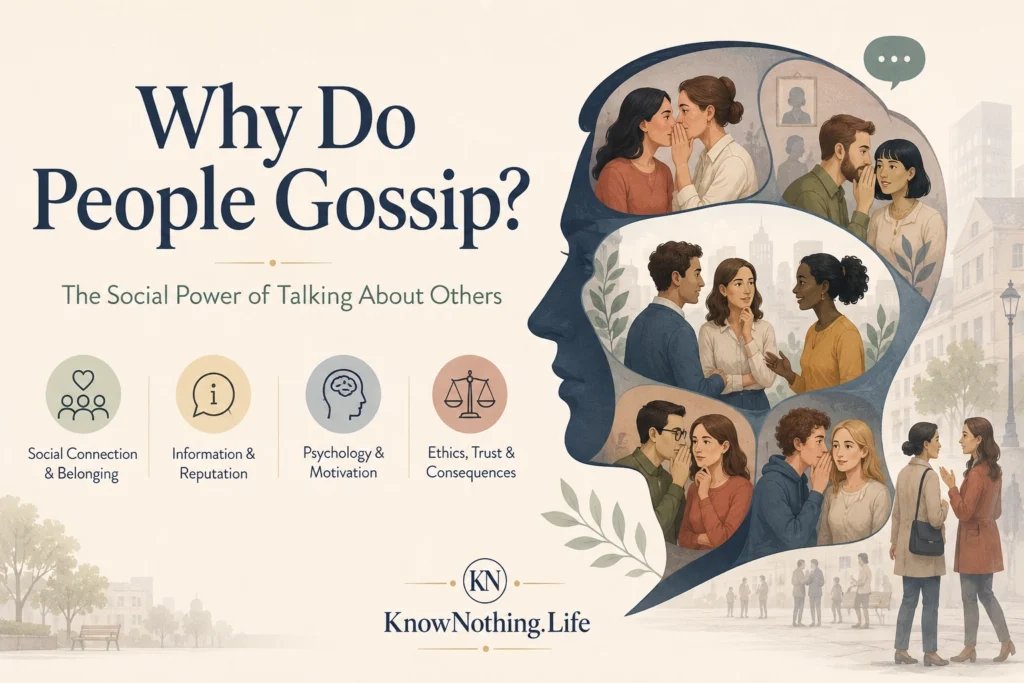
Gossip is often treated as a cheap, petty, or immoral form of speech, but human beings have always talked about people who are not in the room. We discuss who can be trusted, who behaved badly, who is struggling, who is admired, who changed, who betrayed someone, who succeeded, and who violated the expectations of the group. Some gossip is cruel and destructive. It can humiliate, distort, exclude, and turn private pain into public entertainment. But gossip is not always malicious. Much of it is ordinary social information: how people make sense of relationships, reputation, loyalty, danger, status, and belonging.
At its simplest, gossip means talking about absent people. That definition is morally neutral. A conversation about a coworker’s promotion, a friend’s breakup, a neighbor’s kindness, or a public figure’s scandal can all count as gossip. The moral question is not only whether we talk about others, but why, how truthfully, with what intention, and with what effect. Gossip reveals one of the central tensions of social life: people need information about others, but that information can easily become power. To gossip is to participate in the invisible economy of reputation.
The Ancient Suspicion of Gossip
Philosophers and religious teachers have long warned against harmful speech. In many traditions, gossip is condemned because it damages trust and weakens the moral discipline of the speaker. The Hebrew Bible warns against tale-bearing; Buddhism treats right speech as speech that is truthful, useful, timely, and kind; Christianity often frames gossip as a failure of charity; and Stoic philosophers cautioned against wasting the mind on other people’s faults. These traditions recognized that gossip can become a pleasure of superiority. Talking about another person’s weakness can make the speaker feel temporarily cleaner, wiser, or more secure.
Yet philosophy also recognizes that human beings are social animals. Aristotle wrote in the Politics that man is by nature a political animal, meaning that human life is formed through community, speech, judgment, and shared ideas of justice. If humans live socially, they must evaluate one another. Who is honest? Who is dangerous? Who keeps promises? Who abuses power? A total ban on talking about absent people would make moral community nearly impossible. The problem is not social knowledge itself. The problem is when social knowledge becomes cruelty, distortion, cowardice, or entertainment at another person’s expense.
Gossip as Social Information
Psychologically, gossip helps people map the social world. Direct experience is limited. We cannot personally test every person’s character, every risk, or every alliance. Gossip allows people to learn from the experiences of others. If someone is dishonest, exploitative, generous, unstable, loyal, or dangerous, reputational information can help others decide how to behave. In this sense, gossip is not merely noise. It is a tool for social learning.
Robin Dunbar, in Grooming, Gossip, and the Evolution of Language, argued that gossip may have evolved as a human equivalent of primate grooming. Primates maintain bonds through physical grooming, but human groups became too large for grooming alone. Language allowed people to bond with several others at once, exchange social information, and maintain group cohesion. Dunbar’s larger argument is provocative: language may have developed not only to discuss tools, hunting, or abstract ideas, but to manage relationships. Gossip, in this view, is not a social accident. It is one of the engines of human social life.
The Pleasure of Belonging
People gossip because it creates intimacy. Shared information can make people feel included, trusted, and emotionally close. When someone says, “I probably shouldn’t say this, but…,” they are not only transferring information. They are creating a private social space. The listener is being invited into confidence. This is one reason gossip can feel exciting: it offers belonging, secrecy, and the sense of being inside rather than outside the group.
The danger is that belonging built through contempt is unstable. A group may bond by criticizing an outsider, but the same habit can later turn inward. If a person hears someone cruelly gossiping about everyone else, they may reasonably wonder what is said when they are absent. Gossip can create closeness in the moment while weakening trust over time. Philosophically, this reveals a difference between intimacy and alliance. Intimacy is rooted in honest care. Alliance may be rooted only in shared opposition.
Gossip, Status, and Moral Judgment
Gossip also regulates status. People use it to praise, warn, shame, admire, compete, and compare. A compliment passed behind someone’s back can strengthen their reputation. A rumor can damage it. A warning can protect others. A sneer can elevate the speaker by lowering the subject. Because reputation affects friendships, work, romance, leadership, and trust, gossip becomes a form of social currency. People spend it carefully or recklessly.
Friedrich Nietzsche’s insights into resentment are useful here. In On the Genealogy of Morals, he describes ressentiment as the moralizing impulse of those who feel powerless or injured. Some gossip has this quality. It does not seek justice; it seeks relief through lowering another person. The speaker may frame the gossip as moral concern, but the emotional pleasure comes from exposure, humiliation, or envy disguised as virtue. This does not mean all criticism is resentment. It means gossip often requires self-examination: am I warning, understanding, or helping, or am I enjoying someone else’s reduction?
What University Studies Show
Modern research complicates the stereotype that gossip is mostly malicious. A University of California, Riverside study led by Megan Robbins examined everyday gossip and found that the overwhelming majority was neutral rather than positive or negative. The study also challenged common stereotypes, finding that women did not engage in more “tear-down” gossip than men, and lower-income people did not gossip more than wealthier people. In public summaries of the research, Robbins noted that much gossip is simply neutral social talk rather than character assassination.
Other research shows that gossip can promote cooperation. Matthew Feinberg and Robb Willer’s research on “prosocial gossip” found that sharing reputational information can warn others about selfish behavior and help groups maintain cooperation. In one line of studies, gossip helped deter selfishness and encouraged more cooperative behavior. A later study by Feinberg and colleagues found that gossip and ostracism can promote cooperation in groups by allowing people to avoid or exclude those who exploit others. These findings do not make gossip automatically good, but they show why it survives: groups need ways to circulate information about trustworthiness.
The Dark Side of Gossip
The harmful side of gossip appears when speech becomes inaccurate, invasive, or dehumanizing. Gossip can turn a complex person into a single story. It can spread faster than correction, especially when the story is emotionally satisfying. Rumor thrives where evidence is weak but desire is strong. People believe what confirms suspicion, envy, fear, or group loyalty. Once a reputation is damaged, the person may struggle to repair it even if the story was false or exaggerated.
Gossip can also become a form of indirect aggression. Instead of confronting someone directly, people may attack them socially through exclusion, ridicule, or reputation damage. This can be especially painful because the target may not know what is being said, who believes it, or how to defend themselves. In schools, workplaces, families, and online communities, gossip can become social punishment without due process. The person is tried in absence by people who may not understand the whole situation.
Gossip and the Self
People gossip not only to understand others, but to understand themselves. Talking about another person’s choices lets us define our own values. “I would never do that” is often a way of saying, “This is who I believe I am.” Gossip can clarify moral boundaries: loyalty, honesty, ambition, parenting, sexuality, generosity, betrayal, courage, weakness. In this sense, gossip is a mirror. It reveals what a group praises, fears, envies, excuses, and condemns.
But the mirror can distort. When people gossip habitually, they may begin living through observation rather than responsibility. It becomes easier to analyze other people’s flaws than to confront one’s own. Søren Kierkegaard criticized the anonymous “public” for leveling individuals through chatter and detached judgment. That critique applies strongly to gossip culture. The more people speak without responsibility, the easier it becomes to turn human beings into topics.
Ethical Gossip
The phrase “ethical gossip” may sound contradictory, but some speech about absent people is necessary and even morally responsible. Warning a friend about someone’s pattern of exploitation, reporting misconduct, sharing concern about someone in danger, or discussing behavior that affects a group can be justified. The ethical questions are: Is it true? Is it necessary? Is it fair? Would I say some version of this if the person were present? Am I trying to protect, understand, or repair, or am I trying to entertain, punish, or feel superior?
Right speech does not require silence about harm. In fact, silence can protect abusers, manipulators, and irresponsible people. But responsible gossip should remain close to evidence, avoid exaggeration, distinguish fact from interpretation, and preserve the humanity of the person being discussed. The goal should be discernment rather than destruction.
Final Thoughts on Why People Gossip
People gossip because they are social creatures trying to understand other social creatures. They gossip to bond, warn, compare, judge, belong, compete, protect, and make sense of moral life. Philosophy warns us that gossip can corrupt character when it becomes cruelty, cowardice, envy, or idle judgment. Psychology shows that gossip also serves real functions: sharing social information, strengthening bonds, enforcing norms, and protecting groups from exploitation.
The question is not whether humans will talk about absent people. They will. The better question is what kind of people they become when they do. Gossip can be a tool of care or a weapon of humiliation. It can reveal truth or manufacture falsehood. It can protect the vulnerable or entertain the powerful. To gossip wisely is to remember that every reputation belongs to a full human being, and every word spoken in absence leaves a trace in the moral character of the speaker.