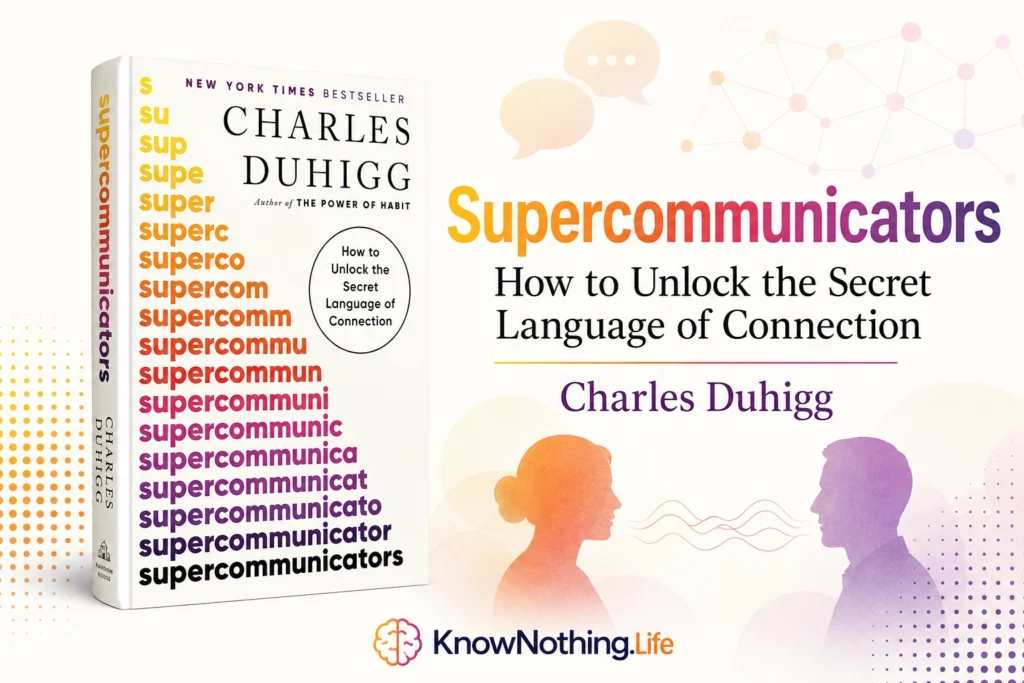
In Supercommunicators: How to Unlock the Secret Language of Connection, Charles Duhigg investigates a deceptively simple question: why do some people consistently make others feel understood while equally intelligent, articulate people struggle to communicate? Published in 2024, the book approaches conversation as a skill rather than an innate personality trait. Duhigg draws on psychology, neuroscience, negotiation research, organizational behavior, and stories involving CIA officers, juries, physicians, television writers, couples, and corporate workplaces. His central claim is that exceptional communicators are not necessarily more charismatic or eloquent. They are unusually attentive to what kind of conversation is taking place and adept at adjusting how they listen and respond. Duhigg calls these people “supercommunicators,” but his larger argument is democratic: their abilities can be learned.
This places Supercommunicators within a much older intellectual tradition concerned with dialogue. In I and Thou, philosopher Martin Buber distinguished between treating another person as an object to be analyzed and encountering that person as a genuine subject. Hans-Georg Gadamer later argued in Truth and Method that authentic dialogue involves openness to having one’s own understanding altered. Duhigg translates something similar into contemporary behavioral science. A successful conversation is not merely a successful transmission of information. It is an interaction in which each participant gradually understands how the other experiences the world. The goal is therefore less “How can I say this perfectly?” than “What is happening between us, and what does this person need from this conversation?”
The Three Conversations Happening Beneath Our Words
The organizing idea of Supercommunicators is that conversations generally involve three broad layers. Duhigg calls them the practical or decision-making conversation—essentially, “What is this really about?”; the emotional conversation—“How do we feel?”; and the social conversation—“Who are we?” A single discussion may move among all three, but trouble begins when participants occupy different layers at the same moment. Someone describing a terrible day may want emotional recognition while the listener immediately offers solutions. A manager may think a disagreement concerns workflow when an employee experiences it as a question of respect or professional identity. Both parties can be sincere and still leave feeling unheard.
Duhigg calls the solution the matching principle. Matching does not mean mechanically copying another person’s gestures or agreeing with everything they say. It means recognizing the mode of conversation and responding on the same level. If someone is expressing fear, responding only with statistics may miss the conversation. If someone genuinely wants a decision, endless emotional exploration may be equally frustrating. This recalls psychologist Carl Rogers’ person-centered approach, particularly his emphasis on accurate empathy and understanding another person’s internal frame of reference. Communication improves when the response addresses the experience the speaker is actually trying to convey rather than the response the listener had already prepared.
Every Important Conversation Contains a Negotiation
Duhigg’s practical conversation begins with the recognition that conversations often contain an implicit negotiation. Before participants can solve a problem, they must determine what problem they are solving, what each person wants, and what rules will govern the discussion. The book illustrates this through jury deliberations and medical consultations. In one example, physician Behfar Ehdaie discovers that presenting prostate-cancer patients with technically correct medical information is not enough. Different patients enter the consultation wanting different things: some seek probabilities and evidence, others reassurance, clarity about family consequences, or help managing fear. Asking open-ended questions before prescribing a conversational direction allows those priorities to surface.
The lesson is close to philosopher H. P. Grice’s account of conversation as a cooperative enterprise. Communication depends upon assumptions about purpose and relevance; when participants disagree about what they are doing together, even logically clear statements can fail. Duhigg therefore encourages questions that reveal goals rather than merely positions. Psychological research supports the value of this approach. Karen Huang, Michael Yeomans, Alison Wood Brooks, Julia Minson, and Francesca Gino found across conversational studies that people who asked more questions—particularly follow-up questions—were generally better liked by their partners because question-asking signaled responsiveness and attention. Effective communication begins not with displaying what we know, but with discovering what the other person considers important.
Emotional Conversations and the Importance of Reciprocity
The emotional layer is where Supercommunicators becomes a book about connection rather than merely efficiency. Duhigg argues that people frequently avoid emotional questions because they expect them to be intrusive, awkward, or inappropriate. Yet conversations often become memorable precisely when participants move beyond facts toward experiences: not simply what happened, but how it felt and why it mattered. Emotional conversation does not require dramatic confession. Happiness, excitement, disappointment, embarrassment, relief, pride, anxiety, and affection all provide information about what a person values.
Duhigg discusses the “Fast Friends” procedure, associated with research by Arthur Aron and colleagues, in which progressively more personal questions can create surprisingly rapid feelings of closeness between strangers. The mechanism is not interrogation but reciprocal disclosure. Connection weakens if one participant continually reveals while the other remains opaque. People tend to move closer when vulnerability travels in both directions. This resonates strongly with Buber’s I and Thou: genuine encounter requires participation rather than observation from a protected distance. The supercommunicator is therefore not someone who extracts extraordinary amounts of information from others. Good communicators reveal enough of themselves to make mutuality possible.
Listening Means Proving That Understanding Occurred
One of Duhigg’s most practical observations is that listening and demonstrating that one has listened are different skills. Silence, eye contact, and nodding may look attentive, but they do not necessarily show that another person’s meaning has been understood. In difficult conversations, Duhigg recommends a process he calls looping for understanding: ask a meaningful question, restate the answer in your own words, and then ask whether your interpretation is accurate. The final step matters because paraphrasing can otherwise become another form of assumption.
This resembles Rogerian reflective listening, but Duhigg places particular emphasis on verification. The listener is not announcing, “I understand you.” The speaker gets to decide whether understanding has actually occurred. That distinction becomes crucial during conflict, when people are often mentally preparing rebuttals while appearing to listen. Research on perceived partner responsiveness similarly emphasizes feeling understood, validated, and cared for as a central component of relationship quality and intimacy. Philosophically, the practice reflects Gadamer’s idea that understanding is dialogical: interpretation remains provisional until it has encountered the perspective of the other.
What Neuroscience Reveals About Connection
Duhigg also explores what happens when communication succeeds at a neurological level. Research by Greg Stephens, Lauren Silbert, and Uri Hasson used functional MRI to compare brain activity in speakers telling stories with activity in people listening to those stories. Their study found forms of speaker-listener neural coupling, and stronger anticipatory coupling was associated with better comprehension. Importantly, these findings should not be reduced to the popular claim that two people literally have identical brains during a good conversation. Duhigg’s own endnotes caution against simplistic localization claims: social cognition and conversational states involve interacting networks rather than a single “communication center.”
The deeper point is that communication is fundamentally coordinated activity. Researchers have also observed synchrony in physiological and behavioral signals during interpersonal interaction; one PNAS study found that conversational partners’ pupils periodically synchronized around moments of shared attention. Duhigg uses such research not to turn conversation into a neuroscience trick, but to reinforce the importance of alignment. Successful speakers continually adjust to listeners, and listeners continually update their understanding of speakers. Conversation is less like sending a package and more like musicians adjusting tempo while performing together.
Communicating Through Conflict Without Trying to Win
The book’s ideas become especially valuable when people disagree. Duhigg argues that many conflicts deteriorate because participants shift from trying to understand the disagreement to trying to defeat the person holding the opposing position. He examines structured discussions between gun-rights and gun-control advocates to illustrate how participants can remain deeply opposed while becoming more capable of hearing one another. The techniques include identifying the emotion beneath an argument, asking sincere questions, looping for understanding, and separating understanding from agreement.
This distinction is philosophically significant. Jürgen Habermas’ theory of communicative action distinguishes communication oriented toward mutual understanding from interaction concerned primarily with strategic success. Duhigg arrives at a practical version of the same insight. If every sentence is evaluated only for its ability to defeat an opponent, conversation becomes strategic combat. If people instead attempt to understand why a belief makes sense from another person’s experience, disagreement can remain without dehumanization. Understanding is not surrender. Someone can accurately comprehend another person’s reasoning and still reject the conclusion. In fact, clearer disagreement often becomes possible only after each participant stops fighting to prove they have listened.
The “Who Are We?” Conversation and Social Identity
Some disagreements cannot be understood purely as disputes over facts because identity is involved. Political affiliation, religion, profession, nationality, race, gender, family role, social class, and countless other affiliations influence how people understand themselves. When conversation threatens an important identity, arguments may suddenly feel personal even when the stated subject seems abstract. Duhigg’s “Who Are We?” conversations therefore require recognizing that people possess multiple identities rather than reducing them to one category. His practical recommendations include drawing attention to overlapping identities, creating equal footing, and discovering or constructing shared group memberships.
The psychological foundation is closely related to social identity research and Gordon Allport’s contact hypothesis. Duhigg discusses political scientist Salma Mousa’s field experiment in post-ISIS Iraq, in which Christian refugees were randomly assigned to soccer teams with either Christian teammates alone or mixed Christian-Muslim teams. Cooperative intergroup contact improved some forms of tolerance and social interaction, although the effects did not simply generalize to every attitude or context. The nuance matters. Duhigg’s lesson is not that finding one commonality magically eliminates prejudice. Shared activity can create a different basis for seeing another person—as teammate, colleague, parent, neighbor, or fellow problem-solver—making a richer social conversation possible.
Making the Hardest Conversations Safer
Duhigg ultimately applies these principles to discussions involving politics, race, workplace inequality, and other subjects where identity threat and historical experience can make conversation unusually difficult. His recommendation is not avoidance. Preparation matters: acknowledge that the discussion may be uncomfortable, avoid sweeping generalizations, speak from personal experience, describe emotions honestly, and demonstrate that another person’s experience has been heard. Research on interracial conversations likewise suggests that people may simultaneously anticipate discomfort and believe such conversations could produce important benefits, illustrating why anxiety alone is a poor reason to avoid meaningful dialogue.
Here Supercommunicators resists the fantasy that better communication means universal agreement. Some value conflicts are real, some interests genuinely compete, and listening does not erase moral differences. The achievement is more modest and arguably more important: making disagreement intelligible. A difficult conversation becomes safer when people no longer need to defend their humanity before discussing the issue itself. Duhigg’s framework asks people to become curious about the emotional and identity dimensions that arguments often conceal.
What Supercommunicators Ultimately Teaches
The most important lesson of Supercommunicators is that excellent communication is less about speaking beautifully than about detecting what another person is trying to do with a conversation. Is this a practical discussion about a decision? An emotional attempt to be understood? A social conversation about respect, belonging, status, or identity? Once that question becomes habitual, Duhigg argues, many familiar communication failures become easier to diagnose. The friend who complains may not need advice. The employee challenging a policy may really be discussing fairness. The patient asking about statistics may actually be expressing fear. Supercommunicators notice the layer beneath the literal words and help both participants move onto the same conversational ground.
The book’s broader philosophical message is that conversation is one of the primary ways human beings construct relationships and shared reality. Buber emphasized genuine encounter, Rogers emphasized empathic understanding, Gadamer treated dialogue as a path toward expanded interpretation, and modern psychology demonstrates how questions, reciprocity, responsiveness, social identity, and interpersonal alignment influence connection. Duhigg turns those traditions into a practical proposition: communication improves when we stop treating conversation as a performance and begin treating it as a collaborative act of discovery. A supercommunicator is not the person who always knows what to say. It is the person who becomes unusually good at finding out what kind of conversation another human being is trying to have—and then genuinely joining them there.