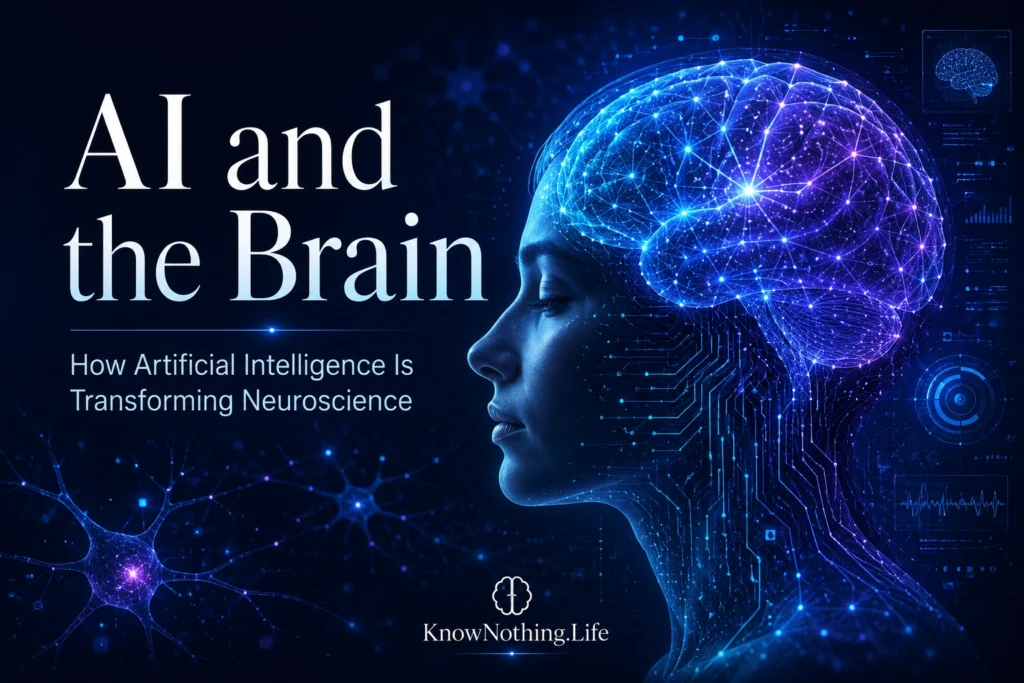
Artificial intelligence and neuroscience have developed through a long exchange of ideas. Neuroscience investigates how biological nervous systems perceive, learn, remember, decide, and act, while AI attempts to build machines capable of performing some of those functions. Early artificial-neural-network theories were explicitly inspired by simplified accounts of neurons. In 1943, Warren McCulloch and Walter Pitts described networks of idealized units that could perform logical operations, helping establish the idea that intelligence might emerge from many simple computational elements working together. Modern AI systems are far more elaborate, but they still use the language of neurons, layers, connections, activation, and learning.
The influence now runs in both directions. Brain research continues to inspire new approaches to memory, attention, reinforcement learning, navigation, and flexible decision-making. At the same time, artificial networks have become tools for testing theories about how biological brains solve complex tasks. Demis Hassabis and colleagues argued in their 2017 review “Neuroscience-Inspired Artificial Intelligence” that studying biological intelligence can suggest useful computational principles, while Blake Richards and colleagues later proposed that neuroscience could analyze the brain in terms of architectures, learning rules, and objective functions similar to those used when designing artificial networks. AI and neuroscience do not seek identical goals, but each field can expose assumptions and possibilities that the other might overlook.
How the Brain Inspired Artificial Intelligence
Artificial neural networks are not detailed simulations of real nervous systems. A biological neuron contains complex molecular machinery, receives signals through thousands of synapses, changes over multiple timescales, and operates within a living body. An artificial unit generally performs a comparatively simple mathematical transformation. Nevertheless, the broad principle of distributed computation proved enormously productive. Information in a neural network is represented through patterns spread across many adjustable connections rather than stored in one explicit location. Training changes those connections so the system becomes better at recognizing patterns, predicting outcomes, or selecting actions.
Several influential AI ideas have biological roots. Reinforcement learning draws on the principle that behavior can be shaped by rewards and prediction errors. Attention mechanisms reflect the need to prioritize selected information, although their implementation differs greatly from biological attention. Memory systems in AI have also been influenced by theories proposing that the brain combines rapid learning of individual experiences with slower extraction of general knowledge. Hassabis and colleagues emphasized that neuroscience has contributed useful ideas involving replay, imagination, hierarchical representation, transfer learning, and continual learning. These inspirations are usually abstractions rather than direct copies, but they show how studying the brain can expand the design space of intelligent machines.
Artificial Networks as Models of the Brain
One of the strongest connections between AI and neuroscience has emerged in vision research. Daniel Yamins and colleagues trained hierarchical artificial networks to recognize objects and then compared the networks’ internal activity with neural recordings from the primate ventral visual stream. Models that performed better at object recognition also predicted responses in inferior temporal cortex more accurately. This suggested that optimizing a system to solve an ecologically relevant task could produce internal representations resembling those found in the brain, even when the model had not been explicitly programmed to imitate every biological detail.
Later work found that networks trained through unsupervised or self-supervised learning could also predict responses across several visual cortical regions. In language research, Martin Schrimpf and colleagues compared 43 computational models with human behavioral and neural measurements. Models that were particularly successful at predicting upcoming words tended to predict brain responses during language comprehension more accurately. These findings make artificial networks useful scientific models, but resemblance does not prove that a model and a brain use the same mechanism. Two systems can produce similar outputs or activity patterns while differing substantially in architecture, learning history, embodiment, and internal computation.
Using AI to Understand Neural Data
Modern neuroscience produces datasets too large and complex to interpret through manual inspection alone. Researchers can record thousands of neurons, image activity across large portions of the brain, trace structural connections, and follow behavior through high-resolution video. Machine-learning systems can identify patterns within these measurements, reduce their dimensionality, classify neural states, and relate population activity to movement or sensory experience. These methods are especially valuable because information is often distributed across populations of neurons rather than represented by one cell acting independently.
A 2023 study introduced CEBRA, a machine-learning method designed to create consistent low-dimensional representations from neural and behavioral data. Steffen Schneider and colleagues applied it to electrophysiological and calcium-imaging recordings, showing that the method could uncover relationships among neural activity, behavior, position, and sensory information across sessions and recording techniques. The researchers also used visual-cortex recordings to decode naturalistic video information. Such methods do not automatically explain why neural activity has a particular structure, but they can reveal patterns that generate new hypotheses and guide more targeted experiments.
Brain Decoding and Communication
AI is also being used to translate measured brain activity into descriptions of what a person is perceiving or attempting to communicate. Jerry Tang and colleagues trained a system to reconstruct the general meaning of stories heard or imagined by participants from functional MRI recordings. The decoder generated semantic paraphrases rather than exact transcripts and required extensive training for each participant. People could also interfere with decoding by deliberately thinking about something else. The study demonstrated that noninvasive recordings can contain enough distributed information to recover aspects of continuous meaning, but it did not create a universal or involuntary thought-reading machine.
Invasive brain–computer interfaces can capture neural signals with greater precision and may restore communication to people who cannot speak. In 2023, Francis Willett and colleagues reported a speech neuroprosthesis that decoded attempted speech from a participant with amyotrophic lateral sclerosis at an average rate of 62 words per minute. Sean Metzger and colleagues developed a separate system that translated cortical activity into text, synthesized speech, and movements of a digital facial avatar for a participant with paralysis following a brainstem stroke. Both systems depended on machine-learning models trained to recognize the neural patterns associated with attempted articulation.
AI in Neurological Research and Medicine
Artificial intelligence can assist with the analysis of brain scans, electrophysiological recordings, medical histories, and other clinical data. Potential applications include identifying lesions, monitoring disease progression, predicting treatment response, and helping clinicians prioritize scans that may require urgent attention. A multicenter real-world study published in 2023 evaluated an AI system for detecting disease activity on serial MRI scans from people with multiple sclerosis. The system achieved high sensitivity compared with a consensus reference standard, illustrating how automated tools may help clinicians compare complex images collected months apart.
Larger foundation models are beginning to be trained on broad collections of neuroimaging data. A 2025 study described Prima, a model trained on more than 220,000 MRI examinations and evaluated during a health-system-wide study covering numerous neurological findings. The model showed strong performance across multiple diagnostic categories and was designed to support worklist prioritization and differential diagnosis. Such results are promising, but clinical usefulness depends on external validation, data quality, calibration, transparency, workflow integration, and performance across hospitals and patient populations. AI should support professional judgment rather than convert a statistical prediction into an unquestionable medical conclusion.
Why Artificial Intelligence Is Not a Digital Brain
Despite their shared vocabulary, artificial and biological neural networks differ fundamentally. Brains learn continuously through perception, movement, emotion, bodily regulation, and social interaction. They operate with limited energy, adapt from relatively few examples, and remain functional despite noisy signals and damaged cells. Many AI systems require enormous training datasets and computational resources, learn during separate training phases, and struggle when conditions differ from their training distribution. An AI model may outperform humans on one carefully defined task while lacking the flexible common sense needed to function independently in an unfamiliar physical environment.
Large language models provide a clear example. Their internal representations can predict some human neural responses, but this does not establish that they understand language exactly as humans do. Human concepts develop through bodies, relationships, goals, perception, action, and culture, whereas a language model may learn primarily from statistical patterns in text and other training data. Anthony Zador and colleagues have proposed an “embodied Turing test” in which artificial agents must acquire and use sensorimotor skills in realistic environments. The proposal reflects a growing view that human-like intelligence cannot be understood entirely through disembodied pattern prediction.
Ethics and the Future of NeuroAI
The convergence of AI and neuroscience creates substantial ethical questions. Brain-decoding systems generate highly sensitive data, and algorithms may infer information beyond the purpose for which a recording was originally collected. Clinical models can reproduce biases present in their training datasets, while opaque systems may make it difficult to understand why a prediction was generated. Brain–computer interfaces also raise questions about consent, ownership, cybersecurity, long-term device support, identity, and whether companies should be permitted to reuse neural recordings to train commercial models.
The future of AI and the brain will likely involve increasingly close cooperation between neuroscientists, engineers, clinicians, ethicists, and patients. Brain-inspired AI may become more efficient, adaptable, and embodied, while AI-assisted neuroscience may reveal patterns that conventional analysis cannot detect. Yet neither field should be treated as a shortcut to understanding intelligence. Artificial models are valuable when they make precise predictions, expose gaps in existing theories, and generate experiments that can be tested against biological evidence. The most productive relationship will not come from declaring that the brain is merely a computer or that AI has recreated the mind, but from using each system to investigate what the other still cannot explain.