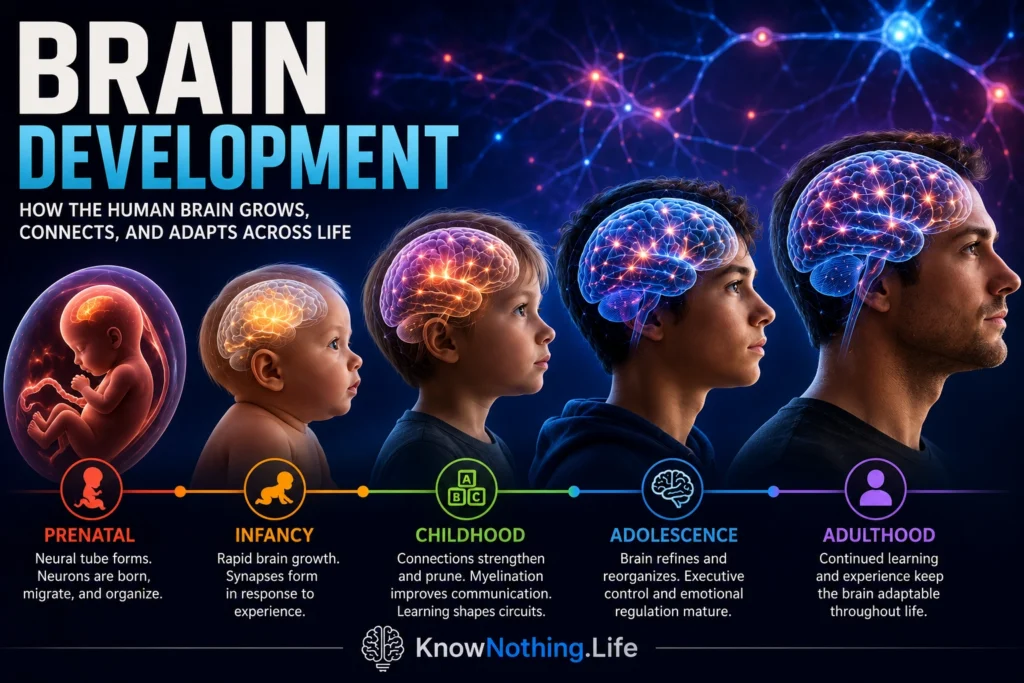
Brain development is the lifelong process through which the nervous system is formed, organized, connected, and modified by experience. It begins only weeks after conception, when embryonic tissue folds into the neural tube, and continues through infancy, childhood, adolescence, and adulthood. During this process, neural stem cells produce neurons and glial cells, neurons migrate to their proper locations, axons grow toward distant targets, synapses form between cells, and networks become increasingly specialized. Development does not simply make the brain larger. It changes how efficiently different regions communicate and how effectively the nervous system supports perception, movement, language, memory, emotion, and decision-making.
The developing brain is neither completely predetermined by genes nor shaped entirely by the environment. Genes regulate the timing and direction of many developmental events, but nutrition, hormones, sensory stimulation, illness, relationships, stress, education, and learning influence how neural pathways are maintained and used. Brain development is therefore best understood as a continuous interaction between biological preparation and experience. Some processes follow highly organized schedules, while others remain flexible enough to adapt to the individual’s surroundings.
Building the Brain Before Birth
Prenatal brain development begins with the formation of the neural tube, which later becomes the brain and spinal cord. Neural progenitor cells divide rapidly, producing enormous numbers of neurons and glial cells. The neurons must then move from their places of origin to appropriate destinations, acquire specialized functions, and develop axons and dendrites. Chemical signals guide growing cells, while spontaneous electrical activity helps organize early networks before the senses are fully functional.
Pasko Rakic’s research helped establish how neurons become arranged within the cerebral cortex. In his radial unit hypothesis, neurons generated near the cerebral ventricles migrate outward along fibers produced by radial glial cells. Related groups of neurons form vertical units that contribute to the layered and columnar organization of the cortex. This framework helped explain how the human cerebral cortex can expand dramatically while maintaining an orderly structure. Disruptions to cell production, migration, or differentiation can alter later brain organization because each stage establishes conditions required by the next.
The prenatal brain is especially sensitive to timing. Alcohol exposure, nutritional deficiencies, infections, placental complications, and certain toxic substances can interfere with neural proliferation, migration, or connectivity. Outcomes vary according to the developmental stage, the intensity and duration of exposure, genetics, and later environmental support. The same event can have different effects depending on whether it occurs during the formation of basic structures, the production of neurons, or the establishment of early connections.
Synapse Formation and Neural Pruning
The early brain produces a remarkable number of synaptic connections. Synapses allow neurons to exchange electrical and chemical signals, making coordinated brain activity possible. Synaptic development begins before birth but accelerates during infancy and childhood. Peter Huttenlocher’s research on the human cortex found that synaptic density rises rapidly during early life and may temporarily exceed adult levels. The brain initially creates a wide range of possible connections rather than constructing only the pathways that will ultimately remain.
Synaptic development does not proceed at the same rate throughout the brain. Huttenlocher and Arun Dabholkar found that synapses accumulated earlier in the auditory cortex than in the prefrontal cortex. Sensory systems generally mature relatively early because infants must quickly process sights, sounds, touch, and movement. Association regions involved in planning, behavioral control, and complex reasoning develop across a much longer period. These differences help explain why basic perceptual abilities appear before mature executive control.
Many early connections are later weakened or eliminated through synaptic pruning. This is not simply a destructive loss of brain material. Pruning can improve efficiency by strengthening well-coordinated pathways and reducing connections that are rarely used or poorly integrated. Experience helps influence which pathways are stabilized, but activity is not the only factor; genes, immune-related processes, hormones, and developmental timing also contribute. Healthy development depends on a balance between creating enough connections for adaptability and refining those connections into stable networks.
Myelination and the Growth of Connectivity
Neural communication also becomes more efficient through myelination. Myelin is a fatty insulating substance that surrounds many axons and allows signals to travel more quickly and reliably. Myelination begins before birth in some pathways, progresses rapidly during infancy, and continues through childhood and adolescence. Motor and sensory pathways often become myelinated earlier than connections supporting higher-order cognitive functions.
Longitudinal imaging of children from infancy through approximately five years of age has documented extensive increases in myelinated white matter throughout the brain. The timing differed across regions, reflecting the order in which developing systems became functionally important. Research involving infants and toddlers has also found relationships between white-matter development and emerging cognitive abilities, including language and general learning. These associations do not mean that a single measurement of myelin can determine intelligence, but they show that efficient communication between regions is central to behavioral development.
White matter continues changing well beyond the preschool years. Jay Giedd and colleagues followed children and adolescents with repeated magnetic resonance imaging and found prolonged increases in white-matter volume alongside regionally specific changes in gray matter. Development therefore involves increasing integration among distant systems as well as local refinement within the cortex. A mature ability such as decision-making depends not only on the condition of one region, but also on how effectively sensory, emotional, memory, and control networks communicate.
Sensitive Periods and the Role of Experience
Some abilities are especially responsive to experience during sensitive periods. During these intervals, the brain is unusually prepared to use particular kinds of input to organize neural connections. David Hubel and Torsten Wiesel demonstrated this principle by temporarily closing one eye in young kittens. The visual cortex reorganized in favor of the open eye, and neurons that would normally respond to both eyes became dominated by the eye that received normal stimulation. Comparable deprivation produced much weaker effects when it occurred later in development.
These findings showed that genetic instructions alone are not enough to establish normal visual processing. The developing visual system requires patterned input during an appropriate period. Sensitive periods also influence aspects of language, hearing, movement, emotional regulation, and social development, although each system follows a different schedule. The existence of sensitive periods does not mean that learning becomes impossible after childhood. It means that some kinds of learning may later require greater effort or produce less complete reorganization.
Experience-dependent development occurs whenever the brain changes in response to circumstances that are specific to the individual. Learning to read, play an instrument, navigate a city, participate in a culture, or speak a particular language alters frequently used networks. Experience-expectant development, by contrast, depends on forms of stimulation that the brain normally anticipates, such as light, patterned sound, movement, and responsive social interaction. Development requires both: widely shared input establishes basic systems, while individual experience creates specialized abilities.
Relationships, Deprivation, and Stress
Human brain development occurs within relationships. Infants depend on caregivers not only for nutrition and physical protection but also for the regulation of attention, sleep, emotional arousal, and stress. Responsive interactions expose children to language, facial expressions, touch, predictable routines, and opportunities for exploration. Caregivers temporarily perform regulatory functions that children gradually learn to manage themselves.
The Bucharest Early Intervention Project examined children who had experienced severe deprivation in Romanian institutions. Children were randomly assigned either to continued institutional care or to specially developed foster care. Those placed with foster families showed better cognitive development, particularly when placement occurred earlier. Long-term follow-up also found that stable, high-quality foster care was associated with more typical patterns of brain electrical activity. The research provided rare experimental evidence that improved caregiving can alter developmental trajectories after early adversity, although recovery varied among children and across abilities.
Stress is not always harmful. Moderate challenges can help children develop coping skills, persistence, and flexibility when supportive adults are available. Prolonged or extreme stress is more concerning because repeated activation of stress hormones can influence attention, sleep, immune function, and neural development. The effects depend heavily on context. Predictability, safety, supportive relationships, and opportunities for recovery can reduce the impact of difficult experiences. Early adversity changes probabilities rather than determining a fixed future.
Childhood and Adolescent Brain Development
Childhood brain development involves increasing specialization and coordination. Longitudinal imaging by Nitin Gogtay and colleagues showed that cortical maturation followed a broad sequence from primary sensory and motor regions toward association areas involved in language, spatial integration, and executive control. The study followed the same participants repeatedly from childhood into early adulthood, revealing that the cortex does not mature everywhere at once.
Adolescence is a major phase of refinement rather than a period in which the brain is simply defective or incomplete. Reward, emotional, and social systems become highly responsive, while prefrontal systems and their connections continue to develop. This combination can increase sensitivity to peers, novelty, and immediate incentives, particularly in emotionally intense situations. It can also support rapid learning, exploration, independence, creativity, and the formation of identity.
Gray-matter measurements often decline in parts of the cortex during adolescence, but this should not automatically be interpreted as a loss of ability. The change reflects several processes, including synaptic refinement, increased myelination near the cortical surface, and alterations in cellular organization. Research on the human prefrontal cortex suggests that the reorganization of synaptic spines continues longer than early models assumed, emphasizing the extended period during which cognitive and emotional networks remain developmentally sensitive.
Development Continues in Adulthood
Adulthood does not mark the end of brain development. The pace and type of change differ from those seen in childhood, but learning continues to modify synaptic strength, network activity, and aspects of brain structure. Eleanor Maguire and colleagues found that licensed London taxi drivers had greater gray-matter volume in the posterior hippocampus than control participants, and the difference was associated with years spent navigating the city. The study did not prove that navigation experience was the only cause, but later comparisons with bus drivers strengthened the connection between complex spatial learning and hippocampal organization.
Training studies provide additional evidence of adult plasticity. Adults learning to juggle showed temporary increases in gray matter within regions involved in visual motion processing, demonstrating that even relatively short periods of skill learning can be accompanied by measurable structural change. Some changes decreased when training ended, showing that plasticity is dynamic rather than a simple accumulation of brain tissue.
The brain remains adaptable throughout life, but plasticity is never unlimited. Age, health, sleep, stress, existing knowledge, injury, and the intensity of practice affect what changes are possible. Brain development is therefore not a straight journey toward a finished adult form. It is an ongoing process of construction, selection, stabilization, and adaptation through which biological systems respond to the demands of a changing life.