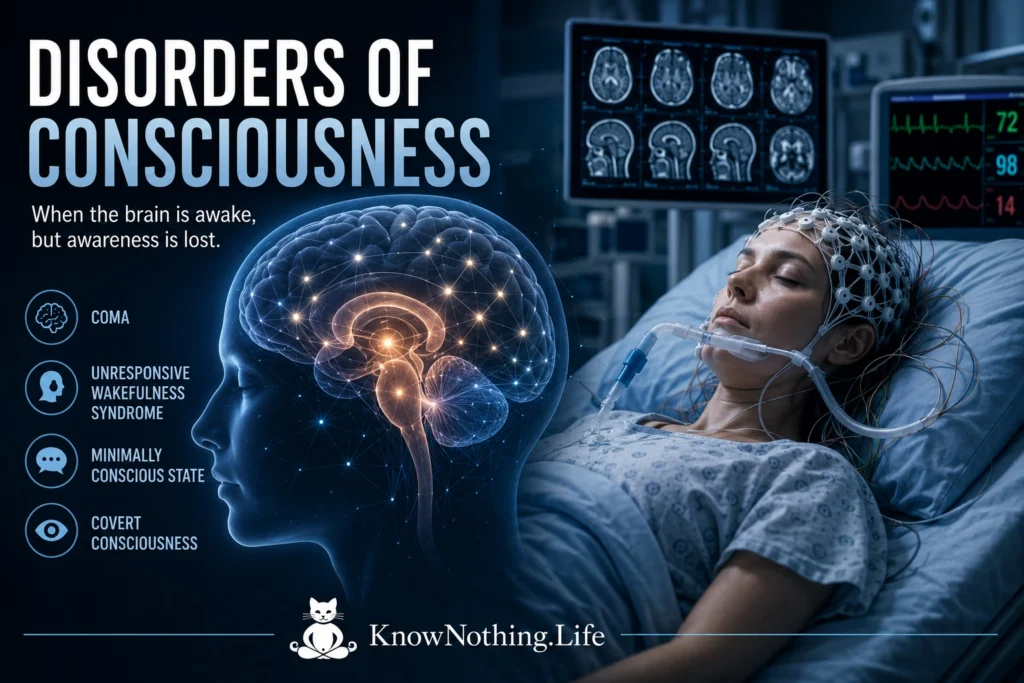
Disorders of consciousness are severe neurological conditions in which wakefulness, awareness, or both are disrupted by injury or disease. They most often follow traumatic brain injury, cardiac arrest, stroke, infection, oxygen deprivation, metabolic failure, or widespread damage to the brain. Consciousness is commonly divided into two interacting dimensions: arousal and awareness. Arousal refers to the capacity to open the eyes and maintain periods of wakefulness, while awareness refers to the presence of meaningful experience involving the self or environment. A patient may regain arousal without recovering clear behavioral signs of awareness, creating some of the most difficult diagnostic situations in medicine.
These conditions must be distinguished from brain death and locked-in syndrome. Brain death is the irreversible loss of all functions of the entire brain, including the brainstem. Locked-in syndrome is not a disorder of consciousness; affected patients can remain fully conscious but are unable to move most of the body because motor pathways have been damaged. Communication may depend on blinking or vertical eye movements. Disorders of consciousness occupy a different clinical territory in which the patient’s capacity for awareness is absent, reduced, inconsistent, or impossible to establish confidently through behavior alone. Nicholas Schiff’s work on recovery after brain injury emphasizes that cognitive function and motor output can become profoundly separated, causing preserved mental abilities to remain hidden.
Coma, Unresponsive Wakefulness, and Minimal Consciousness
Coma is a state of unarousable unresponsiveness in which the eyes remain closed and normal sleep–wake cycles are absent. It usually represents an acute phase after severe injury rather than a permanent condition. Within days or weeks, a patient may regain consciousness, die, or transition into another state. In unresponsive wakefulness syndrome, traditionally called the vegetative state, the eyes may open and sleep–wake cycles return, but examination reveals no reproducible behavioral evidence of awareness. Reflexive movements, facial expressions, startle responses, and automatic chewing may occur without proving that the patient understands or intentionally responds to the environment.
The minimally conscious state is defined by inconsistent but definite evidence of awareness. Joseph Giacino and colleagues formalized the condition in their 2002 paper, “The Minimally Conscious State: Definition and Diagnostic Criteria.” Relevant behaviors may include following a simple command, visually tracking an object, reaching toward something accurately, producing understandable words, or responding appropriately to emotional material. Because these behaviors may appear only occasionally, the distinction from unresponsive wakefulness can be difficult. A patient is considered to have emerged from the minimally conscious state when reliable communication or functional use of objects returns.
How Brain Networks Support Consciousness
Consciousness does not depend on one isolated “awareness center.” Wakefulness requires ascending arousal systems extending from the brainstem and hypothalamus toward the thalamus, basal forebrain, and cerebral cortex. Awareness appears to require sufficiently organized communication among widespread cortical and subcortical networks. Severe injuries may damage these structures directly or disconnect regions that remain anatomically present. A patient can therefore lose consciousness without complete destruction of the cortex if the remaining regions can no longer sustain integrated, differentiated, and flexible activity.
Schiff’s mesocircuit hypothesis proposes that many disorders of consciousness involve reduced activity within interconnected frontal cortex, striatum, globus pallidus, and central thalamus. Widespread brain injury reduces excitatory input to the striatum and cortex, allowing excessive inhibition of the thalamus and further suppressing cortical activity. The resulting network can become trapped in a low-activity state even when some neurons remain viable. This model helps explain why recovery can occur gradually and why treatments affecting dopamine, thalamic activation, or large-scale connectivity may improve responsiveness in selected patients.
The Challenge of Behavioral Diagnosis
Diagnosis traditionally depends on observing whether a patient responds purposefully to sights, sounds, touch, pain, objects, or spoken commands. These examinations are vulnerable to error. Weakness, paralysis, sensory loss, language impairment, fluctuating arousal, sedating medication, seizures, infection, pain, and fatigue can conceal awareness. A patient may understand a command but lack the motor control needed to demonstrate understanding. Responses may also occur only during brief periods of heightened alertness, making a single bedside examination unreliable.
Standardized instruments improve this process. The Coma Recovery Scale–Revised evaluates auditory, visual, motor, verbal, communication, and arousal functions using procedures designed to distinguish reflexive behavior from purposeful responses. In a 2009 study, Caroline Schnakers and colleagues compared clinical consensus diagnoses with standardized assessments in 103 patients. Of 44 patients considered to be in a vegetative state by their clinical teams, 18 were classified as minimally conscious with the scale. The findings showed why repeated structured assessments are more reliable than informal observation alone.
Covert Consciousness and Cognitive Motor Dissociation
In 2006, Adrian Owen and colleagues reported a patient who met behavioral criteria for a vegetative state but could intentionally change her brain activity during functional magnetic resonance imaging. When asked to imagine playing tennis, she activated supplementary motor regions; when asked to imagine walking through her home, she activated areas associated with spatial navigation. The patterns closely resembled those of healthy volunteers following the same commands. Because the two tasks required understanding the instructions and deliberately selecting different mental actions, the findings provided evidence of awareness that could not be expressed through movement.
Martin Monti and colleagues later tested 54 patients using similar methods. Five showed evidence of intentionally modifying brain activity, and one behaviorally unresponsive patient used mental imagery to answer several yes-or-no questions. This separation between cognitive command-following and visible movement is now often described as cognitive motor dissociation or covert consciousness. Electroencephalography offers a more portable method of detecting related responses. Jan Claassen and colleagues found command-related EEG activation in some clinically unresponsive patients during the first days after acute brain injury, and those responses were associated with better later outcomes. These tests can produce false negatives, however, and failure to detect activation does not prove the absence of consciousness.
Recovery, Prognosis, and Treatment
Recovery varies greatly according to the cause, location, and severity of injury, the patient’s age and medical condition, and the state reached during rehabilitation. Traumatic injuries generally have more favorable outcomes than injuries caused by prolonged oxygen deprivation, while patients in a minimally conscious state tend to have better prospects than those remaining in unresponsive wakefulness. Nevertheless, late recovery can occur, and older terms such as “permanent vegetative state” can imply more certainty than the evidence supports. The 2018 clinical guideline from the American Academy of Neurology and partner organizations recommends repeated standardized assessment, treatment of confounding medical problems, and cautious communication of uncertainty to families.
Medical care begins with stabilizing breathing and circulation, treating infections and seizures, correcting metabolic abnormalities, providing nutrition, preventing pressure injuries, maintaining joint mobility, and controlling pain. Rehabilitation uses sensory stimulation, positioning, physical therapy, occupational therapy, communication assessment, and repeated opportunities to demonstrate purposeful behavior. In a randomized placebo-controlled trial, Giacino and colleagues found that amantadine accelerated functional recovery during four weeks of treatment in patients with traumatic disorders of consciousness who were four to sixteen weeks after injury. The medication did not guarantee awakening, and improvement slowed after treatment ended, but the study provided unusually strong evidence for a therapy in a field dominated by small and uncontrolled reports.
Ethics, Communication, and the Future of Care
Disorders of consciousness raise difficult questions about pain, dignity, treatment goals, communication, and decisions involving life-sustaining care. Families may be asked to make choices while prognosis remains uncertain and the patient cannot express personal preferences. Clinicians must explain the difference between wakefulness, observable responsiveness, and possible covert awareness without creating false hope or unwarranted certainty. Pain should be assessed and treated even when a patient cannot describe it, because the absence of a reliable motor response does not establish the absence of suffering. Decisions should consider the patient’s previously expressed values, the medical evidence, repeated evaluations, and the possibility that diagnosis may change.
Advances in EEG, functional imaging, brain stimulation, and machine learning may eventually make hidden cognition easier to detect and communication more accessible. These technologies are currently limited by cost, patient movement, damaged language systems, fluctuating attention, and the need for specialized analysis. A positive result can reveal command-following, but a negative result remains difficult to interpret. The central lesson of modern research is that observable behavior is an imperfect window into the injured brain. Disorders of consciousness cannot be understood as simple states of being awake or unconscious; they are evolving network conditions in which arousal, awareness, language, sensation, and motor control may recover at different rates.