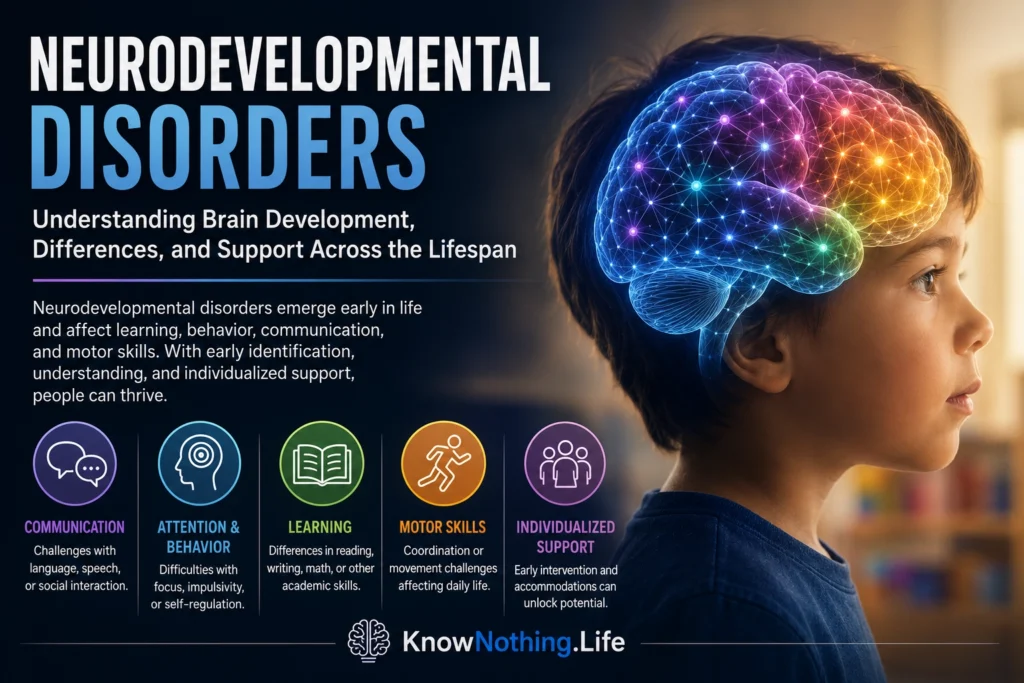
Neurodevelopmental disorders are conditions that emerge during the developmental period and affect cognition, communication, behavior, movement, learning, or adaptive functioning. Their characteristics are usually recognizable in childhood, although some are not identified until academic, occupational, or social demands exceed a person’s available supports. The American Psychiatric Association’s Diagnostic and Statistical Manual of Mental Disorders, Fifth Edition, Text Revision groups intellectual developmental disorder, communication disorders, autism spectrum disorder, attention-deficit/hyperactivity disorder, specific learning disorder, motor disorders, and tic disorders within this category. The conditions differ substantially, but all involve developmental patterns that affect everyday functioning.
The term does not mean that every unusual behavior or cognitive difference is a disease. Human development naturally varies in attention, language, sensory processing, movement, social motivation, and learning style. A clinical diagnosis becomes relevant when a persistent pattern produces meaningful difficulties, requires significant support, or restricts participation in education, relationships, work, self-care, or community life. The same diagnosis can look very different from one person to another, and two people with similar observable difficulties may have different developmental histories and underlying biological influences.
Major Types and Their Characteristics
Intellectual developmental disorder involves limitations in intellectual functions and adaptive behavior, including conceptual, social, and practical abilities. Specific learning disorder affects the acquisition of academic skills such as reading, written expression, or mathematics, even when educational opportunity and general intelligence do not fully explain the difficulty. Communication disorders affect language, speech sounds, fluency, or the social use of communication. Motor disorders include developmental coordination disorder, stereotypic movement disorder, and tic disorders such as Tourette’s disorder. These categories describe patterns of functioning rather than damage to one isolated brain region.
Autism spectrum disorder is defined by persistent differences in social communication and interaction together with restricted or repetitive patterns of behavior, interests, or sensory responses. ADHD is characterized by developmentally inappropriate patterns of inattention, hyperactivity, or impulsivity that interfere with functioning across relevant settings. Neither autism nor ADHD has one uniform presentation. Some autistic people require extensive lifelong assistance, while others live independently but need support with sensory demands, communication, organization, or social environments. ADHD may involve obvious physical restlessness, primarily inattentive difficulties, emotional impulsivity, or combinations that change with age and context.
How Neurodevelopmental Disorders Arise
Brain development depends on the coordinated production, migration, differentiation, and connection of neural cells. Genes regulate these processes, but prenatal conditions, birth complications, nutrition, toxic exposures, illness, stress, learning, and social experience can influence developmental trajectories. Neurodevelopmental disorders rarely result from one simple cause. Some individuals have an identifiable chromosomal change or pathogenic genetic variant, while others show a complex combination of inherited susceptibility and environmental influence. In many cases, no single cause can be established.
Large sequencing projects demonstrate the extraordinary genetic diversity involved. The Deciphering Developmental Disorders study analyzed thousands of families and identified damaging newly occurring, or de novo, variants in numerous genes involved in developmental conditions. The researchers estimated that disorders caused by such variants collectively affect a meaningful proportion of births, while emphasizing that each individual genetic condition may be rare. A later study led by Joanna Kaplanis combined healthcare and research data to identify evidence for 28 additional developmental disorders, illustrating how the list of relevant genes continues to grow.
These genetic findings do not support the idea of a single “autism gene,” “ADHD gene,” or “intelligence gene.” Many genes influence more than one developmental function, and variants in the same gene can produce different outcomes. Genes associated with neurodevelopmental disorders participate in synaptic signaling, gene regulation, chromatin organization, protein production, neuronal migration, and many other cellular processes. Their effects also depend on developmental timing and the wider genome. Genetic information can sometimes clarify diagnosis or medical risk, but it cannot fully predict personality, abilities, support needs, or future quality of life.
Overlap and Co-Occurrence
Diagnostic categories are useful for organizing care and research, but neurodevelopmental characteristics frequently overlap. A child with autism may also meet criteria for ADHD, intellectual disability, a language disorder, epilepsy, anxiety, or a motor difficulty. Someone diagnosed with ADHD may also have dyslexia, developmental coordination disorder, or autistic characteristics. This overlap is not necessarily evidence that an assessment was incorrect. It reflects the fact that attention, language, executive control, sensory processing, motor coordination, and social cognition depend on interconnected developmental systems.
Brain-imaging research similarly challenges the expectation that each diagnosis should correspond to a unique neural signature. A large brain-charting study comparing autism, ADHD, and co-occurring autism and ADHD found that the combined group showed a pattern that could not be understood simply as the addition of two separate disorders. Structural differences varied with age, sex, clinical characteristics, and co-occurrence, reinforcing the importance of developmental trajectories rather than static brain abnormalities. Neuroimaging is valuable for research, but variation within diagnostic groups remains too great for an individual brain scan to serve as a routine stand-alone diagnostic test.
This complexity has encouraged transdiagnostic approaches that study dimensions shared across diagnoses. Executive-function difficulties, emotional dysregulation, sensory sensitivities, sleep disruption, and language impairments may appear in several conditions. Understanding the person’s actual pattern of strengths and difficulties may therefore be more useful than assuming that a diagnostic label explains every behavior. Diagnosis provides a framework, but individualized assessment determines which supports are needed.
Diagnosis and Developmental Assessment
Neurodevelopmental disorders are diagnosed primarily through developmental history, observation, interviews, standardized testing, educational information, and reports from people who know the individual in different settings. Clinicians consider when characteristics began, whether they are persistent, how they affect functioning, and whether another medical, neurological, sensory, psychiatric, or environmental explanation better accounts for them. Assessment may involve psychologists, physicians, speech-language specialists, occupational therapists, educators, genetic counselors, and other professionals.
A single test score should not determine diagnosis or support. Language barriers, cultural expectations, educational access, anxiety, fatigue, hearing or vision problems, and unfamiliar testing environments can all affect performance. Some individuals camouflage or compensate for difficulties, causing their needs to be underestimated. Others may be judged mainly through disruptive behavior when communication problems, sensory overload, sleep disorders, or academic frustration are contributing to the behavior. A high-quality evaluation examines the whole developmental profile rather than searching only for confirmation of one suspected diagnosis.
Genetic testing may be particularly useful when intellectual disability, congenital differences, seizures, regression, unusual growth patterns, or a family history suggests a specific biological cause. A confirmed genetic diagnosis can sometimes guide medical monitoring, inform family planning, connect families with condition-specific resources, or identify research opportunities. However, many test results remain uncertain, and a negative result does not rule out a neurodevelopmental disorder. Genetic diagnosis and behavioral diagnosis answer related but different questions.
Early Intervention and Individualized Support
Early identification can give children access to communication support, educational accommodations, occupational therapy, behavioral strategies, family guidance, and treatment of associated medical conditions. Intervention should target meaningful abilities and participation rather than attempting to erase harmless differences. Useful goals may include functional communication, emotional regulation, independent living skills, literacy, motor coordination, safety, and the ability to express needs or refuse unwanted experiences.
In a randomized trial of the Early Start Denver Model, Geraldine Dawson and colleagues found that autistic toddlers receiving the intervention showed greater average improvements in IQ, adaptive behavior, and diagnostic measures than children receiving community services. Follow-up work found that some gains persisted after the intensive treatment period. These results support the value of developmentally informed early intervention, but they do not mean that one program is appropriate for every autistic child or that intervention can guarantee a particular outcome.
Treatment research in ADHD also demonstrates the importance of matching interventions to specific needs. The Multimodal Treatment Study of Children with ADHD compared carefully managed medication, intensive behavioral treatment, their combination, and routine community care. After 14 months, medication management and combined treatment produced stronger average improvement in core ADHD symptoms than behavioral treatment or ordinary community care, while combined treatment offered advantages for some broader functional outcomes. Later follow-up showed that long-term development was influenced by many factors beyond the original treatment assignment.
Neurodevelopment Across the Lifespan
Neurodevelopmental disorders do not simply disappear when a person reaches adulthood. The expression of characteristics changes as environments and responsibilities change. Hyperactivity may become less visible while organizational difficulty continues. A learning disorder may be less obvious after formal schooling but still affect training or paperwork. Autistic adults may develop effective strategies yet experience exhaustion, sensory overload, or difficulty navigating workplaces designed around implicit social expectations.
Support therefore needs to extend beyond childhood diagnosis. Adults may require educational accommodations, workplace adjustments, communication support, mental-health treatment, coaching, assistance with daily living, or access to specialized medical care. Strengths such as sustained interest, pattern recognition, creativity, honesty, detailed knowledge, or unconventional problem-solving may flourish when environments are accessible and expectations are clearly communicated.
Neurodevelopmental disorders are best understood as developmental pathways rather than fixed collections of deficits. Biology influences how the brain develops, but experience, relationships, education, healthcare, and opportunity shape how those differences affect a person’s life. An authority-based understanding must therefore combine neuroscience with respect for individual identity. The central question is not only how a person differs from a statistical norm, but what conditions allow that person to communicate, learn, participate, and live with dignity.