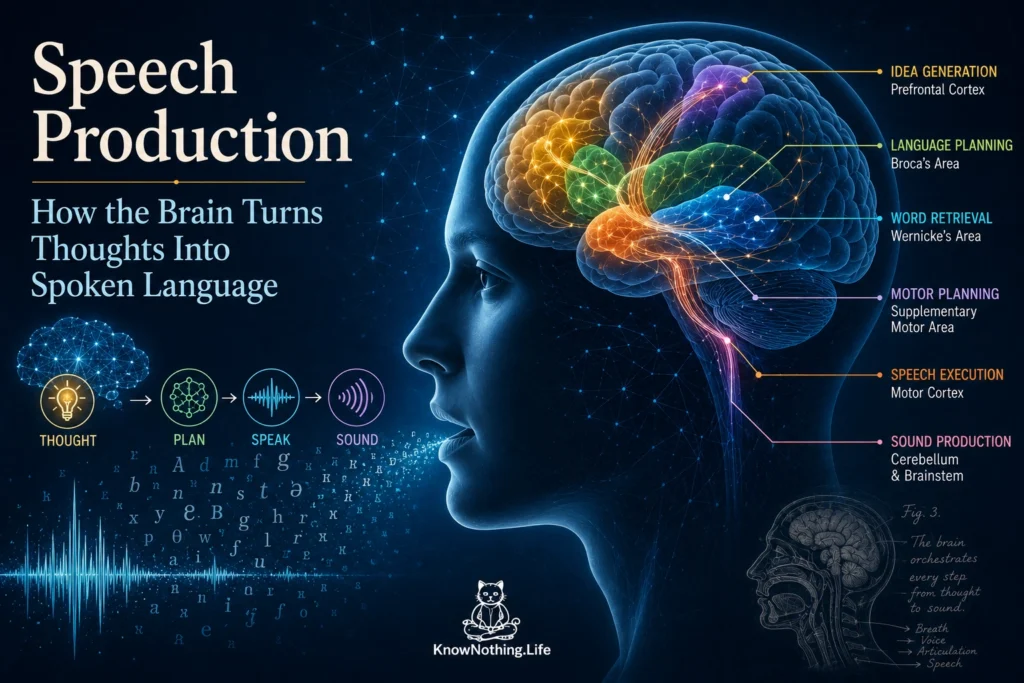
Speech production is the process through which an intention becomes an organized sequence of audible language. It begins before the lips, tongue, or vocal folds move. A speaker must decide what to communicate, select appropriate words, arrange them into a grammatical structure, retrieve their sounds, organize those sounds into syllables, and prepare coordinated movements of the respiratory system, larynx, jaw, tongue, lips, and soft palate. These operations occur rapidly and usually feel effortless, yet ordinary conversation requires the brain to prepare several words every second while considering meaning, timing, social context, and the listener’s reactions.
Speech is not produced by a single brain center. It depends on a distributed network that includes temporal language regions, inferior frontal cortex, premotor and primary motor areas, auditory cortex, somatosensory cortex, the insula, supplementary motor area, basal ganglia, thalamus, brainstem, and cerebellum. Willem Levelt’s influential book Speaking: From Intention to Articulation and the later WEAVER++ model developed with Ardi Roelofs and Antje Meyer described speaking as a series of linked stages, from conceptual preparation through lexical selection, phonological encoding, phonetic planning, articulation, and self-monitoring. Modern neuroscience has refined this account by showing that the stages overlap and interact even though they remain useful for explaining how speaking unfolds.
From Communicative Intention to Word Selection
Speech begins with a preverbal message: an intended meaning that has not yet been converted into specific words. A speaker may want to identify an object, answer a question, tell a story, or influence another person. The conceptual system selects the relevant ideas and perspective before the language system retrieves words that can express them. Word selection is competitive because related concepts activate overlapping candidates. Seeing a dog, for example, may activate “dog,” “animal,” “pet,” and the name of a familiar breed before the intended word is chosen.
Levelt, Roelofs, and Meyer proposed that speakers first retrieve a lemma, an abstract representation containing a word’s meaning and grammatical properties, before retrieving its phonological form. Experiments involving picture naming, semantic interference, speech errors, and reaction times helped establish this distinction, although alternative models disagree about how sharply the stages are separated. Electrophysiological evidence suggests that lexical access can begin within roughly the first 200 milliseconds after a speaker recognizes the intended concept. The process is remarkably fast, but failures become visible in tip-of-the-tongue states, semantic substitutions, and the word-finding problems associated with aphasia.
Phonological Encoding and Speech Sequencing
Selecting a word is not the same as preparing its pronunciation. The brain must retrieve an ordered set of speech sounds, assign them to syllables, determine stress, and adapt the plan to neighboring sounds. Speech is highly context-sensitive: the tongue and lips begin preparing for upcoming sounds before the current sound has finished, a phenomenon called coarticulation. This overlap makes speech fast and efficient, but it also means production cannot consist of issuing isolated motor commands for one phoneme at a time. The system prepares larger, temporally organized units such as syllables and frequently practiced sound sequences.
Intracranial recordings have made the timing of these transformations more visible. Ned Sahin and colleagues recorded activity from Broca’s area while participants read and grammatically modified words, finding distinguishable responses associated with lexical, grammatical, and phonological processing at successive moments. A 2024 study using single-neuron recordings in the language-dominant prefrontal cortex found neurons that represented the phonetic structure and order of planned words before they were spoken. These findings suggest that frontal language regions help organize abstract linguistic information into sequences that can guide speech-motor systems rather than directly controlling every muscular contraction.
Motor Planning and Articulation
Once a sound sequence has been prepared, the nervous system must convert it into coordinated movement. Speech uses much of the same anatomy involved in breathing, chewing, and swallowing, but it demands unusually precise timing. Air from the lungs powers vibration of the vocal folds, producing a sound source whose pitch and intensity can be adjusted. The jaw, tongue, lips, teeth, and palate reshape the vocal tract, creating rapidly changing resonances that listeners recognize as vowels and consonants. These movements are controlled by both hemispheres, although planning and sequencing are often more strongly associated with the left hemisphere.
Direct cortical recordings by Kristofer Bouchard and colleagues showed that the ventral sensorimotor cortex is organized around coordinated articulatory features rather than as a simple map of complete speech sounds. Related work by Adeen Flinker and colleagues found that Broca’s area becomes active while information is transformed from temporal-language representations into articulatory plans, yet becomes relatively quiet once articulation begins and motor cortex assumes a stronger role. These results support a division of labor in which frontal language regions coordinate and prepare speech while motor systems execute patterned movements through pathways reaching the brainstem nuclei that control the vocal tract.
Feedforward Control and Sensory Feedback
Fluent speakers do not wait to hear each sound before deciding how to move. Frequently used words and syllables rely heavily on feedforward commands—motor programs prepared through previous practice. Sensory feedback remains essential because the brain compares the expected consequences of a movement with the sounds and bodily sensations actually produced. Auditory cortex detects discrepancies involving pitch, loudness, and vowel quality, while somatosensory systems monitor contact, pressure, and articulator position. When an error appears, corrective commands can alter the current movement or adjust later attempts.
John Houde and Michael Jordan demonstrated this process by altering participants’ auditory feedback in real time. Speakers gradually changed their vowel production in the opposite direction, even though their physical movements had initially felt normal, and part of the adaptation remained after ordinary feedback returned. The DIVA model developed by Frank Guenther and colleagues formalized the relationship between learned feedforward commands and auditory and somatosensory error correction. In this account, feedback is particularly important while children learn speech and whenever growth, illness, fatigue, or unexpected interference causes an established command to produce a different result.
Rhythm, Voice, and Prosody
Speech production involves more than selecting the correct consonants and vowels. Speakers regulate rate, rhythm, stress, pausing, pitch, and loudness to mark questions, emphasis, emotion, phrasing, and conversational turn-taking. The larynx must coordinate vocal-fold tension with respiratory pressure, while articulatory movements remain synchronized with syllable timing. Across languages, intelligible speech contains strong temporal organization at the syllable level, although languages differ in how they use stress, duration, rhythm, and pitch.
David Poeppel and M. Florencia Assaneo argued that speech rhythm emerges partly from interactions between auditory and motor systems operating at preferred temporal rates. The supplementary motor area, basal ganglia, cerebellum, premotor cortex, auditory cortex, and laryngeal motor regions all contribute to initiating, timing, and adjusting vocal sequences. Tonal languages demonstrate the precision of this system because speakers must produce language-specific pitch trajectories that distinguish one word from another. Direct cortical recordings in Mandarin speakers have identified neural activity related to the control of lexical tones as part of the wider speech-production network.
Speech Production Disorders
Different disorders can interrupt different stages of production. Aphasia may impair word retrieval, grammar, or phonological encoding even when the speech muscles remain capable of moving. Apraxia of speech disrupts the planning or programming of articulatory sequences, often producing effortful initiation, distorted sounds, inconsistent errors, and abnormal prosody. Dysarthria arises when weakness, rigidity, incoordination, or another motor-control problem interferes with execution. These conditions frequently overlap after stroke, making careful assessment necessary rather than treating every reduced or unclear utterance as the same impairment.
Lesion studies have associated acquired apraxia with a left-hemisphere network involving inferior frontal, premotor, motor, insular, and connecting white-matter regions, although no single location explains every case. Developmental stuttering presents a different network-level disturbance in which the fluency and timing of speech are disrupted despite the speaker knowing what they intend to say. A 2024 review by Nicole Neef and Soo-Eun Chang emphasized interactions among speech-motor control, auditory processing, brain development, genetics, and basal-ganglia circuitry while noting that important mechanisms remain unresolved.
The Integrated Speaking Brain
Speech production is sometimes presented as a chain in which one brain region completes a task and passes the result to the next. Evidence instead supports a dynamic network in which planning, word retrieval, sound encoding, motor preparation, sensory prediction, and monitoring overlap. The dorsal speech pathway connects posterior temporal representations with frontal articulatory systems, while ventral pathways help connect words with conceptual meaning. Subcortical and cerebellar circuits contribute timing, initiation, learning, and error correction. No individual component contains a spoken sentence or independently commands its entire production.
The achievement of speech lies in this coordination. An abstract intention becomes words, grammatical relationships, ordered sound sequences, motor programs, airflow, vocal-fold vibration, and precisely timed articulatory movements, all while the speaker listens and adapts. Research ranging from Levelt’s psycholinguistic models to direct recordings of individual neurons demonstrates that speaking is neither purely linguistic nor purely motor. It is a continuous translation among thought, language, sensation, and action—one performed so efficiently that its extraordinary complexity is often noticed only when the system hesitates, makes an error, or becomes impaired.