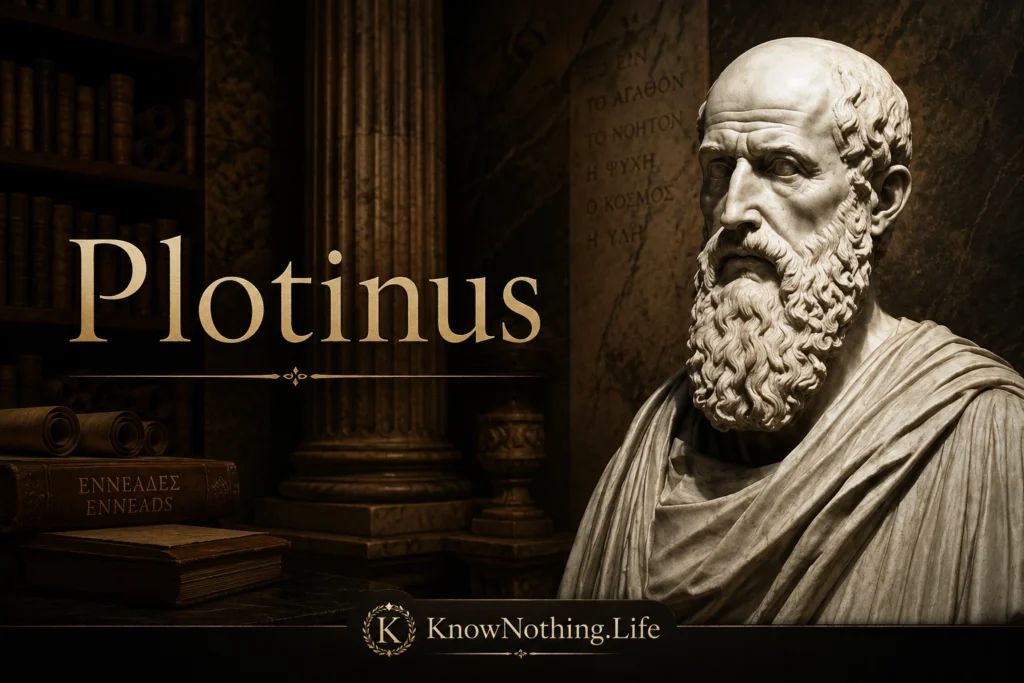
Plotinus was born around 204 or 205 CE, probably in Lycopolis in Egypt, and became the central figure in the philosophical movement later known as Neoplatonism. Little is known with certainty about his early life, partly because he disliked talking about his body, family, or birth. His student Porphyry, who wrote The Life of Plotinus, famously said that Plotinus seemed “ashamed of being in the body.” Whether taken literally or symbolically, the remark captures the direction of his thought. Plotinus was not interested in biography for its own sake. He wanted philosophy to lead the soul beyond ordinary attachment and toward its highest source.
At about age twenty-eight, Plotinus went to Alexandria in search of a teacher. After finding other philosophers unsatisfactory, he encountered Ammonius Saccas, whose teaching transformed him. Plotinus reportedly said, “This was the man I was looking for,” and studied with him for many years. Alexandria gave Plotinus access to a rich intellectual world shaped by Plato, Aristotle, Stoicism, Middle Platonism, religious speculation, and late antique spiritual inquiry. He did not merely repeat Plato. He built a vast metaphysical system in which reality flows from absolute unity into intellect, soul, nature, and the sensible world.
Rome and the Philosophical Circle
In 243 CE, Plotinus joined the military expedition of Emperor Gordian III, hoping to learn more about Persian and Indian philosophy. The campaign failed, Gordian was killed, and Plotinus barely escaped to Antioch. He later settled in Rome, where he began teaching and gathering students. His Roman circle included senators, physicians, intellectuals, women philosophers, and Porphyry, who became his editor and biographer. Plotinus did not teach through public showmanship. He taught through intense discussion, argument, commentary, and spiritual direction.
His school was not a formal academy in the modern sense. It was a philosophical community centered on the purification and elevation of the soul. Plotinus welcomed questions, discussed Plato and Aristotle, and engaged rival schools, including Stoics, Gnostics, skeptics, and materialists. He also served as a trusted adviser to aristocratic families. According to Porphyry, he was asked to care for orphaned children and manage their estates, suggesting that his otherworldly philosophy did not make him useless in practical affairs. He believed the highest life was contemplative, but contemplation did not excuse injustice, disorder, or neglect.
The Enneads and Porphyry’s Arrangement
Plotinus wrote relatively late in life, beginning around the age of fifty. His treatises were not composed as a single book, but as responses to philosophical problems discussed in his school. After Plotinus died, Porphyry edited and arranged the writings into six groups of nine treatises each, giving them the title Enneads, from the Greek word for “nines.” This editorial act shaped the way Plotinus has been read for centuries. The order of the Enneads is not strictly chronological; it is pedagogical and philosophical.
The Enneads cover an enormous range: beauty, virtue, dialectic, soul, providence, time, eternity, matter, evil, intellect, being, the One, contemplation, and mystical union. Plotinus wrote in a dense, difficult style because he was trying to describe realities that, in his view, exceed ordinary language. His philosophy is not systematic in a cold textbook sense. It is an ascent. The reader moves from ethical purification to metaphysical insight, from the visible world to soul, from soul to intellect, and from intellect toward the One beyond being.
The One, Intellect, and Soul
The three central principles of Plotinus’s metaphysics are the One, Intellect, and Soul. The One is the highest reality, beyond being, beyond thought, beyond all division and description. It is not one object among others, not a god with human personality, and not a being inside the universe. It is the absolute source from which all things derive their unity, intelligibility, and existence. Plotinus often identifies the One with the Good, echoing Plato’s Republic, but he pushes the idea into a more radical metaphysical vision.
From the One proceeds Intellect, the realm of pure thought and the Forms. Intellect is not discursive reasoning, but complete self-thinking reality, where knower and known are united. From Intellect proceeds Soul, which mediates between the intelligible and sensible realms. Soul gives life, order, and motion to the cosmos. This procession is not a temporal event, as if the One once decided to create the world. It is an eternal dependence. Reality overflows from the One because fullness naturally gives rise to abundance. The lower does not diminish the higher, just as light radiates without exhausting its source.
Beauty and the Ascent of the Soul
Plotinus’s treatise “On Beauty” is one of the most influential works in ancient aesthetics. He rejects the idea that beauty is merely symmetry or proportion, because simple things such as light, gold, or a noble soul can be beautiful even when not composed of measured parts. Beauty, for Plotinus, is the shining presence of form, unity, and intelligible order within sensible things. A beautiful body points beyond itself to a higher beauty; a beautiful soul is higher still because it participates more directly in intelligible reality.
His famous instruction is inward: “Withdraw into yourself and look.” If the soul does not yet see beauty within, it must sculpt itself, cutting away excess and purifying its vision until it becomes capable of seeing. This gives Plotinus’s aesthetics an ethical force. Beauty is not only something admired from outside. It is something the soul must become able to recognize by becoming more ordered, truthful, and unified. The ascent to beauty is therefore also an ascent to virtue.
Evil, Matter, and the Sensible World
Plotinus has sometimes been misunderstood as a thinker who simply despised the material world. His view is more subtle. The sensible world is lower than the intelligible world, but it is not evil in itself. It reflects order, form, and beauty because it depends on Soul and Intellect. The cosmos is a living image of higher reality. To hate the world as a failed creation would be to misunderstand its derivative goodness. This is one reason Plotinus sharply criticized certain Gnostic groups that treated the visible cosmos as the product of a corrupt maker.
Yet Plotinus also regarded matter as the lowest level of reality, close to privation and darkness. Evil is not a positive power equal to the Good. It is a lack, disorder, weakness, and distance from unity. Human evil arises when the soul turns downward, becomes fascinated by bodily life, and forgets its source. Salvation, then, is not escape from existence but return to order. The soul must remember what it is, detach from domination by appetite, and reorient itself toward the intelligible.
Mysticism and Union With the One
Plotinus is one of the great mystical philosophers of the Western tradition. His thought culminates not in argument alone, but in union with the One. This union cannot be described as ordinary knowledge, because ordinary knowledge requires a distinction between knower and known. The One is beyond such distinction. The soul approaches it by purification, contemplation, and finally a kind of ecstatic simplicity in which the soul is no longer divided from its source.
At the end of the treatise “On Beauty,” Plotinus describes the highest life as “a flight of the Alone to the Alone.” The phrase became one of the most famous lines in Neoplatonic thought. It does not mean selfish isolation. It means the stripping away of multiplicity, distraction, and false identity until the deepest self returns to absolute unity. Porphyry reported that Plotinus attained such union several times during his life. Whether read metaphysically, spiritually, or psychologically, this vision made Plotinus one of the most important philosophers of interior transformation.
Legacy and Lasting Importance
Plotinus died in 270 CE in Campania, after an illness that isolated him from many of his students. According to Porphyry, his final words were about striving to bring the divine in oneself back to the divine in the universe. That statement, whether preserved exactly or shaped by Porphyry’s memory, beautifully summarizes the direction of his life. Plotinus saw philosophy as return: from dispersion to unity, from body-bound confusion to spiritual clarity, from appearance to source.
His influence was immense. Through Porphyry, Iamblichus, Proclus, Augustine, Pseudo-Dionysius, Islamic philosophers, Jewish mystics, Christian theologians, Renaissance Platonists, German idealists, and modern spiritual writers, Plotinus helped shape metaphysics, theology, mysticism, aesthetics, and theories of consciousness. His lasting importance lies in his vision of reality as ordered ascent. He taught that the visible world points beyond itself, that the soul is greater than its distractions, and that the highest truth is not merely argued but lived. Plotinus remains essential because he gave philosophy one of its most powerful images of return: the soul awakening to its source in the One.