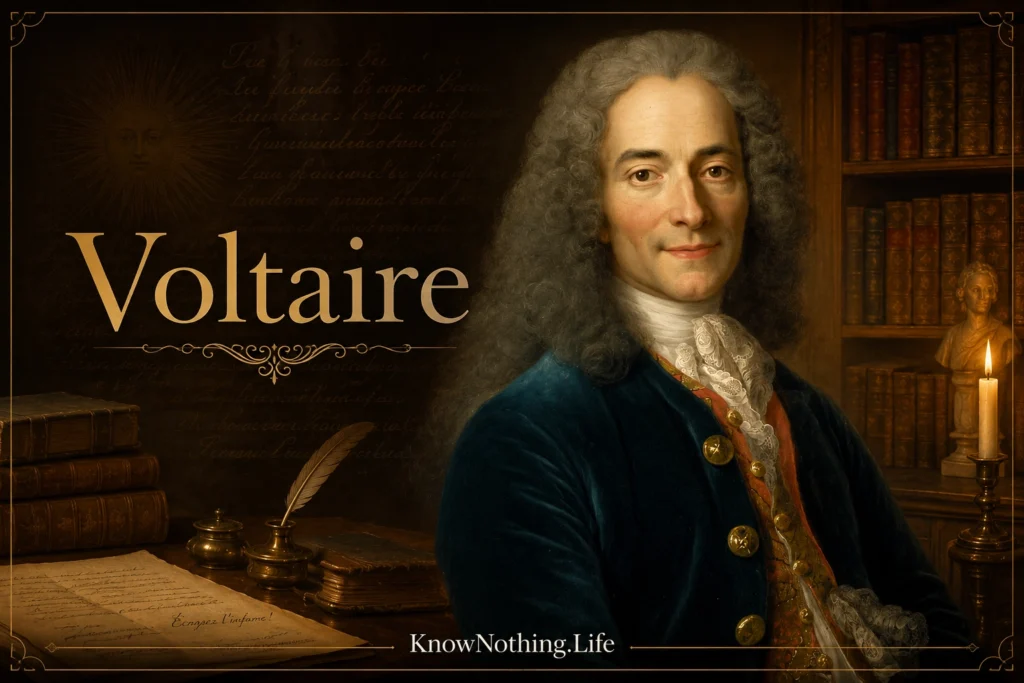
Voltaire was born François-Marie Arouet on November 21, 1694, in Paris, into a prosperous bourgeois family connected to the world of law, administration, and letters. His father wanted him to pursue a respectable legal career, but the young Arouet wanted the more dangerous life of a writer. Educated by Jesuits at the Collège Louis-le-Grand, he learned Latin, rhetoric, theater, and the literary models of classical France. From the beginning, he understood language as power: a sharp sentence could entertain, wound, defend, or overthrow.
His early years were marked by wit, ambition, and trouble. He moved in aristocratic and literary circles, but his talent for satire brought him into conflict with authority. He was imprisoned in the Bastille and, after his release, began using the name Voltaire. In 1718, his tragedy Œdipe became a major success, establishing him as a serious playwright. Yet theater was only the beginning. Voltaire would become poet, dramatist, historian, philosopher, satirist, pamphleteer, public campaigner, and one of the most recognizable voices of the Enlightenment.
England and the Making of a Philosophe
A humiliating quarrel with the aristocrat Chevalier de Rohan led to another crisis. Voltaire was briefly imprisoned and then left France for England in 1726. This exile changed him. In England, he encountered a society that seemed freer, more commercially open, and more tolerant than France. He studied English literature, admired Shakespeare despite later reservations, and absorbed the influence of John Locke, Isaac Newton, parliamentary government, religious pluralism, and public debate. He arrived as a celebrated French poet and left as a European philosophe.
The result was Letters on England, later known in France as Lettres philosophiques or Philosophical Letters, published in 1733–1734. The book praised English science, commerce, religious diversity, and intellectual freedom in ways that implicitly criticized France. One of its most famous lines says that “an Englishman, as one to whom liberty is natural, may go to heaven his own way.” The sentence captures Voltaire’s gift for making a political argument sound effortless. He did not merely praise England; he used England as a mirror in which France could see its own intolerance.
Cirey, Émilie du Châtelet, and Newtonian Science
The Philosophical Letters angered French authorities, and Voltaire found refuge at Cirey with Émilie du Châtelet, the brilliant mathematician, physicist, translator, and intellectual partner who became one of the most important figures in his life. Their relationship was romantic, scholarly, and collaborative. Cirey became a laboratory of Enlightenment learning, filled with books, instruments, correspondence, experiments, and debate. With Du Châtelet, Voltaire studied Newtonian physics and helped popularize Newton in France.
His Elements of the Philosophy of Newton, published in 1738, presented Newtonian science to a wider French audience and opposed the lingering dominance of Cartesian physics. Voltaire was not a great technical scientist in the way Du Châtelet was, but he was a powerful interpreter and publicist of scientific modernity. He saw empirical science as a weapon against empty metaphysics, superstition, and inherited dogma. For Voltaire, reason was not merely private reflection. It had to be made public, readable, and socially effective.
Historian, Courtier, and Restless Outsider
Voltaire also transformed historical writing. Works such as The Age of Louis XIV and Essay on the Customs and Spirit of Nations moved beyond dynastic chronicle and military narrative toward a broader history of civilization, manners, religion, commerce, art, and intellectual life. He helped make history less a record of kings alone and more an account of human culture. This was one of his major Enlightenment contributions: he asked how societies think, worship, produce, govern, and change.
Yet Voltaire was never comfortable in one role. He enjoyed fame, money, aristocratic company, and royal favor, but he also repeatedly quarreled with power. He spent time at the court of Frederick the Great in Prussia, where admiration turned into conflict. His satire of the scientist and academy president Maupertuis angered Frederick, and Voltaire eventually left Berlin under humiliating circumstances. He was both court intellectual and anti-authoritarian critic, insider and exile, performer and rebel. His life was a sequence of escapes from the very circles he had worked to enter.
Candide and the Art of Satire
In 1759, Voltaire published Candide, his most famous work of fiction and one of the sharpest satires ever written. The novella attacks naïve optimism, especially the idea that this is “the best of all possible worlds,” by sending its innocent hero through war, earthquake, execution, disease, betrayal, greed, slavery, and absurd philosophical consolation. The target is not hope itself, but the lazy habit of explaining suffering away with elegant systems. Voltaire’s genius lies in the speed of the book: disaster follows disaster so quickly that metaphysical optimism becomes ridiculous.
The ending is among the most famous in literature. After every theory collapses, Candide concludes that “we must cultivate our garden.” The line has been read in many ways: as resignation, practical wisdom, moral modesty, withdrawal from speculation, or a call to local responsibility. What it does not offer is a grand system. Voltaire’s answer to evil is not a perfect doctrine but useful work, reduced vanity, and attention to what human beings can actually improve. The sentence remains powerful because it is small enough to be livable.
Tolerance, Calas, and Public Justice
Voltaire’s later career made him not only a writer but a public campaigner. The most famous case was that of Jean Calas, a Protestant merchant in Toulouse who was wrongly accused of murdering his son to prevent him from converting to Catholicism. Calas was tortured and executed in 1762. Voltaire investigated, wrote, organized opinion, and helped overturn the conviction. The case gave concrete urgency to his hatred of judicial cruelty and religious fanaticism.
His Treatise on Tolerance, published in 1763, turned the Calas affair into a broader argument against persecution. In it, Voltaire writes that “tolerance never led to civil war; intolerance has covered the earth with carnage.” This was not abstract politeness. For Voltaire, tolerance was a civil necessity in a world where human beings are fallible, sectarian, proud, and easily inflamed by priests and rulers. His famous cry, “Écrasez l’infâme!” or “Crush the infamous thing,” was directed against fanaticism, superstition, and institutional cruelty, not against every form of religious belief.
Religion, Skepticism, and the Philosophical Dictionary
Voltaire was a deist, not an atheist. He rejected atheism as socially and philosophically dangerous, but he fiercely attacked priestcraft, miracles, sectarian hatred, biblical literalism, and religious violence. His view of God was closer to a rational order behind nature than to the dogmatic God of church authority. He wanted religion purified by reason, stripped of cruelty, and removed from coercive power. This is why he could mock theology while still defending belief in a creator.
His Philosophical Dictionary, published in 1764, gave this style one of its most influential forms. Instead of building a system, Voltaire wrote short, sharp entries on religion, politics, philosophy, history, and human folly. The book’s alphabetic structure matched his temperament: quick, mobile, ironic, and difficult to silence. He did not write like a professor constructing a cathedral of concepts. He wrote like a man throwing sparks into dry straw. His skepticism was not passive doubt; it was an active method for exposing pretension.
Ferney, Final Years, and Legacy
In 1759, Voltaire settled at Ferney, near the French-Swiss border, where he became a kind of unofficial monarch of the Enlightenment. From there he managed estates, built prosperity in the village, maintained vast correspondence, welcomed visitors, and continued writing at astonishing speed. The complete edition of his works eventually ran to hundreds of volumes, a sign not only of productivity but of range. Few writers have combined theater, fiction, poetry, history, philosophy, polemic, and political activism so completely.
Voltaire returned triumphantly to Paris in 1778, after decades away, and was celebrated like a living monument. He died on May 30 of that year. His legacy is complex: he could be vain, harsh, elitist, and inconsistent, yet he helped define modern ideals of free inquiry, religious tolerance, public criticism, and intellectual courage. He did not invent the Enlightenment, but he gave it a voice: witty, merciless, humane, theatrical, and unforgettable. Voltaire remains essential because he showed that laughter can be a form of resistance, and that a sentence, sharpened by reason, can become an instrument of justice.