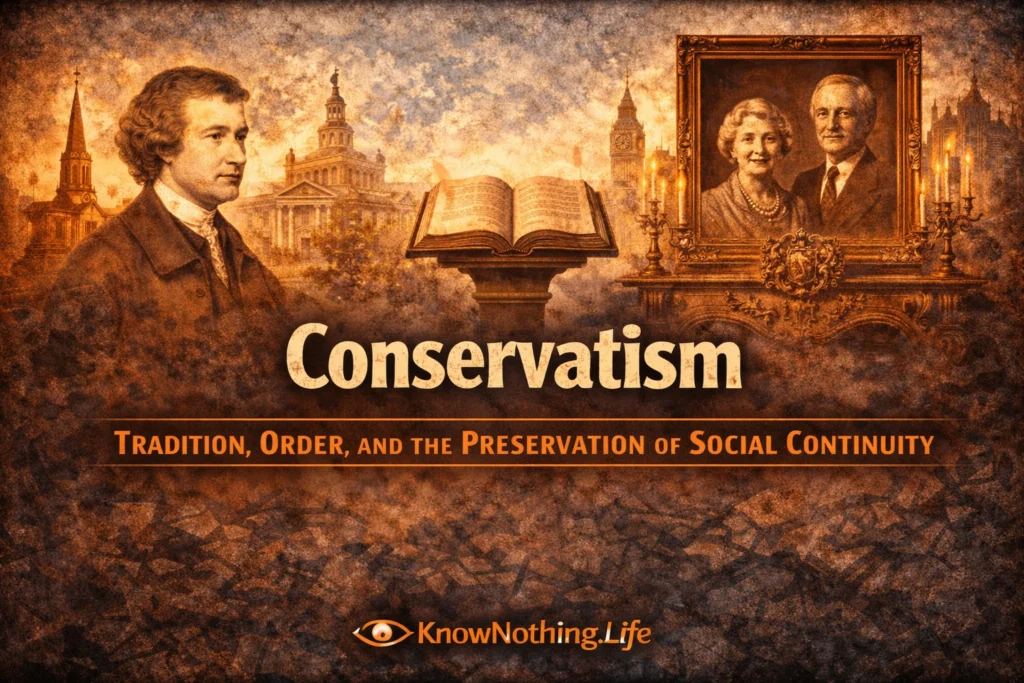
Conservatism is a political and philosophical tradition that emphasizes the value of tradition, social stability, and gradual change. Unlike ideologies that seek to radically transform society according to abstract principles, conservatism is rooted in a cautious approach to reform, grounded in the belief that existing institutions embody accumulated wisdom. It reflects a skepticism toward sweeping theoretical systems and a preference for practices that have evolved over time through experience and necessity.
At its core, conservatism is less a rigid doctrine than a disposition—a way of approaching political life that prioritizes continuity, prudence, and respect for inherited structures. It acknowledges that societies are complex and that attempts to redesign them from first principles often lead to unintended consequences. This perspective does not reject change altogether but insists that change should be incremental and guided by an understanding of historical context. In this sense, conservatism seeks to balance the need for adaptation with the importance of preserving what has proven valuable.
The Foundations of Conservative Thought
The modern articulation of conservatism is most closely associated with Edmund Burke, whose work Reflections on the Revolution in France offers a powerful critique of radical political change. Writing in response to the French Revolution, Burke argues that attempts to reconstruct society based on abstract ideals ignore the complexity of social institutions and the wisdom embedded in tradition. He famously describes society as “a partnership not only of the living, but of the dead and the unborn,” emphasizing the continuity of generations.
Burke’s critique is not a defense of all existing institutions but a warning against the dangers of rapid and untested change. He argues that traditions and customs develop over time in response to practical needs, and therefore deserve respect even if their rationale is not immediately apparent. This perspective introduces a key conservative principle: that knowledge is often tacit and embedded in practices rather than explicitly articulated in theories.
The conservative emphasis on tradition is complemented by a recognition of human limitations. Burke and other conservative thinkers argue that reason alone is insufficient to fully understand or control complex social systems. This skepticism toward rationalism distinguishes conservatism from ideologies that rely heavily on abstract principles, reinforcing its preference for gradual reform and empirical observation.
Authority, Hierarchy, and Social Order
Conservatism places significant importance on authority and social order, viewing them as essential for maintaining stability and cohesion. While liberalism often emphasizes individual autonomy, conservatism highlights the role of institutions such as family, religion, and community in shaping moral and social life. These institutions provide a framework within which individuals develop their identities and values.
The acceptance of hierarchy is another distinguishing feature of conservative thought. Conservatives generally argue that inequalities in status and authority are natural and, in many cases, beneficial. These hierarchies can reflect differences in experience, responsibility, or contribution, and they contribute to the functioning of social systems. However, this does not imply that all forms of inequality are justified; rather, it reflects a belief that attempts to impose strict equality can disrupt social order and undermine stability.
Thomas Hobbes, though not a conservative in the modern sense, provides a foundational argument for the importance of authority in Leviathan. His emphasis on the need for a strong sovereign to prevent disorder aligns with the conservative concern for stability, even if his conclusions differ from later conservative thinkers. This shared focus on order underscores the importance of authority in maintaining a functioning society.
Conservatism and Change
Contrary to common misconceptions, conservatism does not oppose change outright. Instead, it advocates for a measured and cautious approach to reform. Change is seen as necessary but potentially disruptive, requiring careful consideration of its consequences. This perspective is often described as “pragmatic” rather than ideological, emphasizing practical outcomes over theoretical consistency.
Michael Oakeshott articulates this view in his essay “On Being Conservative,” where he describes conservatism as a preference for the familiar over the unknown. Oakeshott argues that change should be approached with humility, recognizing that existing arrangements, even if imperfect, have developed through experience. This does not mean resisting all reform, but rather ensuring that changes are compatible with established practices.
This cautious approach reflects a broader skepticism toward utopian thinking. Conservatives often argue that attempts to create perfect societies overlook the complexities of human nature and social life. By emphasizing gradual improvement rather than radical transformation, conservatism seeks to avoid the unintended consequences that can arise from ambitious but unrealistic projects.
Conservatism, Markets, and the State
Conservatism’s relationship with economic policy has evolved over time, particularly in its engagement with market systems. Many conservative thinkers support free markets as a means of promoting efficiency, innovation, and individual responsibility. This perspective aligns with aspects of classical liberalism, particularly the work of Adam Smith in The Wealth of Nations. However, conservatism tends to place greater emphasis on the social and moral context of economic activity.
Rather than viewing markets as purely self-regulating systems, conservatives often stress the importance of cultural and institutional frameworks that support economic life. These include norms of trust, responsibility, and community, which are seen as essential for the proper functioning of markets. Without these foundations, economic freedom can lead to instability and social fragmentation.
At the same time, conservatism generally favors a limited but effective state. The state’s role is to maintain order, enforce laws, and protect the conditions necessary for social and economic life. While excessive intervention is viewed with suspicion, conservatives recognize that certain functions—such as national defense, infrastructure, and basic welfare—are essential for maintaining stability and cohesion.
Critiques of Conservatism
Conservatism has faced criticism from various perspectives, particularly for its emphasis on tradition and hierarchy. Critics argue that this focus can lead to the preservation of unjust institutions and resistance to necessary reforms. Karl Marx, for example, criticizes conservative thought for defending existing power structures and failing to address underlying inequalities. In works such as Capital, Marx argues that social and economic systems must be transformed to achieve genuine justice.
Other critiques focus on the potential for conservatism to prioritize stability over progress. By emphasizing caution and continuity, conservatives may be seen as reluctant to address urgent issues such as social inequality, environmental challenges, or systemic injustice. This tension reflects a broader debate about the balance between preserving what works and addressing what does not.
Nevertheless, defenders of conservatism argue that these critiques underestimate the risks of rapid change and the value of institutional continuity. They contend that conservatism provides a necessary counterbalance to more radical ideologies, ensuring that reform is grounded in practical experience and historical understanding.
The Enduring Role of Conservatism
Conservatism remains a vital part of political discourse because it addresses fundamental concerns about stability, continuity, and the limits of human knowledge. Its emphasis on tradition and gradual change offers a perspective that complements more reform-oriented ideologies, contributing to a more balanced approach to political life.
In contemporary society, conservatism continues to evolve, responding to new challenges while maintaining its core principles. Issues such as globalization, technological change, and cultural transformation require ongoing reflection about the role of tradition and the pace of change. These developments demonstrate that conservatism is not static but adaptable, capable of engaging with new realities while preserving its foundational insights.
Ultimately, conservatism is defined by its commitment to preserving the conditions that make social life possible. It recognizes that while change is inevitable, it must be guided by an understanding of the past and a respect for the complexity of human institutions. In doing so, it offers a framework for navigating the tensions between continuity and transformation in an ever-changing world.