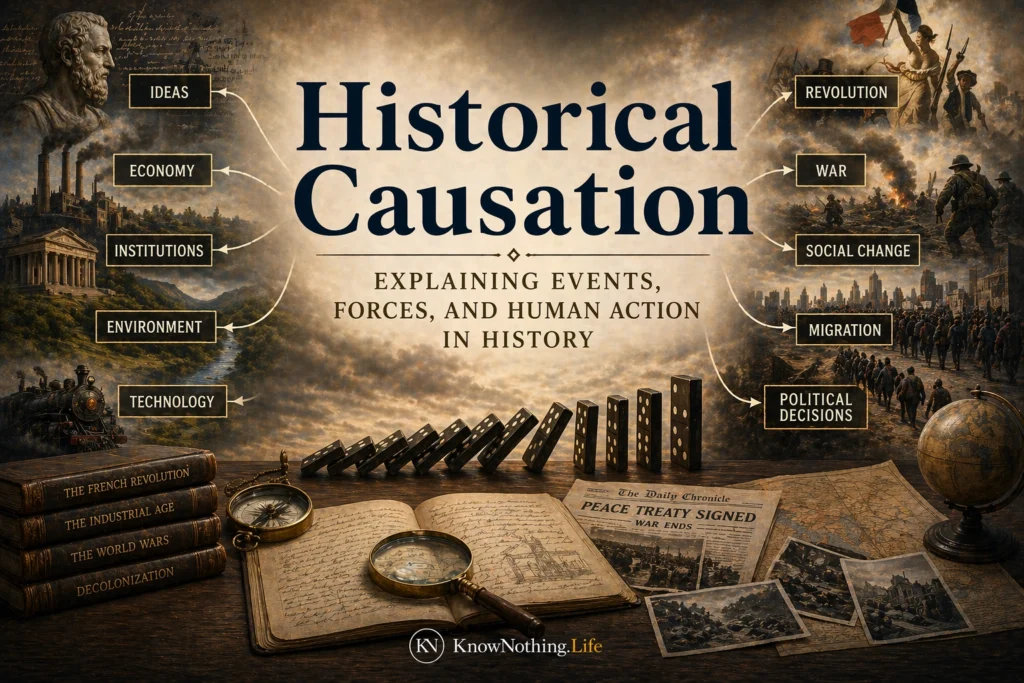
Historical causation concerns one of the most fundamental questions in the study of the past: why do events happen? While history records what occurred, the deeper task of explanation requires identifying the causes that produced those outcomes. Unlike simple chronological description, causation seeks to uncover the relationships between actions, conditions, and consequences. It is not enough to say that something happened; historians aim to understand how and why it happened in the way that it did.
The challenge of historical causation lies in its complexity. Events rarely have a single cause; instead, they emerge from a web of interacting factors, including economic conditions, political structures, cultural beliefs, and individual decisions. This complexity raises important philosophical questions about how causes are identified, how they are prioritized, and whether causal explanations in history can ever achieve the clarity found in the natural sciences. The study of historical causation thus becomes an inquiry into both explanation and interpretation.
What Counts as a Cause?
Determining what qualifies as a cause in history is not straightforward. A cause is typically understood as a factor that contributes to the occurrence of an event, but this definition leaves room for interpretation. Some causes are immediate and visible, such as a political decision or a specific action, while others are underlying and structural, such as economic inequality or long-standing social tensions.
Historians must distinguish between necessary and sufficient causes, as well as between proximate and remote causes. A proximate cause might trigger an event directly, while a remote cause creates the conditions that make the event possible. For example, a single incident may ignite a conflict, but deeper systemic issues often explain why that conflict occurred at all. Understanding these layers requires careful analysis, as emphasizing one type of cause over another can significantly shape the narrative of history.
Individual Agency vs Structural Forces
One of the central debates in historical causation concerns the role of individuals versus broader structural forces. Some explanations focus on the actions and decisions of key figures, suggesting that history is shaped by the choices of influential individuals. This perspective highlights the importance of leadership, intention, and contingency, emphasizing that different decisions could have led to different outcomes.
In contrast, structural approaches argue that individuals operate within constraints imposed by economic systems, social institutions, and cultural norms. From this viewpoint, historical outcomes are less about individual decisions and more about the underlying conditions that shape those decisions. The work of Karl Marx exemplifies this approach, emphasizing material conditions and class dynamics as driving forces. The tension between agency and structure remains a key issue, as most historical explanations involve a combination of both.
Causation and Interpretation
Historical causation is inseparable from interpretation. The selection of causes reflects the historian’s perspective, priorities, and theoretical framework. Different historians may identify different causes for the same event, depending on the questions they ask and the evidence they emphasize. This does not necessarily imply that all interpretations are equally valid, but it does highlight the role of judgment in historical explanation.
Philosophers such as R. G. Collingwood argued that understanding history involves reconstructing the intentions and reasoning of historical actors. According to this view, causes are not merely external conditions but include the thoughts and motivations that guided human actions. This interpretive dimension underscores the idea that historical causation is not simply discovered but constructed through analysis and understanding.
Multiple Causation and Complexity
Most historical events result from multiple interacting causes rather than a single determining factor. This concept of multiple causation reflects the complexity of human societies, where economic, political, cultural, and environmental influences intersect. For example, a revolution may be influenced by economic hardship, political oppression, ideological movements, and external pressures, all of which contribute to the outcome.
The challenge for historians is to analyze these interactions without oversimplifying them. Assigning weight to different causes requires careful reasoning, as emphasizing one factor may obscure the significance of others. This complexity makes historical causation less precise than scientific explanation but also more reflective of the realities of human life. The goal is not to reduce events to a single cause but to understand the interplay of factors that shape them.
Determinism and Contingency
The debate between determinism and contingency is central to the philosophy of historical causation. Deterministic approaches suggest that events are the inevitable result of underlying conditions or laws, implying that history follows a predictable path. This perspective often emphasizes large-scale forces, such as economic systems or technological developments, as the primary drivers of change.
Contingency, on the other hand, highlights the role of chance, unpredictability, and individual decisions. From this viewpoint, history could have unfolded differently if certain events or choices had been different. The assassination of a political leader, for instance, may alter the course of events in ways that cannot be fully predicted. The tension between determinism and contingency reflects broader questions about whether history is governed by necessity or shaped by possibility.
Causal Explanation vs Narrative
Historical causation is closely tied to narrative, as explanations are often presented through stories that connect events in meaningful ways. Narratives provide coherence, linking causes and effects into a sequence that can be understood and communicated. However, the narrative form can also influence how causation is perceived, as the structure of a story may emphasize certain causes while downplaying others.
The philosopher Hayden White argued that historical narratives are shaped by literary conventions, suggesting that the way history is told affects how it is understood. This perspective raises important questions about the relationship between explanation and storytelling, highlighting the need for critical awareness in constructing and interpreting historical accounts.
Evidence and Justification
Causal claims in history must be supported by evidence, but the nature of historical evidence presents unique challenges. Unlike experiments in the natural sciences, historical events cannot be reproduced or tested under controlled conditions. Historians must rely on available sources, which may be incomplete, biased, or ambiguous.
To justify causal explanations, historians use methods such as comparison, corroboration, and contextual analysis. They examine patterns across different cases, assess the reliability of sources, and consider alternative explanations. While certainty is often unattainable, rigorous methodology allows historians to develop plausible and well-supported accounts. The strength of a causal explanation lies not in absolute proof but in its ability to account for evidence and withstand critical scrutiny.
Moral and Ethical Dimensions
Historical causation also has moral and ethical implications. Explaining why events occurred often involves assigning responsibility, whether to individuals, groups, or systems. These judgments can influence how history is remembered and how contemporary societies understand issues such as justice, accountability, and reconciliation.
For example, attributing causation to structural forces may shift attention away from individual responsibility, while focusing on individual actions may overlook systemic factors. Balancing these perspectives is essential for a nuanced understanding of history. The ethical dimension of causation underscores the importance of careful and responsible interpretation, as historical explanations can shape public discourse and collective memory.
Conclusion
Historical causation is a complex and multifaceted concept that lies at the heart of understanding the past. It involves identifying and analyzing the factors that produce events, balancing the roles of individual agency and structural forces, and navigating the interplay between determinism and contingency. Far from being a simple task, explaining history requires careful interpretation, critical evaluation of evidence, and an awareness of the limitations inherent in historical knowledge.
By examining how causes are constructed and justified, the philosophy of historical causation provides deeper insight into the nature of historical explanation. It reveals that history is not merely a sequence of events but a dynamic process shaped by multiple influences and perspectives. In doing so, it encourages a more thoughtful and critical engagement with the past, recognizing both the complexity of human experience and the challenges of understanding it.