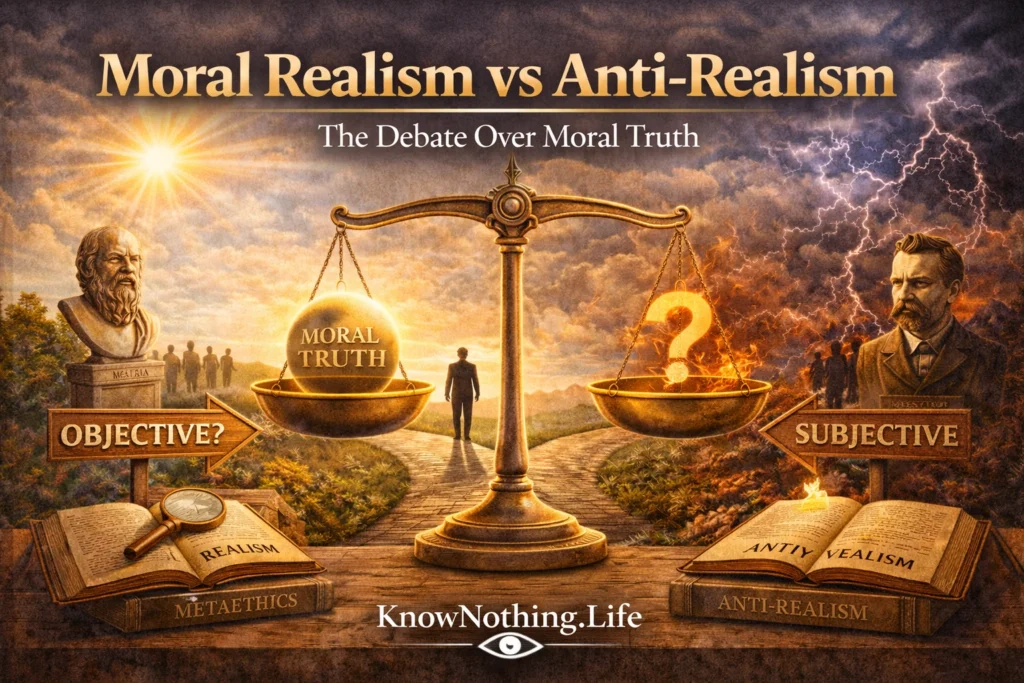
Few debates in philosophy cut as deeply into the foundations of ethics as the question of whether moral truths are real. At stake is not simply how we should act, but whether moral claims—statements like “justice is good” or “cruelty is wrong”—correspond to objective features of the world or merely reflect human attitudes, conventions, or errors. This divide between moral realism and moral anti-realism lies at the heart of metaethics, shaping how philosophers understand the nature of morality, truth, and human judgment.
Moral realism holds that there are objective moral facts—truths about right and wrong that exist independently of individual beliefs or cultural norms. When someone says that an act is wrong, the realist interprets this as a claim that can be true or false in a robust, mind-independent sense. By contrast, moral anti-realism denies this independence. Anti-realists argue that moral claims do not refer to objective facts, but instead arise from subjective attitudes, social agreements, or systematic misconceptions about the world.
This debate is not merely theoretical. It influences how we think about moral disagreement, responsibility, and progress. If moral truths are objective, then ethical disputes may have correct answers waiting to be discovered. If they are not, then morality may be more akin to a human invention—flexible, contingent, and deeply tied to culture and psychology. Understanding this divide is essential for grasping the deeper structure of ethical thought.
The Case for Moral Realism
Moral realism is grounded in the intuition that some moral claims are simply true, regardless of what anyone believes. Acts such as torture, slavery, or genocide are widely regarded as wrong not merely because societies condemn them, but because they violate fundamental moral truths. Realists argue that this sense of objectivity is not an illusion, but a reflection of genuine moral facts that exist independently of human opinion.
Philosophers such as Thomas Nagel have defended moral realism by appealing to the idea of objectivity in human reasoning. In works like The View from Nowhere, Nagel argues that just as we can step back from subjective perspectives in science and logic, we can also adopt an objective standpoint in ethics. From this perspective, moral truths are not reducible to personal preferences but are accessible through rational reflection. This supports the idea that moral disagreement is not merely a clash of attitudes, but a dispute about what is actually the case.
Another influential defender of moral realism is Derek Parfit, whose work On What Matters argues that moral truths are irreducible and necessary. Parfit contends that some normative truths—such as the wrongness of causing unnecessary suffering—are self-evident upon reflection. “When we have strong reasons to act in certain ways,” he suggests, “these reasons are not created by our beliefs but discovered by them.” This view reinforces the realist commitment to moral objectivity, suggesting that ethical inquiry can yield genuine knowledge about how we ought to live.
The Case for Moral Anti-Realism
Moral anti-realism challenges the idea that moral truths exist independently of human thought. According to this perspective, moral claims do not describe objective features of the world but instead reflect subjective attitudes, cultural norms, or conceptual frameworks. Anti-realists argue that the apparent objectivity of morality is either an illusion or a useful fiction.
One of the most influential anti-realist positions is error theory, developed by J. L. Mackie in Ethics: Inventing Right and Wrong. Mackie argued that while moral language presupposes the existence of objective values, no such values actually exist. He described moral properties as “queer”—strange entities that would be unlike anything else in the natural world—and concluded that our moral discourse is systematically false. According to Mackie, when we say that something is wrong, we are making a claim that purports to be true but ultimately lacks a real referent.
Other forms of anti-realism take a less skeptical approach. David Hume, for example, argued that moral judgments are grounded in human sentiment rather than objective facts. In A Treatise of Human Nature, he wrote that morality is “more properly felt than judged,” suggesting that ethical evaluations arise from emotional responses rather than rational discoveries. Similarly, non-cognitivist theories, such as those proposed by A. J. Ayer in Language, Truth and Logic, interpret moral statements as expressions of approval or disapproval rather than factual claims. These perspectives emphasize the human origins of morality, highlighting its dependence on psychological and social factors.
Moral Language and Meaning
A central issue in the realism vs anti-realism debate concerns the meaning of moral language. When we make moral statements, are we describing facts about the world, or are we expressing attitudes, prescriptions, or commitments? This question has led to the development of competing theories about how moral language functions.
Cognitivists, often aligned with moral realism, argue that moral statements are propositions that can be true or false. According to this view, saying “stealing is wrong” is analogous to saying “water boils at 100°C”—both are claims about the world that can be evaluated for truth. This interpretation supports the idea that moral discourse is a form of knowledge-seeking inquiry, where arguments and evidence can lead to correct conclusions.
Non-cognitivists, by contrast, argue that moral statements do not express beliefs but rather attitudes or prescriptions. R. M. Hare, in The Language of Morals, proposed that moral statements function as universalizable commands—ways of guiding action rather than describing reality. This perspective explains why moral language often carries emotional force and motivates behavior, but it also raises questions about whether moral disagreements can be resolved through rational argument. If moral claims are not truth-apt, then disagreement may reflect differing attitudes rather than conflicting beliefs.
Disagreement, Relativism, and Objectivity
One of the strongest challenges to moral realism comes from the diversity of moral beliefs across cultures and historical periods. If moral truths are objective, why do people disagree so profoundly about issues such as justice, rights, and social norms? Anti-realists often point to this variation as evidence that morality is shaped by cultural and psychological factors rather than grounded in universal truths.
Moral relativism, a form of anti-realism, holds that moral truths are relative to specific cultures or individuals. According to this view, there is no single correct moral framework; instead, different societies may have their own valid moral systems. This perspective emphasizes tolerance and the importance of understanding moral practices within their cultural context. However, critics argue that relativism undermines the possibility of moral criticism, making it difficult to challenge practices such as oppression or injustice.
Realists respond by arguing that disagreement does not necessarily imply the absence of truth. In science, disagreement is common, yet it does not lead us to conclude that there are no objective facts about the natural world. Similarly, moral disagreements may reflect differences in information, reasoning, or perspective rather than the absence of moral truth. As Thomas Nagel suggests, the possibility of error presupposes the existence of truth, reinforcing the realist position that moral inquiry aims at objective understanding.
Contemporary Perspectives and Ongoing Debates
The debate between moral realism and anti-realism continues to evolve, with contemporary philosophers exploring new approaches that seek to bridge the divide. Some theorists adopt constructivist positions, arguing that moral truths are not discovered but constructed through rational procedures or social practices. Christine Korsgaard, for example, has argued that moral obligations arise from the requirements of practical reason and the need for self-consistency, offering a middle ground between realism and anti-realism.
Others have developed hybrid theories that combine elements of both perspectives. These approaches recognize the role of human attitudes and cultural contexts while maintaining that certain moral principles have a degree of objectivity. Advances in psychology and neuroscience have also influenced the debate, shedding light on how moral judgments are formed and how they might be shaped by evolutionary and social factors.
Despite these developments, the core questions remain unresolved. Are moral truths out there waiting to be discovered, or are they products of human thought and experience? Can ethical disagreements be objectively resolved, or are they inherently subjective? These questions continue to challenge philosophers and shape the future of ethical inquiry.
Conclusion
The debate between moral realism and anti-realism lies at the foundation of metaethics, raising profound questions about the nature of moral truth, the meaning of ethical language, and the possibility of moral knowledge. Realists argue for the existence of objective moral facts, grounded in reason and accessible through reflection. Anti-realists, by contrast, emphasize the human origins of morality, viewing ethical claims as expressions of attitude, culture, or error.
Through the work of philosophers such as Thomas Nagel, Derek Parfit, J. L. Mackie, and David Hume, this debate has developed into one of the most dynamic areas of contemporary philosophy. Each perspective offers valuable insights, yet neither provides a definitive resolution.
Ultimately, the significance of this debate extends beyond philosophy. It shapes how we understand moral responsibility, navigate disagreement, and pursue justice. Whether moral truths are objective or constructed, the effort to understand them remains a central and enduring aspect of human life.