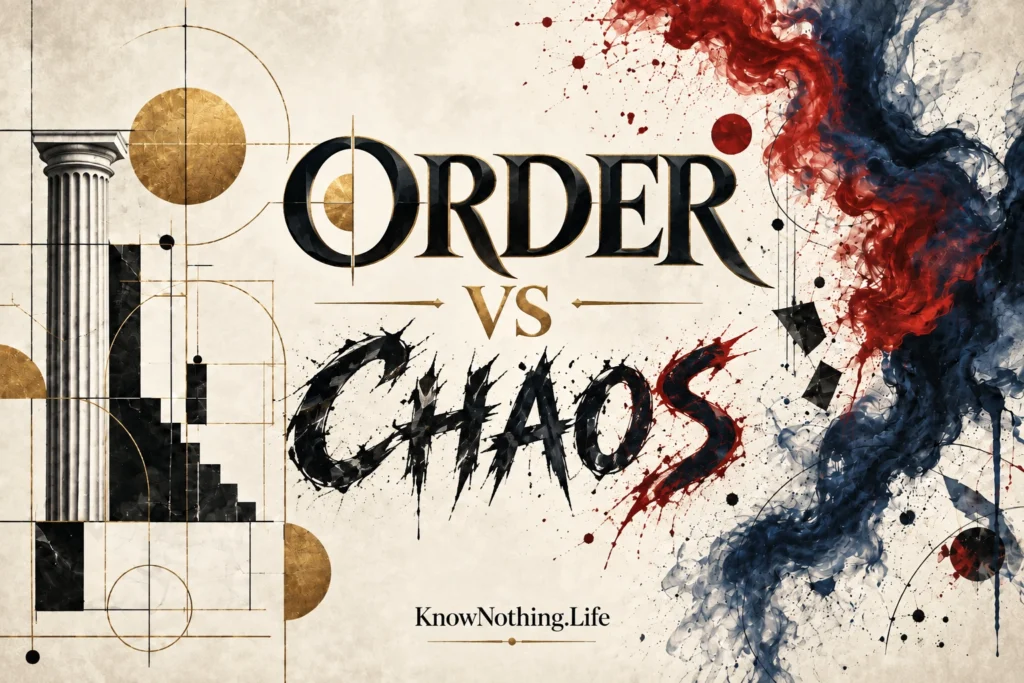
Few oppositions appear as fundamental as order and chaos. Order suggests pattern, stability, law, hierarchy, predictability, and intelligibility. Chaos suggests uncertainty, disruption, unpredictability, dissolution, and possibility. Political societies try to establish order through laws. Individuals create routines to organize their lives. Scientists search for regularities in nature. Religions and mythologies frequently describe creation as the emergence of an ordered world from some primordial condition. Yet excessive order can become rigidity, stagnation, or tyranny, while chaos can produce creativity, adaptation, and entirely new forms.
The philosophical difficulty is that order and chaos are not simple enemies. Life appears to require both. A world of perfect disorder would possess no stable relationships from which organisms, knowledge, societies, or identities could emerge. But a world of perfect order would contain no meaningful novelty or transformation. Across ancient cosmology, political philosophy, Daoism, Nietzsche’s philosophy, modern psychology, and the science of nonlinear systems, the same possibility repeatedly appears: order and chaos may be mutually dependent forces, with each becoming destructive when it completely eliminates the other.
What Do We Mean by Order and Chaos?
In ordinary language, chaos means confusion. Philosophically, however, the concept has carried several different meanings. In Hesiod’s Theogony, one of the oldest surviving Greek cosmological texts, Chaos is the first thing to come into existence, followed by Earth, Tartarus, and Eros. Hesiod’s Chaos was not necessarily the modern idea of random disorder; the Greek term can suggest a gap, opening, or yawning emptiness. Nevertheless, the image became enormously influential: before the recognizable structure of the world appears, there is an indeterminate beginning from which distinctions gradually emerge.
Order likewise means more than neatness. The Greek word kosmos could mean an arrangement or ordered whole and eventually came to designate the world itself. To call reality a cosmos is already to make a philosophical claim: beneath apparent confusion there is some kind of intelligible structure. Laws of nature, mathematical relationships, social institutions, moral principles, categories, languages, habits, and identities are all forms of ordering. Order makes reality navigable. It allows one thing to be distinguished from another and makes expectations possible. But every order also excludes possibilities. A rule makes certain actions legitimate by making others illegitimate; a category clarifies reality by drawing boundaries through it.
Heraclitus and the Order Hidden Inside Conflict
The pre-Socratic philosopher Heraclitus provides one of philosophy’s earliest challenges to the idea that order requires stillness. He is famous for emphasizing continual change, but his surviving fragments do not describe reality as meaningless disorder. Heraclitus speaks of a logos, an intelligible principle common to all things, and describes the world as an “everliving fire” changing according to measures. The Stanford Encyclopedia of Philosophy notes that Heraclitus uses kosmos in one of the earliest surviving Greek passages where the term signifies the world as an ordered whole.
What makes Heraclitus especially relevant to order and chaos is his insistence that opposition can itself generate order. He compares reality to the tension of a bow or lyre: opposing forces do not necessarily destroy a system; their tension may be what holds it together. His notorious statement that “war is the father of all” is less a celebration of warfare than a metaphysical recognition that difference, resistance, and struggle drive transformation. A society without disagreement, a mind without competing impulses, or an ecosystem without opposing pressures might appear peaceful, but complete equilibrium can also mean lifelessness. Heraclitus suggests that stability itself may be a temporary pattern created by movement.
Plato, Hobbes, and the Human Desire for Order
Other philosophers have emphasized the dangers of disorder more strongly. In Plato’s Republic, justice is closely associated with proper arrangement. The individual soul and the political state are treated analogously: harmony occurs when different parts perform their appropriate functions rather than competing to dominate the whole. Plato‘s political philosophy can therefore be understood as an attempt to overcome disorder through rational structure, education, specialization, and rule by those capable of understanding the good. The dialogue continually connects justice with harmony and internal organization rather than simply obedience to isolated rules.
Thomas Hobbes makes the political fear of chaos even more explicit in Leviathan (1651). Hobbes imagines what human existence might become without a common political authority strong enough to enforce agreements. The famous state of nature is not chaotic because people are irrational monsters; it becomes dangerous because insecurity makes cooperation unstable. Without a dependable power capable of enforcing rules, suspicion becomes rational. Hobbes therefore describes the commonwealth as an “artificial man” created to secure protection and peace, comparing laws and institutions to the systems that coordinate a living body. For Hobbes, political order is not merely aesthetically preferable to chaos. It is the structure that makes ordinary life possible.
When Too Much Order Becomes Its Own Disorder
Yet the attempt to eliminate chaos can itself become destructive. A society terrified of instability can respond by regulating more and more areas of life until security becomes domination. Political history repeatedly illustrates this paradox: the promise to abolish uncertainty can justify censorship, surveillance, ideological conformity, or authoritarian rule. Order stops serving human beings and human beings begin serving order. Philosophically, this raises a permanent problem for political theory: how much unpredictability must a free society tolerate?
The same tension occurs within individuals. Habits, rules, schedules, traditions, and identities provide psychological stability, but they can harden into prisons. Someone who organizes every aspect of life to prevent surprise may protect themselves from some dangers while also eliminating experimentation and growth. A perfectly stable identity would never learn anything that required becoming different. Order becomes unhealthy when its purpose changes from organizing life to preventing life from changing.
Daoism and the Problem of Forced Order
Classical Daoist philosophy approaches the problem from a very different direction. Texts associated with the Laozi repeatedly warn against excessive interference, artificial distinctions, and attempts to force reality into rigid human schemes. The ideal of wu wei, usually translated as nonaction or effortless action, does not mean literally doing nothing. It points toward action that cooperates with the tendencies of a situation instead of constantly attempting to dominate them. The related concept of ziran, often rendered as naturalness or spontaneity, describes an order that emerges from things developing according to their own nature.
This produces an important reversal. What appears disorderly to a controlling mind may possess its own pattern. The Daoist problem is therefore not simply chaos but artificial over-ordering. A ruler who constantly intervenes can produce the very instability the ruler wishes to prevent, just as a person who consciously tries to control every movement can become clumsy. The Daodejing nevertheless does not celebrate careless disorder; its advice includes attending to emerging patterns before they become difficult to manage. Modern scholarship notes its instruction to “set things in order before they become chaotic.” The wisdom lies in distinguishing genuine order from compulsive control.
Nietzsche, Apollo, Dionysus, and Creative Chaos
Friedrich Nietzsche gave perhaps the most famous philosophical defense of chaos as a creative force. In The Birth of Tragedy, he interprets Greek culture through two symbolic impulses. The Apollonian represents form, boundaries, clarity, individuality, and beautiful appearance. The Dionysian represents intoxication, dissolution of boundaries, instinct, excess, suffering, and participation in something larger than the individual self. Nietzsche’s crucial point is that great Greek tragedy did not choose one over the other. It emerged through their tension and temporary reconciliation.
Nietzsche later makes the relationship between chaos and creativity even more explicit in Thus Spoke Zarathustra: “one must still have chaos in one, to give birth to a dancing star.” The line is frequently reduced to an inspirational slogan, but philosophically it expresses something deeper. Creation requires the disruption of established forms. Artists must sometimes abandon familiar conventions; thinkers must risk previously secure beliefs; individuals undergoing transformation may experience a period in which their old identity no longer works while a new one does not yet exist. Chaos is frightening precisely because possibilities have not yet settled into form. Nietzsche’s insight is that this unsettled condition can be generative rather than merely defective.
Chaos Theory Changed What “Chaos” Means
Twentieth-century science complicated the philosophical distinction further. Chaos theory demonstrated that systems can follow deterministic rules while still producing behavior that is extraordinarily difficult to predict. Meteorologist Edward Lorenz’s landmark 1963 paper, “Deterministic Nonperiodic Flow,” showed that nonlinear systems could be highly sensitive to small differences in initial conditions: slightly different starting states could eventually produce dramatically different outcomes. Modern philosophy of science therefore distinguishes mathematical chaos from simple randomness. Chaotic systems remain governed by equations; their unpredictability does not necessarily imply the absence of law.
This is philosophically significant because it destroys a tempting equation: order is not the same thing as predictability. A system can possess precise underlying rules and nevertheless resist long-range prediction. Human beings frequently assume that understanding the rules governing something should make its future controllable. Chaos theory shows why this expectation can fail. Weather, ecological systems, economies, and perhaps many social processes contain feedback relationships in which small variations accumulate. Reality can therefore be lawful without being easily foreseeable.
Order Can Emerge From Disorder
The work of physical chemist Ilya Prigogine provides an equally important reversal. Prigogine, awarded the 1977 Nobel Prize in Chemistry for work on nonequilibrium thermodynamics, studied what became known as dissipative structures. Far from equilibrium, certain systems can spontaneously develop new organized patterns. Fluctuations that might initially appear to be disturbances can contribute to the formation of new structures. Prigogine explicitly described such phenomena as “order through fluctuations.”
The philosophical temptation is to turn this into a universal metaphor, and that should be resisted: thermodynamic results do not automatically prove theories about societies or personal growth. But they do demonstrate something important about nature. Disorder and organization do not always exist in a zero-sum relationship. Under some conditions, instability becomes part of the mechanism through which a different order arises. The collapse of one pattern may create the conditions for another. In this limited but powerful sense, nature itself challenges the assumption that stability is always constructive and disruption always destructive.
Why Humans Crave Order
The struggle between order and chaos is not only metaphysical or political; it is psychological. Human beings are prediction-making organisms. Goals, beliefs, routines, and explanatory models reduce the number of possible interpretations and actions confronting us. Jacob Hirsh, Raymond Mar, and Jordan Peterson’s 2012 entropy model of uncertainty proposed that conflicting possibilities increase psychological uncertainty and that clear goals and belief structures help constrain it. Their framework connects heightened uncertainty with anxiety and treats uncertainty management as an important adaptive problem.
Yet uncertainty is not uniformly harmful. A large experience-sampling study and subsequent experiments found that experimentally heightened uncertainty could increase savoring of positive experiences in the present moment. This provides a psychological parallel to the philosophical argument: human beings need enough order to orient themselves, but complete predictability may reduce attentiveness, exploration, and appreciation. We want to know what tomorrow will bring, yet a life in which tomorrow contains absolutely nothing unexpected would be strangely impoverished.
Order and Chaos Are Not Enemies
The deepest mistake may therefore be treating order and chaos as two armies from which philosophy must choose a winner. Order gives continuity to identity, societies, knowledge, and relationships. Chaos introduces variation, novelty, challenge, and the possibility of transformation. Without order, nothing stable can develop. Without disruption, existing structures become permanent simply because they already exist.
A healthy society consequently needs laws but also mechanisms through which laws can change. A healthy mind needs identity but also the ability to revise its self-understanding. Scientific knowledge requires established theories but advances when anomalies force those theories to change. Art requires form, but new forms frequently arise by violating previous conventions. Even biological systems survive not by remaining perfectly unchanged but by maintaining organization while adapting to changing environments.
The philosophical question is therefore not “Should we choose order or chaos?” It is “What deserves to remain stable, and what must be allowed to change?” Heraclitus saw harmony in opposing tensions. Hobbes understood why political order protects human life. Daoism warned that excessive control can violate the patterns it tries to manage. Nietzsche recognized the creative potential of instability. Lorenz showed that lawful systems can remain unpredictable, while Prigogine demonstrated that new forms of organization can arise under conditions far from equilibrium.
Order without chaos becomes rigidity. Chaos without order becomes dissolution. Between them lies the possibility of a world capable of remaining coherent and becoming something new.