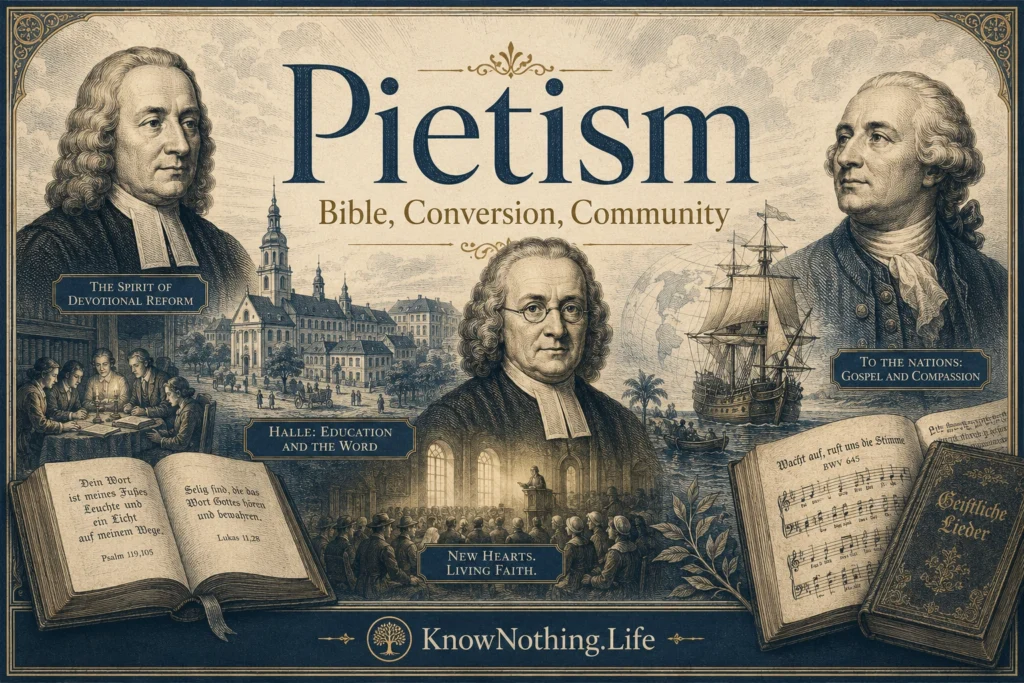
Pietism was one of the most influential movements in the history of Protestant Christianity, yet its importance is often overshadowed by the Reformation that preceded it and the Enlightenment that developed alongside it. Emerging most clearly in German Lutheran territories during the late seventeenth century, Pietism attempted to move Christianity beyond doctrinal correctness and institutional membership toward a religion that could be experienced, practiced, and demonstrated in everyday life. Its advocates emphasized Bible reading, conversion, personal devotion, moral transformation, small religious gatherings, charitable activity, education, and what later generations would call a religion of the heart. Although Pietists usually considered themselves faithful heirs of Martin Luther rather than founders of a new denomination, they believed the Protestant Reformation had left unfinished work. Correct theology, they argued, meant little if it did not create changed human beings.
The movement became extraordinarily diverse. Philipp Jakob Spener provided its most famous early program in Pia Desideria in 1675; August Hermann Francke transformed Pietist ideals into schools, orphanages, publishing enterprises, and missionary networks centered at Halle; Nikolaus Ludwig von Zinzendorf helped channel Pietist spirituality into the renewed Moravian Church; and Moravian encounters later influenced John Wesley and the development of Methodism. Other forms of Pietism developed in Württemberg, Scandinavia, Switzerland, the Netherlands, Britain, and North America. Modern scholars therefore describe Pietism less as one tightly controlled organization than as a broad religious, social, and cultural renewal movement whose different branches shared an emphasis on lived Christianity, individual responsibility, and spiritual transformation. Oxford historian Hartmut Lehmann describes early modern Pietism as the most important Protestant renewal movement in central Europe after the Reformation.
The Religious World That Produced Pietism
Pietism emerged from a Protestant Europe that had spent generations defending confessional boundaries. After Luther’s break with Rome, Lutheran theologians devoted enormous energy to defining and protecting doctrine against Roman Catholicism, Calvinism, Anabaptism, and competing interpretations within Protestantism itself. Confessional precision had understandable historical reasons, but critics increasingly feared that Christianity was becoming identified with possessing the correct theological formulas. The devastation and disruption associated with the Thirty Years’ War of 1618–1648 further intensified questions about the moral and spiritual condition of Christian Europe. Pietists did not generally reject Lutheran theology. Rather, they questioned what happened when theological orthodoxy existed without visible transformation in the lives of ordinary Christians. Modern scholarship accordingly places Pietism within the crises of seventeenth-century European religion as well as the intellectual transition toward the Enlightenment.
One of the movement’s most important predecessors was Lutheran devotional writer Johann Arndt, whose four-volume True Christianity appeared between 1606 and 1610. Arndt drew on earlier Christian mystical traditions to emphasize spiritual renewal, union with Christ, prayer, repentance, and the transformation of the believer. His writings became enormously influential among later Pietists, especially Spener, because they offered a language for discussing Christianity as an inner and practical reality rather than solely a confessional system. Pietism also absorbed influences from English Puritan devotional literature, Reformed spirituality, and other European renewal movements. It was therefore simultaneously Lutheran and international: a movement born inside German Protestantism but connected to a much larger seventeenth-century search for a form of Christianity that could be personally lived.
Philipp Jakob Spener and Pia Desideria
The figure most commonly called the father of Pietism is Philipp Jakob Spener (1635–1705), a Lutheran pastor who became increasingly dissatisfied with what he regarded as the spiritual weakness of the established church. While serving in Frankfurt am Main, Spener encouraged small gatherings eventually known as collegia pietatis, or colleges of piety. Participants met outside ordinary worship to discuss sermons, read Scripture, pray, and speak about Christian life. Spener imagined such gatherings not necessarily as replacements for the church but as ecclesiolae in ecclesia—small communities of serious devotion existing within the larger church. Their popularity demonstrated that many laypeople wanted forms of religious participation extending beyond listening to clergy during formal services.
Spener gave the movement its classic manifesto in Pia Desideria, or Pious Desires, published in 1675. He proposed six broad reforms: more extensive reading and discussion of Scripture; serious recognition of the priesthood of all believers; greater emphasis on practicing Christianity rather than merely knowing doctrine; greater charity in religious controversy; reform of theological education so future ministers developed spiritual character as well as academic knowledge; and preaching directed toward cultivating genuine Christian life. Spener summarized his theological emphasis by declaring that “our entire Christianity consists in the inner or new man, and its soul is faith.” His concern was not to abolish doctrine but to reconnect belief with transformation. Christianity should produce something recognizable in the believer’s character and conduct.
The Bible, Conversion, and the Religion of the Heart
Pietists placed Scripture at the center of spiritual renewal, but their approach differed from treating the Bible primarily as a collection of propositions used in theological disputes. Reading was supposed to become devotional and transformative. Lay Christians were encouraged to read Scripture privately, in families, and in small groups and then ask how biblical teachings should alter their lives. This contributed to what modern scholars sometimes describe as the democratization of theology. Religious interpretation was no longer imagined solely as the work of university-trained clergy. Laymen and laywomen increasingly participated in religious discussion, produced devotional writing, recorded spiritual experiences, and sometimes exercised significant influence within Pietist networks.
The language of rebirth, regeneration, conversion, and the “new person” consequently became central to Pietist spirituality. A Christian could belong to a church, understand doctrine, receive the sacraments, and still be considered spiritually unawakened if faith had never become personally real. August Hermann Francke’s own religious crisis in 1687 became an influential example. While preparing a sermon, he confronted doubts about whether he genuinely possessed the faith he was expected to preach. His resolution of that crisis helped establish conversion experience as an important theme within Halle Pietism. Later evangelical movements inherited much of this vocabulary. Historian David Kling notes that Pietists deliberately contrasted nominal religion with a faith experienced in the heart, stressing regeneration and inward transformation rather than mere assent to formal teaching.
August Hermann Francke and Pietism in Action
If Spener supplied Pietism with a program, August Hermann Francke (1663–1727) demonstrated what that program could accomplish institutionally. Francke became associated with the newly established University of Halle, which developed into the movement’s most important intellectual and organizational center. His Pietism insisted that inward renewal should lead outward into education, philanthropy, publishing, pastoral work, and social reform. In 1695, after finding four thalers and sixteen groschen donated for charitable purposes, Francke decided to establish a school for poor children. He later recalled his conviction: “One must do something good with this.” From that modest beginning grew the vast complex now known as the Francke Foundations.
The institutions at Halle eventually included an orphanage, schools serving different social groups, facilities for girls’ education, teacher training, printing and publishing operations, biblical institutes, collections for scientific instruction, and missionary organizations. Francke’s educational philosophy paid attention to individual abilities while combining religious discipline with practical subjects. The institutions also illustrate why Pietism cannot adequately be described as mere emotional spirituality. Its leaders built organizations. Halle Pietists developed international correspondence networks, distributed books and Bibles, trained clergy and teachers, and connected religious renewal with attempts to alleviate poverty. The Francke Foundations describe Halle Pietism as a movement combining Bible-centered faith with social reform and educational innovation—an approach intended ultimately to improve society by transforming individuals.
Missions, Zinzendorf, and the Moravian Connection
Pietism also became an important force in the expansion of Protestant missions. The Danish-Halle Mission sent Bartholomäus Ziegenbalg and Heinrich Plütschau, both connected with Halle Pietism, to Tranquebar in southern India in the early eighteenth century. The mission established schools and other institutions and became one of the earliest sustained Protestant missionary enterprises outside Europe. Halle’s extensive networks also reached Eastern Europe and eventually North America. These activities helped transform Protestant mission from scattered individual efforts into something increasingly supported by educational institutions, printing operations, correspondence networks, fundraising, and organized training.
Another major development came through Nikolaus Ludwig von Zinzendorf (1700–1760), who had grown up within Pietist circles and attended school at Halle. Beginning in 1722, Zinzendorf permitted Protestant refugees from Moravia to settle on his estate, where they founded the community of Herrnhut. The community became the center of the renewed Moravian Church, or Unitas Fratrum, whose spirituality combined older Moravian traditions with strong Pietist influences. A major religious renewal at Herrnhut in 1727 was followed by extensive missionary activity beginning in the 1730s. Moravian missionaries traveled into the Caribbean, Greenland, North America, and elsewhere, creating a global network extraordinary for the relatively small size of their community.
Pietism and the Birth of Evangelical Protestantism
One of Pietism’s most consequential international connections involved the English clergyman John Wesley. Wesley encountered Moravians during his unsuccessful missionary journey to Georgia and was deeply impressed by their spiritual confidence. During a dangerous Atlantic storm in 1736, he observed that the Moravians remained calm while other passengers panicked. His continued interactions with Moravian Christians contributed to the religious crisis that culminated in his famous Aldersgate experience in London on May 24, 1738. Listening to a reading from Luther’s preface to Romans, Wesley recorded in his journal, “I felt my heart strangely warmed.”
Methodism subsequently developed according to Wesley’s own Anglican theology and organizational genius, so it should not simply be classified as English Pietism. Yet historians recognize substantial continuity between Pietist, Moravian, and early Methodist emphases: conversion, assurance, disciplined small groups, Bible reading, hymn singing, personal holiness, missionary activity, and active concern for the spiritual condition of ordinary people. The Oxford scholarship on this relationship describes “heart religion” as a major point of convergence among Pietists, Moravians, and the Wesleys. Through such connections, Pietist spirituality became one of the streams feeding the eighteenth-century Evangelical Revival and later British and American evangelical Protestantism.
Controversy and the Dangers of Religious Subjectivity
Pietism generated substantial opposition from orthodox Lutheran clergy and political authorities. Critics feared that private religious gatherings weakened ecclesiastical order and encouraged people without theological training to assume spiritual authority. Conventicles could also create informal communities whose members considered themselves more genuinely Christian than ordinary churchgoers. Pietist language about conversion sometimes appeared to divide congregations into the spiritually awakened and the merely nominal. In more radical forms, movements associated with Pietism developed prophetic expectations, separatist tendencies, apocalyptic speculation, and hostility toward institutional churches. Authorities in some territories responded by restricting or prohibiting private gatherings. Even Spener and Francke eventually distanced themselves from some forms of radical religious enthusiasm.
The deeper theological criticism concerned subjectivity. If genuine Christianity is proven by internal experience, critics asked, how can believers distinguish authentic faith from emotion, imagination, or spiritual pride? If doctrine is treated as secondary to experience, what prevents Christianity from becoming whatever an individual feels it to be? These questions followed Pietism throughout its history. Yet the strongest Pietists did not intend to choose experience instead of Scripture or doctrine. Spener’s project was designed to make traditional Christian beliefs spiritually effective, not to discard them. The tension between objective teaching and subjective experience nevertheless became part of Pietism’s inheritance and would repeatedly appear within later revivalist and evangelical movements.
Pietism, the Enlightenment, and the Modern Individual
Pietism developed at almost the same historical moment as the European Enlightenment, and their relationship was more complicated than simple opposition. Later Pietists sometimes became strong opponents of Enlightenment rationalism, but early Pietism shared with the Enlightenment an interest in education, reform, individual responsibility, literacy, social improvement, and criticism of inherited institutions. Oxford scholarship emphasizes that Pietism contributed to processes of individuation and encouraged both men and women to assume greater responsibility for their own spiritual development. Its elaborate networks of schools, books, correspondence, autobiographies, and devotional literature also helped create a culture in which individuals increasingly examined and narrated their inner lives.
Philosopher Immanuel Kant provides a striking example of this intersection. Kant was raised in a Pietist environment, and scholars continue to identify Pietism as an important influence on his early understanding of religion and moral seriousness. Kant later rejected many aspects of Pietist religious practice, but its emphasis on inward moral scrutiny belonged to the cultural environment from which his philosophy emerged. Pietism and Enlightenment rationalism eventually became rivals in some contexts, yet both participated in the broader transformation of European consciousness toward the responsible individual as a moral and intellectual agent. The history of Pietism therefore belongs not only to church history but also to the development of modern ideas about education, selfhood, conscience, and personal responsibility.
The Lasting Legacy of Pietism
Pietism’s most enduring achievement was its insistence that religion must become lived experience. Spener asked whether correct doctrine actually produced Christian lives. Francke asked what converted people should do about poverty, ignorance, and education. Zinzendorf and the Moravians demonstrated how communities centered on intense devotion could develop international missionary networks. Wesley carried related themes into Methodism, where small groups, conversion, disciplined spiritual practice, social concern, and evangelical preaching became defining features. Through these channels, Pietism influenced Lutheranism, Moravianism, Methodism, revivalism, evangelicalism, missionary movements, Christian education, hymnody, philanthropy, and devotional culture far beyond Germany.
Its legacy is also visible in a question that continues to divide and energize religious communities: What makes faith real? Is Christianity primarily a system of doctrines, participation in a church, an inward experience, a moral way of life, or some combination of all four? Pietism answered that theological knowledge without spiritual transformation was incomplete. That answer could become excessively individualistic or emotionally demanding, as its critics recognized, but it also forced Protestant Christianity to confront the difference between professing a religion and attempting to live it. More than three centuries after Pia Desideria, the enduring Pietist challenge remains remarkably recognizable: belief should not simply be something a person knows or says. It should become visible in how that person thinks, acts, serves, learns, and lives.