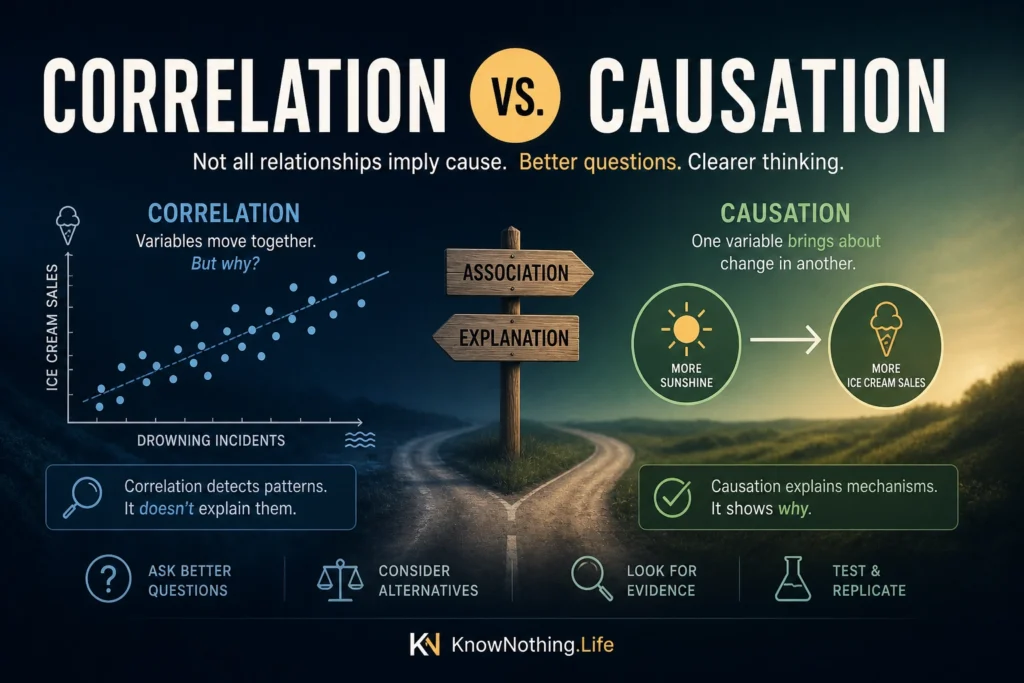
The distinction between correlation and causation is one of the most fundamental principles in scientific reasoning. At its simplest, correlation refers to a relationship between two variables—when one changes, the other tends to change as well—while causation implies that one variable directly produces a change in another. Although the difference may appear straightforward, confusion between the two is common, leading to errors in interpretation, flawed conclusions, and misguided decisions.
In psychology and the broader sciences, this distinction is critical. Researchers often observe patterns and associations in data, but determining whether those patterns reflect true causal relationships requires careful analysis and rigorous methodology. As Karl Pearson, a pioneer of correlation analysis, demonstrated, statistical relationships can reveal important patterns, but they do not, by themselves, explain why those patterns exist. This limitation underscores the need for deeper inquiry beyond surface-level associations.
Understanding the difference between correlation and causation is not merely an academic exercise. It has practical implications for fields ranging from medicine and public policy to everyday decision-making. By recognizing the limits of correlation and the requirements for establishing causation, individuals can make more informed judgments and avoid common pitfalls in reasoning.
Defining Correlation
Correlation describes the degree to which two variables are related. This relationship can be positive, meaning that both variables increase or decrease together, or negative, meaning that one variable increases as the other decreases. The strength of this relationship is often quantified using a correlation coefficient, a statistical measure that ranges from -1 to +1.
The concept of correlation was formalized by Karl Pearson, whose work laid the foundation for modern statistical analysis. Pearson’s correlation coefficient provides a standardized way to assess the strength and direction of relationships between variables, making it a widely used tool in research. However, while correlation can indicate that two variables are related, it does not specify the nature of that relationship.
Importantly, correlation does not imply causation. Two variables may be correlated for a variety of reasons, including coincidence, the influence of a third variable, or complex underlying mechanisms. Recognizing this limitation is essential for interpreting data accurately and avoiding erroneous conclusions.
The Concept of Causation
Causation refers to a relationship in which one variable directly influences another. Establishing causation requires more than observing a pattern; it involves demonstrating that changes in one variable produce changes in another, while ruling out alternative explanations. This typically requires controlled experimentation and careful analysis.
Philosophically, the concept of causation has been a subject of debate for centuries. David Hume famously argued that causation cannot be directly observed, only inferred from consistent patterns of association. According to Hume, what we perceive as causation is based on the repeated observation of one event following another, rather than a direct perception of a causal link. This skepticism highlights the challenge of establishing causality with certainty.
In scientific practice, causation is inferred through evidence that meets specific criteria, such as temporal precedence (the cause must occur before the effect), covariation (the variables must be related), and the elimination of alternative explanations. These criteria provide a framework for distinguishing causal relationships from mere correlations, guiding researchers in their investigations.
Common Misinterpretations and Errors
One of the most common errors in reasoning is the assumption that correlation implies causation. This fallacy can lead to incorrect conclusions and misguided actions. For example, a correlation between two variables may suggest a relationship, but without further analysis, it is impossible to determine whether one causes the other.
A classic example of this error involves spurious correlations—relationships that arise by chance or are influenced by a third variable. For instance, ice cream sales and drowning incidents may be positively correlated, but this does not mean that one causes the other. Instead, both are influenced by a third variable, such as temperature. This illustrates the importance of considering alternative explanations when interpreting correlations.
Another common issue is reverse causation, where the direction of the relationship is misunderstood. In some cases, it may appear that variable A causes variable B, when in fact B influences A. Distinguishing between these possibilities requires careful analysis and, often, experimental evidence.
Research Methods for Establishing Causation
To move beyond correlation and establish causation, researchers rely on experimental methods. In an experiment, the independent variable is manipulated, and its effect on the dependent variable is observed. By controlling other variables and using random assignment, researchers can isolate the causal relationship and rule out alternative explanations.
The importance of experimental design has been emphasized by researchers such as Donald Campbell, who highlighted the role of internal validity in establishing causation. Without proper control and randomization, it is difficult to determine whether observed effects are truly caused by the independent variable or influenced by other factors.
In cases where experiments are not feasible, researchers may use quasi-experimental designs or advanced statistical techniques to infer causality. Methods such as longitudinal studies, regression analysis, and causal modeling can provide insights into potential causal relationships, although they often require careful interpretation and cannot fully replace controlled experiments.
The Role of Statistics and Interpretation
Statistics play a crucial role in analyzing relationships between variables, but they must be interpreted with caution. Correlation coefficients, regression models, and other statistical tools provide valuable information about patterns in data, but they do not, on their own, establish causation. As Ronald Fisher emphasized, statistical methods are tools for inference, not proof of causality.
Interpreting statistical results requires an understanding of the underlying assumptions and limitations of the methods used. For example, a strong correlation may indicate a meaningful relationship, but it does not reveal the direction or mechanism of causation. Similarly, statistical significance does not necessarily imply practical significance, highlighting the need for careful analysis.
The integration of statistical analysis with theoretical reasoning is essential for drawing valid conclusions. By combining empirical data with a clear understanding of the underlying processes, researchers can develop more accurate and meaningful interpretations of their findings.
Implications for Science and Society
The distinction between correlation and causation has far-reaching implications for science and society. In fields such as medicine, public health, and economics, decisions are often based on the interpretation of data. Misunderstanding the nature of relationships between variables can lead to ineffective or even harmful interventions.
In everyday life, individuals are frequently exposed to claims based on correlations, particularly in media and advertising. Understanding the difference between correlation and causation enables people to critically evaluate these claims and make more informed decisions. As Daniel Kahneman has noted in his work on cognitive biases, humans are prone to seeing patterns and inferring causality even when none exists.
Education in scientific reasoning and statistical literacy is therefore essential for navigating a data-driven world. By developing the ability to distinguish between correlation and causation, individuals can better understand the complexities of information and avoid common errors in judgment.
Conclusion
The distinction between correlation and causation is a cornerstone of scientific thinking, shaping how researchers interpret data and draw conclusions. While correlation provides valuable insights into relationships between variables, it does not, on its own, establish causality. Determining causal relationships requires careful analysis, rigorous methodology, and the elimination of alternative explanations.
From the statistical contributions of Karl Pearson to the philosophical insights of David Hume and the methodological advances of Donald Campbell, the study of correlation and causation has evolved into a sophisticated framework for understanding relationships in data. These contributions highlight both the power and the limitations of scientific inquiry.
Ultimately, recognizing the difference between correlation and causation is essential for both science and everyday reasoning. It encourages a more critical and nuanced approach to interpreting information, fostering a deeper understanding of the world and the processes that shape it.