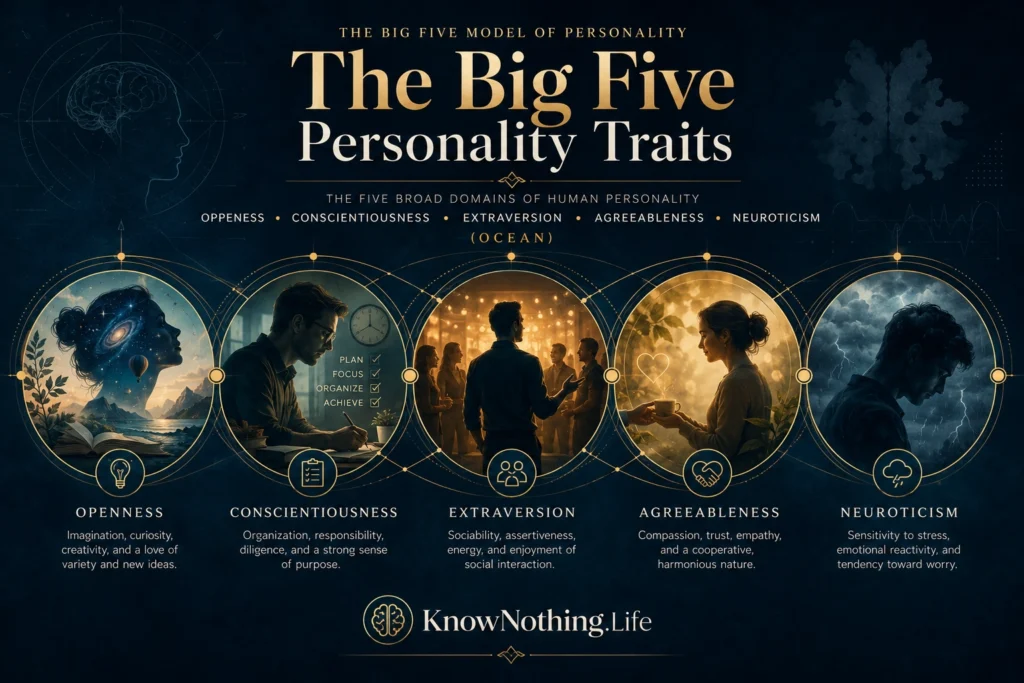
The Big Five model of personality traits is one of the most respected frameworks in modern psychology because it gives researchers a clear, evidence-based way to describe human individuality. The model organizes personality into five broad trait domains: Openness to Experience, Conscientiousness, Extraversion, Agreeableness, and Neuroticism. These five traits are often remembered through the acronym OCEAN, though some researchers arrange them differently as CANOE. The important point is not the acronym, but the model’s central claim: much of ordinary personality can be understood through stable, measurable patterns in how people think, feel, behave, and respond to the world.
Unlike personality “types,” the Big Five does not place people into fixed boxes. It treats traits as dimensions, meaning each person falls somewhere along a continuum. Someone may be highly conscientious, moderately agreeable, low in neuroticism, high in openness, and average in extraversion. Another person may be emotionally sensitive, imaginative, reserved, skeptical, and loosely organized. The Big Five is powerful because it does not try to reduce a person to one label. Instead, it offers a trait profile: a map of tendencies that influence behavior without fully determining destiny.
The Trait Tradition in Personality Psychology
The Big Five belongs to the trait tradition, which assumes that personality consists partly of enduring patterns that can be described, measured, and compared. Gordon Allport was one of the most important early trait theorists. In Personality: A Psychological Interpretation, Allport defined personality as “the dynamic organization within the individual of those psychophysical systems that determine his unique adjustments to his environment.” This definition remains influential because it treats personality as both psychological and biological, both stable and adaptive. Personality is not a mask worn in public; it is an organized pattern shaping how a person meets life.
Allport’s work helped move psychology away from vague character descriptions and toward systematic study. Later researchers used statistical methods to discover which personality descriptions clustered together. This was crucial because the Big Five was not invented from pure theory alone. It emerged from repeated attempts to organize thousands of trait words into broader patterns. The assumption was simple but profound: if certain traits are important in human social life, ordinary language will contain many words for them. This idea became known as the lexical hypothesis, and it shaped much of the research that eventually produced the Big Five.
The Origins of the Big Five
The historical path to the Big Five involved several major figures. Allport and Henry Odbert cataloged thousands of personality-related terms in 1936, creating a foundation for later lexical research. Raymond Cattell then reduced these terms using factor analysis and developed the 16 Personality Factors model. Although Cattell’s system was influential, later researchers found that a smaller set of five broad dimensions repeatedly appeared in trait ratings. Ernest Tupes and Raymond Christal’s work was especially important because their analyses found five recurrent factors labeled Surgency, Agreeableness, Dependability, Emotional Stability, and Culture, which closely resemble today’s Big Five domains.
Warren Norman, Lewis Goldberg, Paul Costa, and Robert McCrae later helped establish and popularize the five-factor structure. Goldberg’s lexical research strengthened the idea that the Big Five represents broad categories embedded in ordinary personality language. Costa and McCrae advanced the model through the Five-Factor Model and the NEO Personality Inventory, making it one of the most widely used systems in personality assessment. Their work helped show that the Big Five traits are not just convenient labels, but measurable tendencies with relevance to relationships, work, health, aging, and mental well-being.
Openness to Experience
Openness to Experience describes imagination, curiosity, aesthetic sensitivity, emotional depth, intellectual exploration, and willingness to consider new ideas. People high in openness often enjoy art, literature, philosophy, novelty, symbolism, travel, unusual perspectives, and abstract thinking. They tend to be drawn toward complexity and possibility. People lower in openness may prefer familiarity, tradition, practical routines, concrete facts, and proven methods. Low openness does not mean low intelligence; it often reflects a stronger preference for stability, realism, and continuity.
Openness matters because it influences how people relate to change. A highly open person may enjoy ambiguity and experimentation, while a less open person may find too much novelty disruptive or unnecessary. In education and creativity, openness is often linked to intellectual curiosity and creative production. In everyday life, it can shape music preferences, political imagination, spiritual exploration, career choices, and tolerance for difference. At its best, openness expands perception. At its extreme, it may become impracticality, restlessness, or attraction to novelty for its own sake.
Conscientiousness
Conscientiousness refers to self-discipline, organization, responsibility, planning, reliability, persistence, and impulse control. Highly conscientious people tend to keep promises, finish tasks, arrive on time, prepare carefully, and pursue long-term goals. They are often described as dependable, hardworking, orderly, and achievement-oriented. People lower in conscientiousness may be more spontaneous, flexible, relaxed, and tolerant of disorder, but they may also struggle with procrastination, inconsistency, or follow-through.
Conscientiousness is one of the most practically important Big Five traits because many life outcomes depend on sustained self-regulation. School achievement, job performance, health habits, financial management, and long-term projects all require the ability to organize behavior across time. Conscientiousness is not glamorous, but it is powerful. It turns intention into action and action into habit. Still, it also needs balance. Extreme conscientiousness can become rigidity, perfectionism, overcontrol, or difficulty adapting when plans fail.
Extraversion
Extraversion describes social energy, assertiveness, activity level, enthusiasm, positive emotionality, and responsiveness to reward. Highly extraverted people often enjoy conversation, group activity, leadership, excitement, and visible engagement with the world. They may think aloud, seek stimulation, and feel energized by social contact. People lower in extraversion, commonly described as introverted, may prefer solitude, smaller groups, slower pacing, and deeper internal processing. Introversion is not the same as shyness or social fear; it is often a lower need for external stimulation.
Carl Jung helped popularize the language of introversion and extraversion in Psychological Types, describing extraversion as an outward orientation toward objects, people, and external reality. Later, Hans Eysenck gave the trait a biological interpretation, connecting extraversion and introversion to arousal and stimulation-seeking. In the Big Five model, extraversion includes multiple facets: warmth, gregariousness, assertiveness, activity, excitement-seeking, and positive emotion. This explains why extraversion can appear as sociability, confidence, energy, or joy rather than merely talkativeness.
Agreeableness
Agreeableness concerns compassion, kindness, trust, cooperation, forgiveness, modesty, and concern for others. Highly agreeable people tend to be warm, helpful, sympathetic, and motivated to preserve social harmony. They may assume good intentions and avoid unnecessary conflict. People lower in agreeableness may be more skeptical, competitive, blunt, tough-minded, or willing to challenge others. Low agreeableness does not automatically mean cruelty; it can also involve independence, realism, and resistance to manipulation.
Agreeableness plays a central role in relationships because it influences how people handle conflict, trust, apology, compromise, and care. A highly agreeable person may be a loyal friend, supportive partner, or effective caregiver. However, excessive agreeableness can lead to people-pleasing, avoidance of necessary confrontation, or difficulty setting boundaries. Lower agreeableness can be useful in negotiation, criticism, debate, and leadership under pressure, but it may damage relationships if it becomes callousness. The trait is best understood as a balance between compassion and self-protection.
Neuroticism
Neuroticism refers to emotional instability, anxiety, moodiness, self-consciousness, irritability, vulnerability to stress, and sensitivity to threat. People high in neuroticism tend to experience negative emotions more frequently and intensely. They may worry, anticipate problems, react strongly to uncertainty, or recover slowly from stress. People low in neuroticism tend to be calmer, steadier, and more emotionally resilient. They are not emotionless; they are simply less likely to be overwhelmed by emotional turbulence.
Neuroticism is especially important in mental health research because it is associated with vulnerability to anxiety, depression, chronic stress, and emotional dysregulation. Yet neuroticism also has adaptive roots. Sensitivity to danger can make people careful, prepared, and alert to risk. The problem arises when threat sensitivity becomes excessive, causing ordinary uncertainty to feel dangerous. In this sense, neuroticism is not simply “bad personality.” It is a heightened emotional alarm system that can either protect or exhaust the person depending on intensity and context.
Stability, Change, and Personality Development
One reason the Big Five became so influential is that it allows psychologists to study personality across the lifespan. Traits show meaningful stability, especially in adulthood, but they are not completely fixed. Costa and McCrae’s Personality in Adulthood argued for the enduring stability of personality across adult development while presenting the five-factor model as a major framework for understanding adult personality.
Later research has emphasized both stability and change. Many people become more conscientious, agreeable, and emotionally stable as they age, a pattern sometimes called the maturity principle. Life roles, relationships, work responsibilities, therapy, education, trauma, and deliberate habit change can all influence personality expression. A person may remain naturally introverted but become more socially skilled. Someone high in neuroticism may learn emotional regulation. A less conscientious person may build systems that make reliability easier. Traits shape development, but development can also reshape traits.
Why the Big Five Matters
The Big Five matters because it gives people a vocabulary for self-understanding without reducing them to stereotypes. It helps explain why one person seeks novelty while another values tradition, why one person thrives on structure while another resists it, why one person loves public engagement while another prefers quiet concentration, why one person trusts easily while another questions motives, and why one person remains calm while another feels stress intensely. These differences are not random flaws. They are recurring patterns in human personality.
The model is also useful because it encourages humility. Every trait has strengths and liabilities. Openness can produce creativity or impracticality. Conscientiousness can produce achievement or rigidity. Extraversion can produce connection or impulsivity. Agreeableness can produce kindness or self-neglect. Neuroticism can produce caution or distress. The question is not simply whether a trait is good or bad, but how it functions in a particular life, culture, relationship, or environment.
Final Thoughts on the Big Five Model of Personality Traits
The Big Five model remains one of psychology’s most important achievements because it transforms the complexity of personality into a clear, research-supported structure. Openness, Conscientiousness, Extraversion, Agreeableness, and Neuroticism do not explain everything about a person, but they capture many of the most reliable ways human beings differ. The model connects ordinary language, statistical research, biological tendencies, social behavior, and life outcomes into one practical framework.
At its best, the Big Five is not a labeling system but a tool for insight. It helps people understand their habits, strengths, vulnerabilities, and preferred environments. It also helps us understand others with greater patience. People do not all need the same amount of novelty, order, stimulation, harmony, or emotional reassurance. A mature view of personality recognizes difference without turning it into destiny. The Big Five endures because it shows that human character is both patterned and flexible, both measurable and deeply personal.