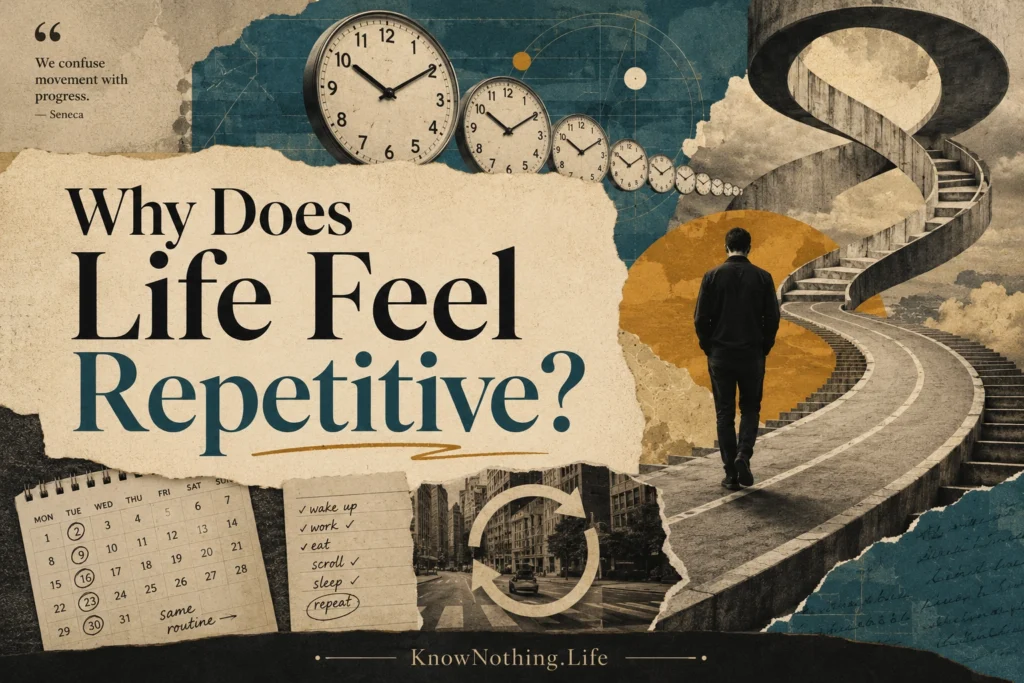
There are periods of life when the days seem to lose their edges. You wake up, follow roughly the same sequence of tasks, interact with many of the same people, handle familiar responsibilities, consume familiar entertainment, go to sleep, and begin again. Nothing may be obviously wrong. You may have work, relationships, hobbies, and responsibilities that you once wanted. Yet an uncomfortable impression begins to emerge: I have already lived this day before. Weeks blur together, months seem strangely short in retrospect, and even pleasurable experiences can start feeling predictable.
Psychology suggests that this feeling is not simply caused by having an objectively repetitive schedule. It emerges from the interaction of attention, memory, novelty, reward, autonomy, challenge, and meaning. Human brains are extraordinarily good at turning repeated experiences into efficient patterns. That ability makes everyday life manageable, but it has a psychological cost: the more familiar an experience becomes, the less information the mind may treat as noteworthy. Research on routines, boredom, hedonic adaptation, and time perception helps explain why a perfectly functional life can nevertheless begin to feel as though it is running on a loop.
The Brain Is Designed to Stop Noticing What Stays the Same
One reason life feels repetitive is that the nervous system is built to become less responsive to predictable information. Psychologists broadly describe this process as habituation: repeated exposure to the same or similar stimuli usually produces diminishing psychological responses. A ticking clock that initially attracts attention soon disappears from awareness. The smell of a room becomes less noticeable after several minutes. A new commute initially contains hundreds of details, but after months of driving it, large portions may occur almost automatically. Familiarity allows the brain to conserve attention for information that might actually require action.
This efficiency is enormously useful. Imagine having to consciously reconsider how to brush your teeth, navigate your house, operate your phone, or perform every familiar task each day. Automaticity frees cognitive resources for more demanding problems. But when large portions of life become predictable, the same mechanism can alter the experience of living. Familiar events generate fewer surprises, require less deliberate attention, and create fewer clearly differentiated moments. Repetition can therefore produce the paradoxical sensation of being constantly busy while simultaneously feeling as though very little is happening. William Matthews’ experimental work on repetition and subjective time has found that repeated stimuli can even appear shorter in duration than novel stimuli, illustrating how familiarity alters temporal experience at a surprisingly basic perceptual level.
Routine Can Make Time Collapse in Memory
Our experience of time depends partly on whether we are judging time while it is happening or remembering it afterward. A boring afternoon can seem painfully long in the moment because attention repeatedly returns to the passage of time. Yet months filled with nearly identical afternoons may seem remarkably short in retrospect. The reason is that remembered time is partly constructed from the events, changes, boundaries, and memorable episodes stored within it. When days contain distinctive experiences, they provide more psychological landmarks. When many days resemble one another, fewer clear boundaries separate them.
Dinah Avni-Babad and Ilana Ritov demonstrated this relationship between routine and remembered time in a series of experiments and field studies published in the Journal of Experimental Psychology: General. Participants tended to remember periods filled with routine activity as shorter than periods containing less routine. More recently, University of Pennsylvania psychologist Brynn Sherman and University of North Carolina researcher Sami Yousif found another intriguing temporal effect: repeated experiences were systematically remembered as having occurred farther back in time than nonrepeated experiences, with distortions reaching substantial proportions of the studied interval. Repetition does not merely make life seem similar; it can alter the way the mind organizes when events seem to have happened.
This helps explain a familiar adult experience: individual workdays may sometimes drag, yet an entire year can vanish with astonishing speed. Childhood and early adulthood are often filled with firsts—first schools, friendships, jobs, relationships, apartments, trips, achievements, failures, and discoveries. Later periods may contain fewer major transitions. The calendar still advances at exactly the same rate, but autobiographical memory contains fewer sharply differentiated markers. Life can therefore feel repetitive partly because memory is compressing similar experiences into broader categories rather than preserving every instance as a distinct episode.
Hedonic Adaptation Makes Extraordinary Things Ordinary
Life can also become repetitive because humans adapt emotionally to circumstances that once felt exciting. Psychologists sometimes refer to this tendency as hedonic adaptation. A new job, home, possession, relationship milestone, salary increase, or lifestyle change can initially produce intense positive emotion. With repeated exposure, however, the new condition becomes part of normal life. Expectations adjust. What once felt extraordinary becomes the new baseline.
Kennon Sheldon, Sonja Lyubomirsky, and colleagues tested this process in research on what they called the Hedonic Adaptation Prevention model. Their longitudinal study found evidence that the emotional benefits of positive life changes decline partly because positive emotions generated by the change diminish and aspirations rise. Importantly, continued appreciation and variation in experiences appeared capable of slowing this adaptation. The implication is not that humans are incapable of lasting happiness. Rather, psychological systems appear especially sensitive to change relative to expectation. Once an improvement becomes expected, it produces less psychological contrast.
This explains why endlessly acquiring new things rarely solves the problem of repetition for long. A new car eventually becomes simply “the car.” A new house becomes home. A long-awaited promotion becomes Monday morning. Even entertainment demonstrates adaptation: the tenth episode, hundredth social-media scroll, or thousandth repetition of a favorite song cannot reproduce the psychological novelty of the first encounter. Without intentional variation or renewed appreciation, even desirable circumstances can fade into the background of consciousness.
Boredom Is Really a Problem of Engagement
When people say that life feels repetitive, they are frequently describing something deeper than simple sameness: boredom. Yet boredom does not necessarily mean there is literally nothing to do. John Eastwood, Daniel Smilek, Alexandra Frischen, and Mark Fenske argued in their influential review The Unengaged Mind that boredom is fundamentally connected to attention. They described it as an aversive state in which a person wants satisfying engagement but is unable to successfully direct attention toward something that provides it. Someone can therefore be surrounded by entertainment, information, responsibilities, and stimulation while still feeling profoundly bored.
Repetition becomes especially aversive when familiar activities no longer demand enough ability, curiosity, or personal investment to hold attention. The experience then shifts from “I know what comes next” to “nothing here requires me.” This distinction is important. A carpenter can perform similar work every day without feeling bored if each project presents meaningful challenges. A musician can rehearse the same piece hundreds of times while remaining deeply engaged because perception becomes increasingly refined. Conversely, someone switching constantly between apps, videos, messages, and news can experience chronic boredom despite enormous surface-level variety. Novel stimulation is not the same thing as meaningful engagement.
Research by Wijnand van Tilburg and Eric Igou at the University of Limerick additionally suggests that boredom has an existential dimension. Their experiments found that boredom increased people’s motivation to recover a sense of meaningfulness, including through stronger identification with valued social groups. Boredom may therefore function partly as a psychological signal saying that the current activity is failing to provide sufficient attention, challenge, purpose, or significance.
Routine Is Not the Enemy
It would be a mistake, however, to conclude that routines automatically make life empty. In fact, research suggests almost the opposite in certain circumstances. Samantha Heintzelman of Rutgers University and Laura King of the University of Missouri examined routines and meaning in life across both survey and experience-sampling studies. People with stronger preferences for routine tended to report greater meaning in life, and moments in which participants were performing typical routine behaviors were also associated with greater momentary feelings of meaning.
Why would repetition sometimes generate boredom but other times generate meaning? Because routines provide coherence. They organize time, reduce unnecessary decisions, stabilize relationships, and connect daily behavior with larger commitments. Cooking dinner for one’s family every evening is repetitive, but its repetition may express care. Practicing a skill every morning is repetitive, but it may embody mastery. Going to the same workplace every day can feel monotonous, yet it may also support a family, contribute to a community, or advance a personally important project. The psychological problem is therefore not repetition by itself. It is repetition that has become disconnected from attention, growth, choice, or significance.
This difference helps explain why a stable life can feel deeply satisfying to one person and suffocating to another. The relevant question is less “How many things repeat?” than “What does the repetition represent?” Rituals often gain their power precisely because they recur. Birthdays, holidays, weekly dinners, morning walks, religious practices, athletic training, and creative disciplines obtain meaning through repetition rather than despite it. Routine becomes psychologically impoverishing primarily when it ceases to feel chosen, meaningful, challenging, or connected to anything larger than itself.
The Existential Fear of Living the Same Life Again
Philosophers recognized the unsettling nature of repetition long before psychologists measured it experimentally. Søren Kierkegaard devoted an entire 1843 work, Repetition, to the paradoxical relationship between repetition, memory, possibility, and human existence. Friedrich Nietzsche later imagined the “eternal recurrence” in The Gay Science: what if a person were told that every moment of life would have to be lived again, endlessly and identically? Nietzsche’s thought experiment transforms repetition into a question of evaluation. Would the prospect be horrifying, or could a person affirm life so completely that even its repetitions would be welcomed?
Albert Camus offered perhaps the most famous image of repetitive existence in The Myth of Sisyphus. Sisyphus is condemned to push a stone uphill only to watch it roll down again, repeating the same apparently pointless action forever. Camus used the myth not merely to describe boredom but to confront the larger problem of meaning in an indifferent universe. The disturbing feature of Sisyphus’ punishment is not physical effort alone; it is effort without culmination. There is no final destination at which the repetitive labor becomes complete.
This distinction applies surprisingly well to modern life. Repetition becomes oppressive when every completed task merely generates another identical task: another inbox, commute, bill, meeting, shopping trip, load of laundry, deadline, or notification. The experience lacks a sense of movement toward something. Viktor Frankl‘s Man’s Search for Meaning approached the same problem from another direction, emphasizing that meaning can emerge through work, love, responsibility, and one’s stance toward unavoidable circumstances. From this perspective, the opposite of repetitive living is not constant excitement. It is experiencing one’s repeated actions as belonging to a meaningful trajectory.
Psychological Richness May Be the Missing Ingredient
Contemporary well-being research has traditionally focused heavily on two desirable forms of life: a happy life, characterized by positive emotion and satisfaction, and a meaningful life, characterized by purpose and significance. Psychologist Shigehiro Oishi and colleagues have argued for a third dimension: the psychologically rich life. Psychological richness involves variety, complexity, interesting experiences, perspective-changing events, and encounters that alter how a person understands the world.
A person can therefore have a life that is both happy and meaningful yet still feel repetitive. Consider someone with a loving family, financial stability, safe routines, and meaningful work. Nothing is obviously missing according to traditional measures of well-being. Yet if experiences rarely challenge assumptions, introduce new people, require new abilities, or reveal unfamiliar perspectives, the person may still sense that life has become psychologically narrow. This does not mean abandoning stability or pursuing endless excitement. Psychological richness can come from travel, but it can also come from reading unfamiliar ideas, learning an instrument, meeting different communities, studying history, attempting difficult projects, changing one’s environment, creating something, or deliberately doing familiar things in unfamiliar ways.
How to Make Life Feel Less Repetitive
The most effective response to repetitive life may therefore be to increase differentiation rather than stimulation. Simply consuming more entertainment often produces rapidly diminishing returns because passive novelty is easy to adapt to. More durable change comes from experiences that require active participation: learning, making, exploring, practicing, solving, connecting, risking manageable failure, or assuming responsibility for something whose outcome is uncertain. These activities create stronger boundaries between experiences because they generate new memories and demand genuine attention.
Small changes can matter more than dramatic reinventions. Taking a different walking route, speaking to someone new, learning a new recipe, visiting an unfamiliar neighborhood, studying a subject outside one’s normal interests, changing the structure of a weekend, writing about the day, or starting a project with measurable stages can introduce new memory markers without destabilizing the rest of life. Sheldon and colleagues’ work on hedonic adaptation suggests that variety and appreciation can help preserve the emotional value of positive circumstances, while research on psychological richness suggests that novelty and complexity add a dimension of well-being not captured by happiness alone.
Attention matters just as much as schedule. A person who rushes through every routine while mentally anticipating the next task may experience little of what actually happens. Familiar experiences often contain more variation than memory records because attention has stopped looking for it. The solution is not necessarily to destroy routines but to decide which ones deserve protection, which ones deserve variation, and which ones have outlived their purpose.
Why Life Feels Repetitive
Life often feels repetitive because the human mind is exceptionally good at adapting. Familiar experiences require less attention. Repeated events become compressed in memory. Positive changes gradually become normal. Activities that no longer provide challenge or meaning struggle to hold attention. When these processes converge, months of genuine living can be remembered as though almost nothing happened.
But repetition itself is not the problem. Some of the most meaningful parts of life—friendship, love, family, craftsmanship, learning, exercise, ritual, creativity, and responsibility—depend heavily on repetition. The deeper issue is whether repeated behavior still contains attention, choice, challenge, connection, growth, or purpose. A life can remain outwardly stable while becoming inwardly richer.
Perhaps the goal, then, is not to escape repetition entirely. Human life will always contain mornings, meals, chores, work, obligations, seasons, and recurring needs. The more useful task is to prevent familiarity from becoming invisibility. Novelty gives memory landmarks. Challenge gives attention something to grasp. Meaning transforms repeated actions into commitments. And psychological richness allows familiar life to continue expanding rather than simply repeating. The calendar may inevitably circle through the same days and seasons, but consciousness does not have to travel through them in exactly the same way.