The distinction between positive and negative freedom is one of the most influential frameworks in modern political philosophy, shaping debates about rights, autonomy, and the role of the state. At its core, the distinction asks a deceptively simple question: what does it mean to be free? Is freedom merely the absence of interference, or does it require the presence of certain conditions that enable individuals to act meaningfully? These two interpretations—negative and positive freedom—offer competing yet complementary answers, each grounded in a different understanding of human agency and social life.
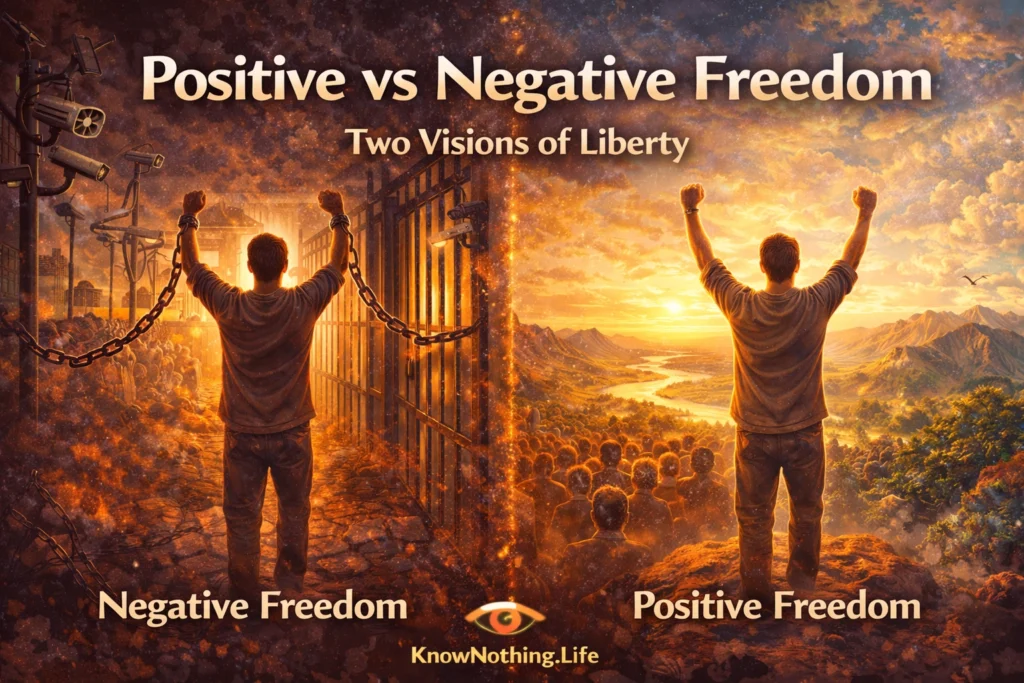
Negative freedom emphasizes non-interference: an individual is free to the extent that others do not obstruct their actions. Positive freedom, by contrast, focuses on self-mastery and the capacity to direct one’s own life. While these ideas are often presented as opposing views, they are better understood as different dimensions of a complex concept. The tension between them reflects broader disagreements about the nature of autonomy, the legitimacy of authority, and the purpose of political institutions. Understanding this distinction is essential for evaluating contemporary issues ranging from economic inequality to personal rights.
The Origins of the Distinction
The modern articulation of positive and negative freedom is most closely associated with Isaiah Berlin, whose essay Two Concepts of Liberty provides a clear and influential formulation. Berlin defines negative liberty as the area within which a person can act without interference from others, while positive liberty concerns the ability to be one’s own master. He traces these ideas to earlier philosophical traditions, showing how they emerged from different responses to the problem of human freedom.
Berlin’s analysis is not merely descriptive but also cautionary. He warns that the pursuit of positive freedom can lead to coercion if authorities claim to know what individuals truly need in order to be free. This concern reflects historical experiences in which regimes justified restrictions on individual liberty in the name of collective goals or moral development. As Berlin writes, “The ‘positive’ sense of the word ‘liberty’… derives from the wish on the part of the individual to be his own master.” Yet this wish, he argues, can be interpreted in ways that justify imposing a particular vision of the good life on others.
The distinction itself, however, has deeper roots. Enlightenment thinkers grappled with the meaning of freedom in the context of emerging political and social structures. The tension between individual independence and collective authority was already present in their work, setting the stage for Berlin’s later formulation. By clarifying these two concepts, Berlin provides a framework that continues to shape philosophical and political discourse.
Negative Freedom and Liberal Individualism
Negative freedom is closely associated with the liberal tradition, particularly the work of John Locke and John Stuart Mill. In Two Treatises of Government, Locke argues that individuals possess natural rights that must be protected from interference, including the rights to life, liberty, and property. Freedom, in this view, is secured by limiting the power of the state and preventing arbitrary control.
Mill develops this idea further in On Liberty, where he articulates the harm principle as a guideline for restricting freedom. According to Mill, individuals should be free to act as they wish unless their actions harm others. This principle reflects a strong commitment to personal autonomy and the belief that individuals are the best judges of their own interests. Mill famously declares, “Over himself, over his own body and mind, the individual is sovereign.”
Negative freedom has been central to the development of modern democratic societies, informing constitutional protections, civil liberties, and legal frameworks. Its emphasis on non-interference aligns with the idea that freedom is best preserved by minimizing external constraints. However, critics argue that this conception overlooks the ways in which social and economic conditions can limit freedom in practice. A person may be free from interference yet unable to act due to poverty, lack of education, or systemic barriers.
Positive Freedom and the Ideal of Self-Mastery
Positive freedom shifts the focus from external constraints to internal capacity. It asks whether individuals have the ability to act according to their own rational will and to pursue meaningful goals. This idea is closely linked to the philosophy of Jean-Jacques Rousseau, who explores the concept of freedom in The Social Contract. Rousseau argues that true freedom is found not in the absence of constraints but in participation in collective self-governance. By aligning individual will with the general will, individuals achieve a higher form of autonomy.
The notion of self-mastery is also central to the work of G. W. F. Hegel. In Philosophy of Right, Hegel presents freedom as the realization of rational will within social institutions. For Hegel, individuals are not truly free in isolation; freedom is achieved through participation in ethical life, including family, civil society, and the state. This perspective emphasizes that freedom is not merely a personal condition but a social achievement.
Positive freedom has inspired approaches that prioritize education, social welfare, and democratic participation as means of enabling individuals to flourish. However, it also raises concerns about paternalism. If freedom is defined in terms of rational self-realization, authorities may claim to act on behalf of individuals’ true interests, even against their expressed desires. This tension highlights the difficulty of distinguishing between empowering individuals and imposing a particular vision of the good life.
Tensions and Critiques
The distinction between positive and negative freedom reveals a fundamental tension in the concept of liberty. Negative freedom prioritizes individual independence and protection from interference, while positive freedom emphasizes empowerment and self-realization. Each approach captures an important aspect of freedom, yet each also faces limitations. Negative freedom can appear too minimal, failing to address the conditions necessary for meaningful choice, while positive freedom risks overreach and coercion.
Philosophers have sought to reconcile these perspectives or to critique their underlying assumptions. Charles Taylor, for example, argues that the dichotomy is overly simplistic and that a richer understanding of freedom must account for the social and cultural contexts in which individuals form their identities. In his essay “What’s Wrong with Negative Liberty,” Taylor contends that freedom cannot be reduced to non-interference because individuals’ desires and choices are shaped by their environment.
Similarly, Amartya Sen offers a capabilities-based approach that integrates elements of both positive and negative freedom. In Development as Freedom, Sen argues that freedom should be understood in terms of what individuals are actually able to do and be. This perspective emphasizes both the removal of constraints and the provision of opportunities, bridging the gap between the two concepts.
Contemporary Relevance
The distinction between positive and negative freedom remains highly relevant in contemporary political and social debates. Issues such as healthcare, education, and economic inequality often hinge on differing conceptions of freedom. Advocates of negative freedom may argue that individuals should be left free from government interference, while proponents of positive freedom emphasize the need for public policies that enable individuals to achieve their potential.
Technological developments also raise new questions about freedom. Digital surveillance, data collection, and algorithmic decision-making can limit negative freedom by introducing new forms of interference, while also affecting positive freedom by shaping the choices available to individuals. These challenges highlight the need for a nuanced understanding of freedom that can address both dimensions.
Globalization further complicates the picture by extending the scope of freedom beyond national boundaries. Economic interdependence and global institutions influence the conditions under which individuals exercise their freedom, raising questions about responsibility and justice on a global scale. In this context, the interplay between positive and negative freedom becomes even more complex, requiring new frameworks for analysis.
The Enduring Debate
The debate between positive and negative freedom is not one that can be definitively resolved. Instead, it reflects the complexity of human life and the multiple dimensions of freedom. Both concepts capture essential aspects of what it means to be free, and both are necessary for a comprehensive understanding of liberty. The challenge lies in balancing these dimensions in a way that respects individual autonomy while also promoting the conditions for human flourishing.
As societies continue to evolve, the distinction between positive and negative freedom provides a valuable lens for examining political and ethical questions. It encourages reflection on the limits of authority, the role of institutions, and the responsibilities individuals have toward one another. By engaging with this framework, we gain a deeper appreciation of the challenges involved in creating and sustaining a free society.
Ultimately, the conversation about positive and negative freedom is not merely theoretical. It has real implications for how we design laws, allocate resources, and understand our obligations to others. It is a debate that continues to shape the pursuit of liberty, reminding us that freedom is both a right to be protected and a capacity to be cultivated.