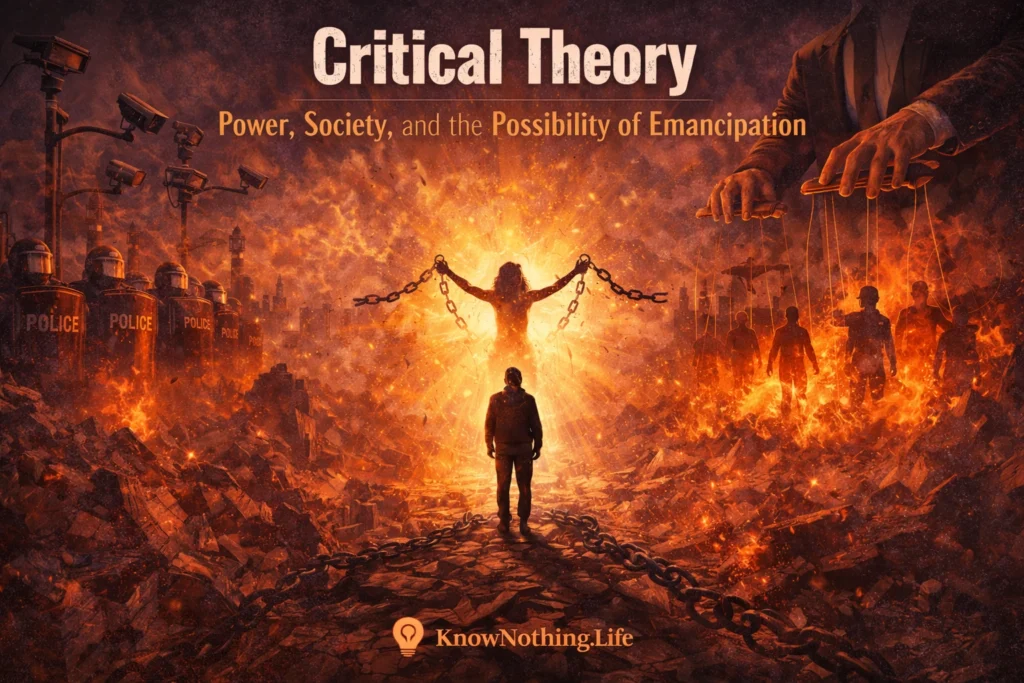
Critical Theory is a broad and evolving philosophical tradition that seeks not only to understand society but to transform it by uncovering the structures of power, domination, and ideology that shape human life. Originating in the early twentieth century with the Frankfurt School, Critical Theory brings together philosophy, sociology, political theory, and cultural analysis in a unified effort to critique modern society and envision more just alternatives. Key figures in this tradition include Max Horkheimer, Theodor Adorno, Herbert Marcuse, and later thinkers such as Jürgen Habermas.
At its core, Critical Theory challenges the idea that knowledge is neutral or purely objective. Instead, it argues that knowledge is shaped by social, economic, and political forces, often serving to reinforce existing power structures. The task of critical thought, therefore, is to expose these forces and to reveal the ways in which systems of domination are maintained. As Horkheimer famously wrote in his essay “Traditional and Critical Theory,” “The point is not merely to describe the world but to change it,” emphasizing the transformative ambition of the tradition. This commitment to critique and emancipation distinguishes Critical Theory from more conventional approaches to philosophy and social science.
The Frankfurt School and the Critique of Modernity
The origins of Critical Theory lie in the work of the Frankfurt School, a group of intellectuals associated with the Institute for Social Research in Germany. Max Horkheimer and Theodor Adorno were central figures in this movement, developing a critique of modernity that addressed the rise of capitalism, mass culture, and authoritarianism. In their influential work Dialectic of Enlightenment, they argue that the Enlightenment’s emphasis on reason and progress has paradoxically led to new forms of domination.
Horkheimer and Adorno suggest that instrumental reason—the use of rationality as a tool for control and efficiency—has come to dominate modern society. Rather than liberating individuals, reason has been harnessed to serve economic and political interests, reducing human beings to objects within systems of production and consumption. “Enlightenment behaves toward things as a dictator toward men,” they write, highlighting the coercive potential of rationality when divorced from ethical reflection.
Their critique extends to the concept of the “culture industry,” which describes how mass media and entertainment standardize culture and reinforce dominant ideologies. Through films, music, and advertising, individuals are subtly conditioned to accept existing social arrangements, limiting the possibility of critical thought. This analysis reveals the pervasive nature of power in modern society, operating not only through institutions but also through everyday cultural practices.
Marcuse and the Critique of Consumer Society
Herbert Marcuse, another key member of the Frankfurt School, developed a powerful critique of advanced industrial society, particularly in his work One-Dimensional Man. Marcuse argues that modern societies create false needs—desires shaped by consumer culture that serve to maintain the existing system rather than fulfill genuine human potential. These needs keep individuals focused on consumption and conformity, limiting their capacity for critical reflection and resistance.
Marcuse’s concept of “one-dimensionality” describes a society in which alternative ways of thinking and living are marginalized or absorbed into the dominant system. Critical thought is neutralized, and dissent is often co-opted or commodified. “The people recognize themselves in their commodities,” he writes, illustrating how identity becomes tied to consumption. This integration of individuals into the system creates a form of control that is subtle yet pervasive.
Despite this critique, Marcuse remains committed to the possibility of liberation. He identifies marginalized groups, particularly students and countercultural movements, as potential agents of change. By rejecting imposed needs and exploring new forms of life, individuals can challenge the structures of domination and create space for genuine freedom. Marcuse’s work thus combines a deep skepticism of modern society with a persistent hope for transformation.
Habermas and Communicative Rationality
In the later development of Critical Theory, Jürgen Habermas sought to revise and extend the Frankfurt School’s ideas, offering a more optimistic account of reason and social change. In works such as The Theory of Communicative Action, Habermas distinguishes between instrumental rationality and communicative rationality. While the former is oriented toward control and efficiency, the latter is grounded in dialogue and mutual understanding.
Habermas argues that communication provides a basis for rational consensus and democratic participation. Through open and inclusive dialogue, individuals can challenge power structures and negotiate shared norms. “Only those norms can claim validity that meet with the approval of all affected,” he writes, emphasizing the importance of participation and equality in the formation of social agreements. This perspective shifts the focus of Critical Theory from critique alone to the conditions for constructive social interaction.
His work also addresses the “colonization of the lifeworld,” a process in which systems of power and money encroach upon everyday life, undermining social relationships and communication. By reclaiming spaces for genuine interaction, Habermas believes that individuals can resist domination and foster more democratic forms of society. His contributions represent a significant evolution of Critical Theory, balancing critique with a vision of rational and ethical communication.
Critical Theory and Culture, Identity, and Power
Beyond its classical figures, Critical Theory has expanded to address a wide range of issues related to culture, identity, and power. Influenced by post-structuralism and other movements, contemporary critical theorists examine how systems of domination intersect with race, gender, class, and sexuality. This intersectional approach reveals the complexity of power relations and the ways in which different forms of oppression are interconnected.
Critical Theory also engages with media and technology, analyzing how new forms of communication shape public discourse and influence social behavior. The rise of digital platforms has introduced new dynamics of power, where information is both democratized and controlled in unprecedented ways. By applying critical analysis to these developments, theorists seek to understand their implications for democracy, identity, and social justice.
This expansion reflects the adaptability of Critical Theory as a framework for understanding contemporary challenges. Its emphasis on critique and transformation continues to inspire new approaches to social analysis, encouraging individuals to question assumptions and explore alternative possibilities.
Legacy and Contemporary Relevance
Critical Theory remains a vital and influential tradition, offering tools for analyzing the complexities of modern society. Its focus on power, ideology, and emancipation provides a framework for understanding issues ranging from economic inequality to cultural representation. By combining philosophical insight with social analysis, it bridges the gap between theory and practice.
In a world marked by rapid change and persistent inequality, the insights of Critical Theory are more relevant than ever. Its emphasis on questioning authority, exposing hidden structures, and imagining alternatives encourages a more engaged and reflective approach to social life. It challenges individuals to move beyond passive acceptance and to participate actively in shaping their world.
At the same time, Critical Theory faces ongoing debates about its scope and methods. Critics argue that its focus on critique can sometimes lead to pessimism or paralysis, while others emphasize the need for more concrete solutions. These discussions highlight the dynamic nature of the tradition, which continues to evolve in response to new challenges and perspectives.
Final Reflections on Critical Theory
Critical Theory represents a powerful and ambitious attempt to understand and transform society by uncovering the forces that shape human life. Through the work of thinkers like Horkheimer, Adorno, Marcuse, and Habermas, it has developed a rich and multifaceted approach to the study of power, culture, and social change. Its commitment to critique and emancipation sets it apart as a philosophy deeply engaged with the realities of the modern world.
The enduring significance of Critical Theory lies in its insistence that knowledge and power are inseparable, and that understanding the world requires a willingness to question and challenge its structures. By fostering critical awareness and encouraging transformative action, it offers a path toward a more just and equitable society. In this sense, Critical Theory is not only a philosophical tradition but a call to engage with the world in a thoughtful and purposeful way.