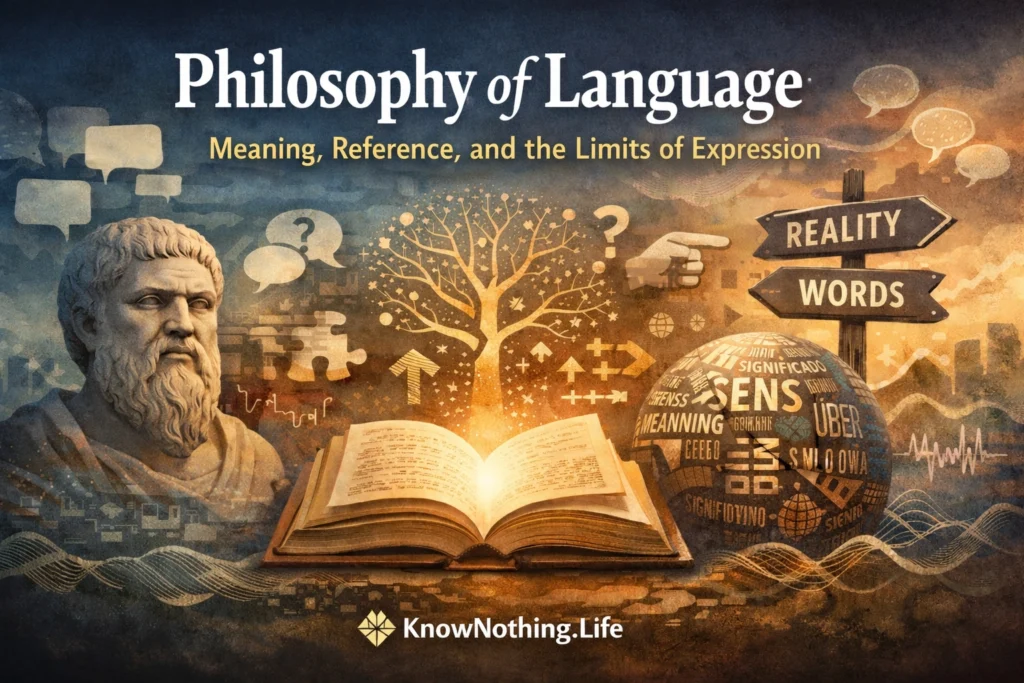
The philosophy of language stands at the intersection of philosophy, linguistics, and logic, concerned with how language connects to the world, conveys meaning, and shapes thought itself. At its core lies a deceptively simple question: how do words mean anything at all? From everyday conversations to formal scientific theories, language operates as the primary medium through which humans understand, categorize, and communicate reality. Yet the mechanisms that make meaning possible—reference, truth, intention, and context—are deeply complex and often contested.
Modern philosophy of language emerged as a central field in the late nineteenth and early twentieth centuries, particularly within the tradition of analytic philosophy. Thinkers such as Gottlob Frege, Bertrand Russell, and Ludwig Wittgenstein revolutionized the study of language by treating it not merely as a tool for expression, but as a structured system capable of logical analysis. Their work laid the foundation for ongoing debates about meaning, reference, and the relationship between language and reality—debates that continue to evolve in contemporary philosophy.
Meaning and Reference
One of the central concerns in the philosophy of language is the distinction between meaning and reference. When we use a word or phrase, we typically intend it to refer to something in the world. For example, the name “Aristotle” refers to a specific historical individual. However, as Gottlob Frege famously argued, reference alone does not fully capture meaning. Frege introduced the distinction between sense (Sinn) and reference (Bedeutung), suggesting that a term’s sense is the mode of presentation through which its reference is given. Thus, two expressions may refer to the same object while having different meanings, as in “the morning star” and “the evening star,” both of which refer to Venus.
This distinction opened the door to a more nuanced understanding of how language operates. Meaning is not merely a direct link between words and objects, but involves cognitive and conceptual structures that shape how those objects are understood. Later philosophers, including Saul Kripke, challenged aspects of Frege’s view by introducing the idea of rigid designation. Kripke argued that proper names refer directly to objects without the mediation of descriptive content, and that this reference remains fixed across possible worlds. His work reshaped debates about necessity, identity, and how language connects to reality.
Truth and Logical Structure
Another foundational issue in the philosophy of language is the nature of truth and its relationship to linguistic structure. Language is not only used to refer, but also to make statements that can be evaluated as true or false. The question, then, is what it means for a statement to be true, and how the structure of language contributes to that truth.
Bertrand Russell advanced this discussion through his theory of descriptions, which aimed to resolve ambiguities in language by translating ordinary sentences into precise logical forms. For example, the sentence “The current king of France is bald” appears meaningful, yet it refers to something that does not exist. Russell showed that by analyzing its logical structure, we can understand why the sentence is false rather than meaningless. His work demonstrated that surface grammar often conceals deeper logical forms that determine meaning and truth conditions.
Building on this, philosophers such as Alfred Tarski developed formal theories of truth, attempting to define truth in a rigorous and mathematically precise way. Tarski’s semantic conception of truth—captured in statements like “ ‘Snow is white’ is true if and only if snow is white”—provided a framework for understanding how language relates to reality without falling into paradox. These developments reinforced the idea that language can be systematically analyzed, and that its logical structure plays a crucial role in determining meaning.
Language and Use
While early analytic philosophers focused on logic and structure, later thinkers emphasized the importance of language as a social and practical activity. Ludwig Wittgenstein, in his later philosophy, rejected the idea that meaning is a fixed relation between words and objects. Instead, he argued that meaning arises from use within specific forms of life. Words do not have meaning in isolation; they gain significance through the roles they play in human practices.
Wittgenstein introduced the concept of “language games” to illustrate how meaning is shaped by context. Different activities—giving orders, telling jokes, making scientific claims—each involve distinct rules and conventions that govern how language is used. To understand a word is not to grasp an abstract definition, but to know how it functions within a particular practice. This shift marked a move away from purely formal analysis toward a more pragmatic and contextual understanding of language.
This perspective was further developed by philosophers such as J. L. Austin and John Searle, who explored how language is used to perform actions. In speech act theory, utterances are not merely descriptions of the world but can also constitute actions—promising, ordering, apologizing, and more. This insight expanded the scope of the philosophy of language, showing that meaning is not only about representation but also about intention and social interaction.
Language and Thought
The relationship between language and thought has long been a topic of philosophical debate. Does language shape how we think, or does it merely express thoughts that exist independently? Some philosophers and linguists have argued for a strong connection between the two, suggesting that the structure of a language influences the way its speakers perceive and conceptualize the world.
This idea is often associated with the linguistic relativity hypothesis, sometimes linked to figures like Benjamin Lee Whorf. According to this view, differences in language can lead to differences in cognition, affecting everything from perception to reasoning. While strong versions of this hypothesis remain controversial, there is growing evidence that language can influence certain cognitive processes, particularly in areas such as color perception, spatial reasoning, and categorization.
Philosophers have approached this issue from multiple angles. Some argue that thought is fundamentally linguistic, while others maintain that it operates in a more abstract, non-linguistic medium. Jerry Fodor, for instance, proposed the idea of a “language of thought,” a mental representation system underlying all human cognition. Whether or not such a system exists, the debate highlights the deep and intricate relationship between language and the mind.
Reference, Context, and Pragmatics
As the field has developed, increasing attention has been given to the role of context in determining meaning. Words and sentences do not exist in a vacuum; their interpretation often depends on the circumstances in which they are used. Indexical expressions such as “I,” “here,” and “now” derive their meaning directly from context, making it impossible to fully understand them without considering the speaker and situation.
Philosophers like David Kaplan have developed sophisticated theories to account for this phenomenon, distinguishing between the character of an expression (its general rule of use) and its content (what it refers to in a particular context). This distinction helps explain how the same sentence can express different propositions depending on who says it and when.
Pragmatics, the study of how context influences meaning, also examines how speakers convey more than they explicitly state. H. P. Grice introduced the concept of conversational implicature, showing how listeners infer additional meaning based on shared assumptions and cooperative principles. For example, if someone says “It’s getting late,” they may be indirectly suggesting that it is time to leave. Such implications are not encoded in the literal meaning of the sentence but arise from the context and the expectations of communication.
The Limits of Language
Despite its power, language has limits. Not everything can be easily expressed, and some aspects of experience may resist linguistic capture. This theme was central to the early work of Ludwig Wittgenstein, who famously concluded that “whereof one cannot speak, thereof one must be silent.” For Wittgenstein, language could represent facts about the world, but it could not meaningfully express ethical, aesthetic, or metaphysical truths.
This view has been both influential and controversial. Some philosophers argue that language can, in fact, be extended to address such domains, even if imperfectly. Others maintain that certain experiences—such as subjective consciousness or profound emotional states—are inherently ineffable. The tension between what can be said and what lies beyond language continues to shape philosophical inquiry.
In more recent discussions, the limits of language have also been explored in relation to artificial intelligence and formal systems. Can machines truly understand language, or do they merely manipulate symbols according to rules? This question echoes earlier debates about meaning and interpretation, suggesting that the philosophy of language remains deeply relevant in an age of technological transformation.
Conclusion
The philosophy of language is a rich and evolving field that addresses some of the most fundamental questions about human understanding. From the nature of meaning and reference to the role of context, use, and cognition, it reveals the complexity underlying even the simplest acts of communication. What begins as an inquiry into words quickly expands into a broader investigation of thought, reality, and the human condition.
Through the work of figures like Gottlob Frege, Bertrand Russell, and Ludwig Wittgenstein, the field has developed powerful tools for analyzing language and its functions. Yet it also remains open-ended, continually adapting to new insights from linguistics, psychology, and computer science. In exploring how language works, the philosophy of language ultimately illuminates how we make sense of the world—and ourselves.