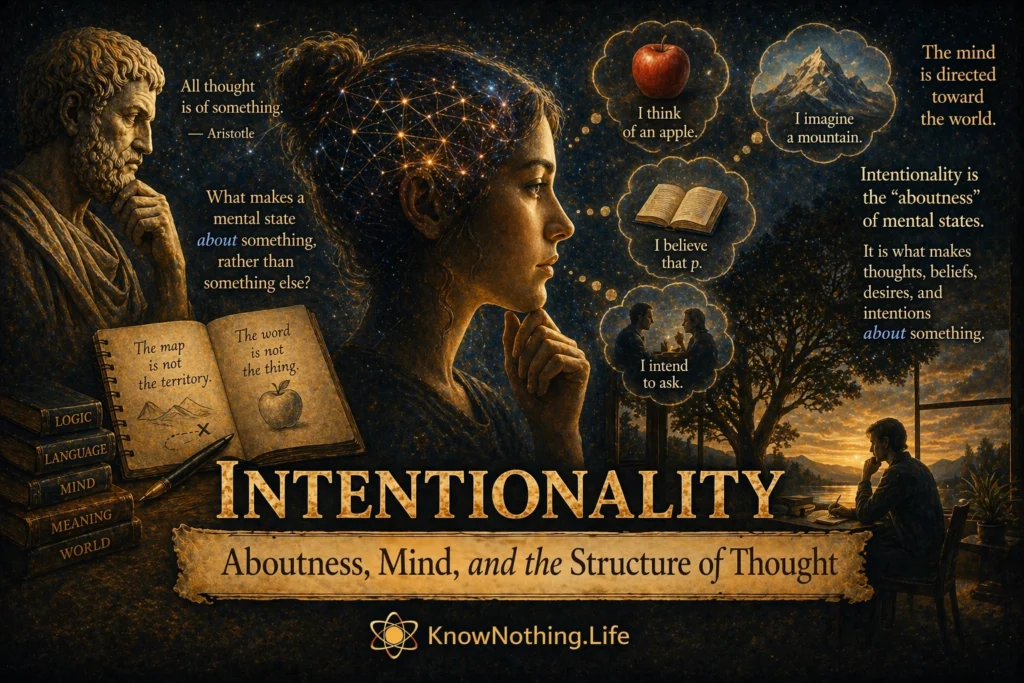
Intentionality is the philosophical concept that describes the “aboutness” of mental states—the capacity of thoughts, beliefs, desires, and perceptions to be directed toward objects, properties, or states of affairs. When you believe that it is raining, your belief is about the weather; when you desire a glass of water, your desire is directed toward a particular object. This directedness is what philosophers mean by intentionality, and it has long been considered a defining feature of the mind.
The concept traces back to medieval philosophy but was revived in modern discussions by Franz Brentano, who argued that intentionality is the mark of the mental. According to Brentano, all and only mental phenomena exhibit intentionality, distinguishing them from physical phenomena. This idea has had a lasting influence, shaping debates in the philosophy of mind, language, and cognitive science. Understanding intentionality is essential for explaining how thoughts relate to the world and how meaning arises in both mental and linguistic contexts.
The Nature of Aboutness
At its core, intentionality concerns the relationship between mental states and their objects. A belief, for instance, is not merely a mental occurrence; it is a belief about something. This raises the question of how mental states can be directed toward objects that may or may not exist. For example, one can think about fictional characters or imagine impossible scenarios, yet these thoughts still exhibit intentionality.
Philosophers have proposed various accounts of this phenomenon. Some argue that intentionality involves a form of representation, where mental states encode information about the world. Others suggest that it is a more primitive feature of the mind, not reducible to simpler components. The challenge lies in explaining how this “aboutness” arises and how it connects mental states to their objects.
The problem becomes even more complex when considering misrepresentation. A belief can be false, yet it still has intentional content. This suggests that intentionality does not depend on the existence or truth of its object, but rather on the structure of the mental state itself. Explaining this feature has been a central task in the philosophy of mind.
Intentionality and Representation
One influential approach to intentionality is the representational theory of mind, which holds that mental states are representations of the world. According to this view, thoughts function similarly to symbols, carrying information about objects and states of affairs. Jerry Fodor developed this idea through his “language of thought” hypothesis, proposing that cognition involves the manipulation of internal symbols according to syntactic rules.
This approach aligns closely with computational models of the mind, which treat thinking as a form of information processing. If mental states are representations, then intentionality can be understood in terms of how these representations are structured and used. This perspective has been influential in both philosophy and cognitive science, providing a framework for studying cognition in systematic terms.
However, critics argue that representational theories may not fully capture the richness of intentionality. They point out that representation alone may not explain how meaning arises, particularly in cases involving context, embodiment, or social interaction. These concerns have led to alternative approaches that emphasize the role of environment and practice in shaping intentional content.
Intentionality and Consciousness
Intentionality is closely linked to consciousness, though the relationship between the two is a matter of debate. Some philosophers argue that all intentional states are conscious, while others maintain that intentionality can exist without conscious awareness. For example, unconscious beliefs or desires may still be about something, even if they are not currently experienced.
John Searle has argued that intentionality is grounded in biological processes and is a fundamental feature of the mind. He distinguishes between intrinsic intentionality, which belongs to mental states, and derived intentionality, which is attributed to artifacts like language or computers. According to Searle, while machines can simulate intentionality, they do not possess it in the same way that humans do.
The connection between intentionality and consciousness raises further questions about the nature of experience. If intentionality involves directedness toward objects, then it may play a role in structuring conscious awareness. Understanding this relationship is crucial for developing a comprehensive account of the mind.
Naturalizing Intentionality
A major challenge in the philosophy of mind is the attempt to “naturalize” intentionality—that is, to explain it in terms consistent with the natural sciences. If the mind is part of the physical world, then intentionality must somehow arise from physical processes. This has led to various theories that seek to ground intentionality in causal, informational, or biological terms.
One approach is to link intentionality to causal relationships between mental states and the world. For example, a belief about fire might be caused by the presence of fire, establishing a connection between the mental state and its object. Another approach focuses on information, suggesting that mental states carry information about the world in a way analogous to signals in a communication system.
Despite these efforts, naturalizing intentionality remains a difficult task. Critics argue that purely physical explanations may fail to capture the normative aspects of intentionality, such as truth and reference. A belief can be correct or incorrect, but it is not clear how such normative properties can be reduced to physical processes. This challenge continues to drive debate in the field.
Intentionality and Language
Intentionality is also central to the philosophy of language, as linguistic expressions are typically about something. Words, sentences, and symbols derive their meaning from their ability to refer to objects and convey information. Understanding how this works requires examining the relationship between mental intentionality and linguistic meaning.
Some philosophers argue that language derives its intentionality from the minds of its users. According to this view, words have meaning because they are used by agents with intentional states. Others suggest that language itself can possess a form of intentionality, independent of individual minds. These differing perspectives reflect broader debates about the nature of meaning and communication.
Ludwig Wittgenstein emphasized the role of use and context in shaping meaning, suggesting that intentionality in language cannot be fully understood without considering social practices. This approach highlights the interplay between individual cognition and collective activity, showing that intentionality is not purely an internal phenomenon but is embedded in shared forms of life.
Challenges and Contemporary Debates
Intentionality continues to be a central topic in contemporary philosophy, with ongoing debates about its nature and implications. One key issue is whether intentionality can be fully explained in naturalistic terms or whether it requires a fundamentally different kind of explanation. Another is the relationship between intentionality and other aspects of the mind, such as consciousness and emotion.
Emerging fields such as artificial intelligence and cognitive science have brought new perspectives to these debates. As machines become more capable of processing information and interacting with the world, questions arise about whether they can possess genuine intentionality or merely simulate it. These issues have practical as well as theoretical significance, influencing how we understand intelligence and agency.
The study of intentionality also intersects with broader philosophical concerns, including the nature of truth, reference, and representation. By examining how mental states relate to the world, philosophers gain insight into the structure of thought and the foundations of knowledge.
Conclusion
Intentionality lies at the heart of our understanding of the mind, capturing the essential feature of mental states as being about something. From the foundational work of Franz Brentano to contemporary debates about representation and naturalization, it has remained a central and challenging concept in philosophy.
By exploring how thoughts, beliefs, and desires relate to the world, the study of intentionality sheds light on the nature of meaning, consciousness, and cognition. It reveals the complexity of the mind and its connections to language, reality, and human experience, ensuring its continued importance in philosophical inquiry.