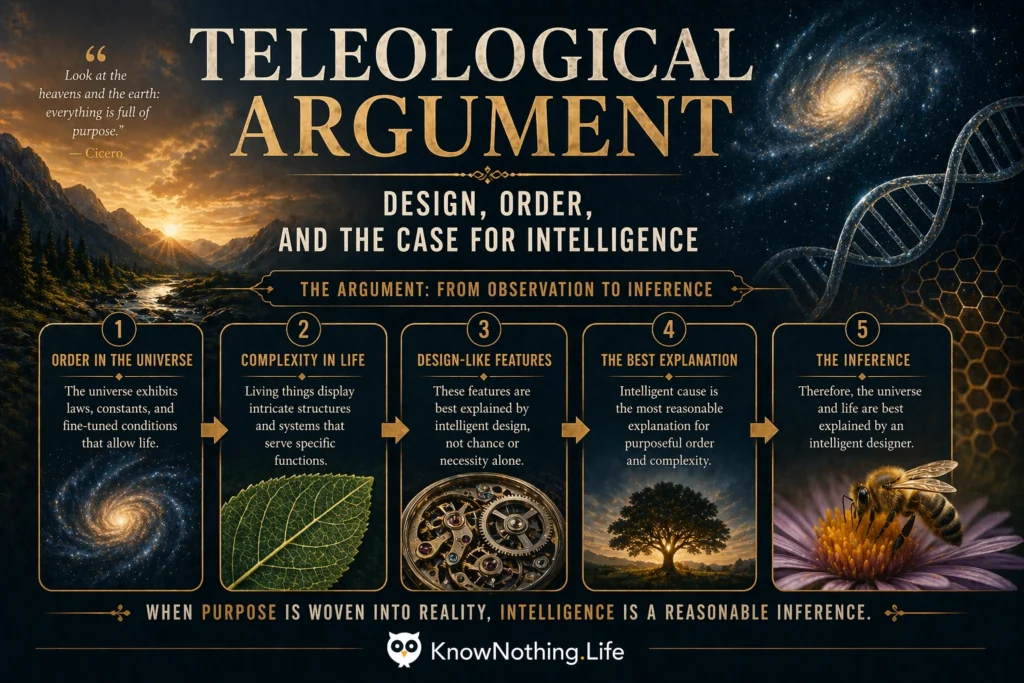
The teleological argument, often called the argument from design, is one of the most intuitive and historically influential arguments for the existence of God. It begins with the observation that the world exhibits order, complexity, and apparent purpose. From the intricate structure of living organisms to the fine-tuned laws of physics, the universe appears to be organized in ways that suggest intentional design rather than random occurrence.
The term “teleological” derives from the Greek word telos, meaning end or purpose. The argument thus focuses on the idea that natural phenomena are directed toward ends, exhibiting goal-oriented behavior or structure. Philosophers have long debated whether this apparent purpose is genuine or merely a projection of human interpretation. The teleological argument seeks to show that the best explanation for such order and purpose is the existence of an intelligent designer.
Classical Foundations
The roots of the teleological argument can be traced back to ancient philosophy. Aristotle introduced the concept of final causes, arguing that natural objects and processes are directed toward specific ends. For Aristotle, understanding a thing fully required knowing not only its material and efficient causes but also its purpose.
In medieval philosophy, this idea was integrated into theological frameworks. Thomas Aquinas presented a version of the teleological argument in his Fifth Way, arguing that non-rational objects act toward ends in a consistent manner, which implies the guidance of an intelligent being. Since these objects lack awareness, their directedness must be explained by something that possesses knowledge and intention.
These classical formulations emphasize the pervasive order and regularity of nature. The consistent behavior of natural phenomena suggests that they are not random but structured in a way that points beyond themselves. This foundational idea set the stage for later developments of the argument.
The Watchmaker Analogy
One of the most famous expressions of the teleological argument is the watchmaker analogy, developed by William Paley in the eighteenth century. Paley asked us to imagine finding a watch on the ground. Its intricate design and purposeful arrangement of parts would naturally lead us to infer the existence of a watchmaker.
Paley extended this reasoning to the natural world, arguing that the complexity and functionality of living organisms are far greater than those of a watch. The human eye, for example, exhibits a level of sophistication that seems unlikely to have arisen by chance. Therefore, he concluded, the existence of such complexity points to an intelligent designer.
The watchmaker analogy captures the intuitive appeal of the teleological argument. It relies on everyday reasoning about design and causation, making it accessible and persuasive to many. However, it also raises questions about whether the analogy between human artifacts and natural systems is valid, a point that has been extensively debated.
Evolution and Natural Explanations
The teleological argument faced a significant challenge with the development of evolutionary theory. Charles Darwin proposed that the complexity of living organisms could be explained through natural selection, a process that does not require intentional design. Over time, small variations that enhance survival are preserved, leading to the gradual emergence of complex structures.
This explanation undermines the need for a designer in accounting for biological complexity. What appears to be purposeful design can be understood as the result of cumulative, non-directed processes. Evolution provides a mechanism by which order and adaptation can arise naturally, without invoking a guiding intelligence.
Despite this challenge, proponents of the teleological argument have adapted their reasoning. Some argue that evolution itself may be part of a broader design, while others shift the focus from biological complexity to the fundamental laws and constants of the universe.
Fine-Tuning and Modern Teleology
In contemporary philosophy and cosmology, the teleological argument has been reformulated in terms of fine-tuning. The physical constants of the universe—such as the strength of gravity and the properties of fundamental particles—appear to be precisely calibrated to allow for the existence of life. Even slight variations in these constants could render the universe inhospitable.
Advocates of the fine-tuning argument contend that this precise calibration is unlikely to be the result of chance. Instead, it suggests that the universe has been designed with the conditions necessary for life. This version of the argument shifts the focus from biological organisms to the underlying structure of the cosmos.
Critics, however, offer alternative explanations, such as the multiverse hypothesis. If there are many universes with different physical constants, it is not surprising that at least one of them would support life. This debate highlights the ongoing tension between design-based and naturalistic explanations of order.
Purpose and Interpretation
A key issue in the teleological argument is whether purpose is an objective feature of the world or a projection of human interpretation. Do natural phenomena genuinely have purposes, or do we impose purposive explanations based on our own cognitive tendencies?
Philosophers have explored this question in relation to the concept of teleology itself. Some argue that purpose is a fundamental aspect of reality, while others view it as a useful way of describing complex systems. The distinction between intrinsic and extrinsic purpose becomes important here, as it determines whether teleological explanations are grounded in the world or in our perspective.
This issue also connects to broader philosophical debates about meaning and explanation. If purpose is not inherent in nature, then teleological arguments may be based on a misunderstanding of how the world works. On the other hand, if purpose is real, then it may point to a deeper metaphysical foundation.
Strengths and Criticisms
The teleological argument has several strengths. It appeals to observable features of the world, such as complexity and order, and uses intuitive reasoning about design. Its adaptability has allowed it to evolve in response to scientific developments, maintaining its relevance in contemporary discussions.
However, it also faces significant criticisms. The analogy between natural systems and human artifacts may be misleading, as the processes that produce them are fundamentally different. Additionally, natural explanations such as evolution and the multiverse challenge the necessity of a designer.
Another criticism concerns the nature of the designer itself. Even if the argument succeeds in showing that some form of intelligence is responsible for the order of the universe, it does not necessarily establish the existence of a deity with the attributes traditionally associated with God. This limitation raises questions about the scope of the argument’s conclusions.
Conclusion
The teleological argument remains a central and enduring part of philosophical discussions about the existence of God. From the classical insights of Aristotle and Thomas Aquinas to the watchmaker analogy of William Paley and modern fine-tuning arguments, it has taken many forms while retaining its core focus on design and purpose.
Although challenged by scientific and philosophical critiques, the argument continues to provoke reflection on the nature of order, complexity, and explanation. Whether one finds it convincing or not, the teleological argument offers a powerful lens through which to consider the relationship between the world and the possibility of a guiding intelligence.