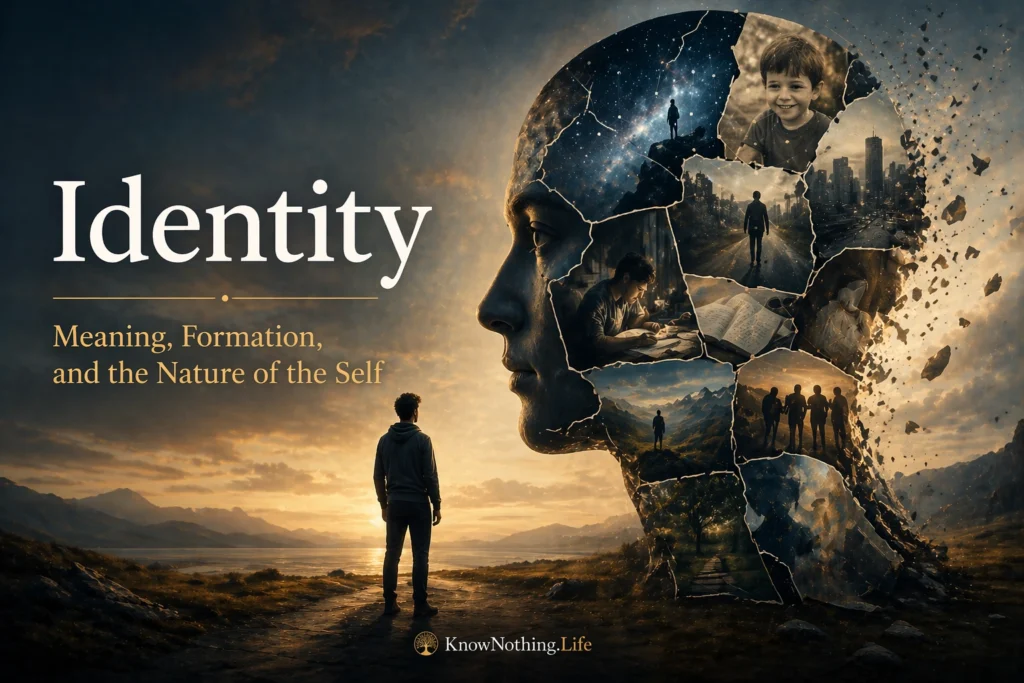
Identity is one of the most fundamental yet complex concepts in philosophy, shaping how individuals understand themselves and their place in the world. At its simplest, identity answers the question “Who am I?”—but this question quickly unfolds into layers of psychological, social, and philosophical inquiry. Identity is not merely a label or a collection of traits; it is an evolving structure that integrates memory, experience, culture, and self-perception into a coherent sense of being.
Philosophers have long debated whether identity is something stable and enduring or something fluid and constructed. Some traditions treat identity as an essential core that persists through change, while others view it as a dynamic process shaped by time, context, and relationships. In modern thought, identity has become even more multifaceted, intersecting with questions about consciousness, language, society, and technology. Understanding identity is not just an abstract exercise—it influences how individuals make decisions, form relationships, and interpret their own lives.
Historical Foundations of Identity
The philosophical exploration of identity can be traced back to ancient inquiries into the nature of being and selfhood. Early Greek philosophers sought to understand what remains constant amid change, a question that naturally extended to human identity. Heraclitus emphasized perpetual change, suggesting that one cannot step into the same river twice. This perspective implied that identity is not fixed but continuously evolving. In contrast, Parmenides argued for the permanence of being, laying the groundwork for the idea that identity must have a stable, unchanging essence.
Later, classical philosophers deepened the discussion. Plato viewed identity as tied to the soul, a rational and eternal aspect of the individual that exists beyond the physical world. Aristotle, however, emphasized substance and form, suggesting that identity arises from the integration of matter and purpose. These early frameworks introduced a central philosophical tension: whether identity is rooted in an unchanging essence or emerges from changing conditions.
As philosophy developed, this tension persisted. Medieval thinkers often aligned identity with the soul and divine order, while early modern philosophers began to shift focus toward the mind and personal experience. These evolving perspectives laid the groundwork for contemporary debates about identity as both a metaphysical and psychological phenomenon.
Personal Identity and Continuity
One of the most enduring questions in philosophy is what makes a person the same over time. Despite changes in appearance, beliefs, and circumstances, individuals tend to experience themselves as continuous beings. This sense of continuity raises important questions: What binds the past self to the present? Is identity grounded in memory, the body, or something more abstract?
John Locke offered a highly influential answer by linking identity to memory. According to Locke, personal identity is defined by the continuity of consciousness—specifically, the ability to recall past experiences. This theory suggests that identity is psychological rather than physical, rooted in awareness rather than substance. However, Locke’s view also introduces challenges. If memory defines identity, what happens in cases of amnesia or false memories? Can identity persist when memory fails or becomes unreliable?
Later philosophers critiqued and expanded upon this framework. David Hume argued that there is no stable self underlying our experiences, only a bundle of perceptions that change over time. From this perspective, continuity is an illusion created by the mind’s tendency to connect experiences. Modern debates have further complicated the issue, incorporating thought experiments involving brain transplants, cloning, and artificial intelligence. These scenarios test the limits of traditional theories and highlight the difficulty of defining identity in a world where the boundaries of the self are increasingly uncertain.
Psychological and Narrative Identity
Beyond metaphysical questions, identity is deeply tied to psychological processes. Individuals construct a sense of self by organizing experiences, beliefs, and values into a coherent framework. This psychological dimension of identity emphasizes interpretation and meaning rather than fixed essence. Identity becomes something that is actively shaped rather than passively discovered.
The narrative theory of identity, associated with thinkers like Paul Ricoeur, suggests that people understand themselves through stories. These narratives integrate past events with present understanding and future aspirations, creating a sense of continuity and purpose. Rather than existing as a static entity, identity unfolds over time as individuals reinterpret their experiences. This process is influenced by memory, imagination, and cultural context, making identity both personal and socially embedded.
At the same time, psychological identity is not entirely self-determined. External influences—such as family, culture, and language—play a significant role in shaping how individuals see themselves. The stories people tell about themselves are often shaped by the narratives available within their social environment. This interplay between internal and external factors highlights the complexity of identity as both a personal and collective phenomenon.
Social and Cultural Identity
Identity is not formed in isolation. From early childhood, individuals develop a sense of self through interaction with others and participation in social structures. Social identity encompasses aspects such as gender, ethnicity, nationality, and social roles, all of which contribute to how individuals define themselves and are perceived by others. These dimensions of identity are deeply embedded in cultural norms and historical contexts.
Philosophers and social theorists have emphasized that identity is shaped by recognition and interaction. Georg Wilhelm Friedrich Hegel argued that self-consciousness emerges through relationships with others, particularly through processes of recognition and struggle. This idea suggests that identity is not merely internal but relational, dependent on how individuals are acknowledged within their social world.
Modern discussions of identity often focus on issues of power and representation. Social identities can influence access to opportunities, shaping experiences in profound ways. The concept of intersectionality highlights how different aspects of identity intersect, creating unique combinations of privilege and disadvantage. In this context, identity becomes not only a philosophical question but also a political and ethical one, raising concerns about justice, equality, and inclusion.
The Fluidity and Construction of Identity
Contemporary philosophy increasingly emphasizes the fluid and constructed nature of identity. Rather than viewing identity as fixed, many thinkers argue that it is shaped by ongoing processes of change and adaptation. This perspective aligns with developments in psychology and sociology, which highlight the role of environment, culture, and experience in shaping the self.
Postmodern philosophers have been particularly influential in challenging traditional notions of identity. Michel Foucault explored how identity is shaped by systems of knowledge and power, suggesting that what individuals take to be their “true self” is often influenced by social structures and discourses. Similarly, Judith Butler argued that aspects of identity, such as gender, are performed rather than innate, constructed through repeated actions and social expectations.
This emphasis on construction does not necessarily imply that identity is arbitrary. Instead, it highlights the ways in which identity is shaped by context and interaction. Individuals are not entirely free to define themselves in any way they choose, but neither are they completely determined by external forces. Identity emerges from the dynamic interplay between agency and structure, allowing for both continuity and change.
Identity in the Modern World
In the contemporary era, questions of identity have taken on new significance due to technological and cultural shifts. The rise of digital platforms has created new spaces for identity expression, allowing individuals to present and reinvent themselves in ways that were previously impossible. Online identities can differ from offline ones, raising questions about authenticity and the nature of the self in a digital age.
Globalization has also contributed to the complexity of identity. As cultures interact and blend, traditional boundaries of identity become less rigid. Individuals may navigate multiple cultural frameworks, leading to hybrid identities that challenge conventional categories. This fluidity can be both liberating and disorienting, offering new possibilities while complicating the search for a stable sense of self.
At the same time, advances in science and technology are reshaping philosophical debates about identity. Developments in neuroscience, genetics, and artificial intelligence raise questions about what it means to be human. If consciousness can be replicated or altered, how does this affect our understanding of identity? These emerging challenges ensure that the philosophy of identity remains a dynamic and evolving field.
Conclusion
Identity is a multifaceted concept that resists simple definition. It encompasses questions of continuity, consciousness, social interaction, and cultural influence, making it one of the most complex subjects in philosophy. From ancient debates about permanence and change to modern discussions of narrative and social construction, identity has been understood in diverse and often conflicting ways.
What becomes clear through these explorations is that identity is neither entirely fixed nor entirely fluid. It is shaped by an ongoing interaction between internal experience and external context, between memory and transformation, between individuality and community. This dynamic nature allows identity to adapt and evolve while still providing a sense of coherence and meaning.
Ultimately, the study of identity invites deeper reflection on what it means to be human. It challenges assumptions about selfhood and encourages a more nuanced understanding of how individuals come to define themselves. As the world continues to change, so too will the ways in which identity is understood, ensuring that this enduring philosophical question remains as relevant as ever.