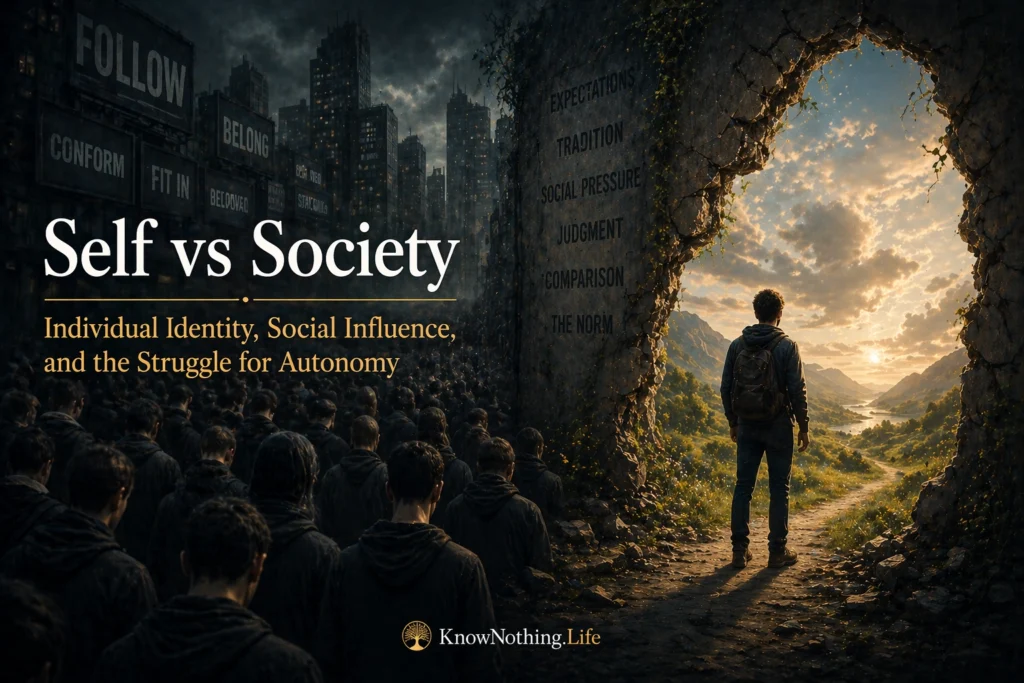
The tension between the individual and society is one of the most enduring themes in philosophy. On one side stands the self—unique, conscious, and driven by personal desires, values, and aspirations. On the other stands society—a complex network of norms, institutions, and expectations that shape behavior and define what is acceptable. The relationship between these two forces is neither purely oppositional nor entirely harmonious. Instead, it is a dynamic interplay in which identity is both formed and constrained.
The question “Who am I?” cannot be fully answered without considering the social context in which it arises. From language and culture to laws and moral systems, society provides the framework within which individuals develop a sense of self. At the same time, individuals possess the capacity to question, resist, and reshape these frameworks. The philosophy of self versus society explores this tension, examining how identity emerges at the intersection of personal agency and social influence.
Historical Perspectives on the Individual and Society
Philosophical debates about the relationship between the self and society date back to ancient times. In classical Greece, thinkers such as Plato emphasized the importance of social order and harmony, envisioning a just society in which individuals fulfill roles that contribute to the common good. For Plato, the individual’s identity was closely tied to their function within the larger structure of the state. Aristotle similarly argued that humans are inherently social beings, describing them as “political animals” whose fulfillment depends on participation in a community.
In contrast, later philosophical traditions placed greater emphasis on individual autonomy. Thomas Hobbes viewed society as a necessary construct to prevent chaos, suggesting that individuals surrender some freedoms in exchange for security. John Locke offered a more optimistic perspective, arguing that society exists to protect individual rights, including life, liberty, and property. These differing views reflect an ongoing tension between the need for social order and the desire for personal freedom.
The Enlightenment further amplified the importance of the individual, emphasizing reason, autonomy, and self-determination. Yet even within this framework, the role of society remained central. Philosophers recognized that while individuals possess inherent rights, these rights are realized and protected within a social context. The balance between individual and collective interests continues to be a central concern in modern philosophy.
The Social Construction of the Self
One of the most influential ideas in contemporary philosophy is that the self is not formed in isolation but constructed through social interaction. From birth, individuals are immersed in a network of relationships that shape their understanding of the world. Language, in particular, plays a crucial role, providing the categories and concepts through which individuals interpret their experiences.
Georg Wilhelm Friedrich Hegel argued that self-consciousness arises through recognition by others. According to Hegel, individuals come to understand themselves not only through introspection but through their interactions with other people. This process of recognition is essential for the development of identity, highlighting the fundamentally social nature of the self.
Sociological perspectives further emphasize this point, suggesting that identity is shaped by roles and expectations. Individuals internalize social norms, adopting behaviors and values that align with their cultural environment. While this process enables social cohesion, it also raises questions about authenticity. If the self is shaped by external influences, to what extent can individuals claim ownership of their identity? The social construction of the self suggests that individuality is always intertwined with the collective.
Conformity, Norms, and Social Pressure
Society exerts a powerful influence on individual behavior through norms and expectations. These norms provide guidelines for acceptable conduct, enabling coordination and cooperation within a community. However, they also create pressure to conform, often limiting individual expression. The tension between conformity and individuality is a central theme in the philosophy of self versus society.
Philosophers and social theorists have explored the mechanisms through which conformity operates. Michel Foucault examined how power is embedded in social institutions, shaping behavior through subtle forms of control. Rather than relying solely on coercion, modern societies often regulate individuals through norms and expectations that are internalized over time. This internalization can make social control appear natural, even inevitable.
At the same time, conformity is not inherently negative. It allows individuals to function within a shared framework, facilitating communication and cooperation. The challenge lies in balancing the benefits of social order with the need for personal freedom. Excessive conformity can suppress creativity and individuality, while complete rejection of norms can lead to fragmentation and instability. Navigating this balance requires a nuanced understanding of the relationship between the self and society.
Autonomy and Resistance
Despite the powerful influence of society, individuals are not passive recipients of social norms. They possess the capacity for autonomy—the ability to reflect on and choose their actions. Autonomy allows individuals to question societal expectations, challenge injustices, and redefine their identities. This capacity for resistance is a defining feature of human agency.
Existentialist philosophers such as Jean-Paul Sartre emphasized the importance of individual freedom, arguing that individuals are responsible for creating their own essence through their choices. For Sartre, society may impose constraints, but it cannot determine the individual’s identity. The self is ultimately defined by action, not by external labels or expectations.
Resistance to society can take many forms, from subtle acts of nonconformity to large-scale social movements. These acts of resistance highlight the dynamic nature of the relationship between the individual and the collective. While society shapes the self, individuals also have the power to reshape society. This reciprocal relationship underscores the complexity of the tension between self and society.
Identity, Belonging, and Conflict
The relationship between self and society is not only a matter of influence and resistance—it is also a source of identity and belonging. Humans have an inherent need to connect with others, to feel part of a community. Social identities, such as cultural, national, or professional affiliations, provide a sense of belonging and meaning. These identities can enrich individual experience, offering support and shared purpose.
However, this sense of belonging can also create conflict. Individuals may struggle to reconcile personal values with societal expectations, leading to tension and uncertainty. Conflicts can arise when societal norms clash with individual beliefs, forcing individuals to choose between conformity and authenticity. These conflicts are often deeply personal, shaping the trajectory of one’s life and identity.
Philosophical discussions of identity highlight the importance of navigating these tensions. Rather than viewing self and society as opposing forces, many thinkers emphasize their interdependence. Identity is formed through interaction, and belonging does not necessarily require conformity. The challenge lies in finding a balance that allows for both connection and individuality.
Self vs Society in the Modern World
In the modern era, the tension between self and society has taken on new dimensions. Globalization, technological advancements, and cultural shifts have transformed the ways in which individuals interact with society. Digital platforms, for example, provide new spaces for self-expression while also introducing new forms of social pressure and comparison.
Social media illustrates this dual dynamic. On one hand, it allows individuals to present their identities and connect with others across the globe. On the other hand, it can reinforce conformity by promoting certain standards of success, beauty, and behavior. The curated nature of online identities can blur the line between authenticity and performance, complicating the relationship between self and society.
At the same time, modern societies are increasingly diverse, offering a wider range of identities and perspectives. This diversity can empower individuals to explore different aspects of themselves, but it can also create challenges in navigating conflicting norms and expectations. The modern context highlights the ongoing relevance of the philosophical tension between self and society, demonstrating that it is not a problem to be solved but a condition to be understood.
Conclusion
The relationship between self and society is a complex and dynamic interplay that shapes human identity. Society provides the framework within which individuals develop, offering norms, values, and structures that enable social life. At the same time, individuals possess the capacity for autonomy, allowing them to question and reshape these frameworks.
Philosophical exploration reveals that the tension between self and society is not a simple opposition but a interdependency. It is through interaction with others that individuals come to understand themselves, yet it is through personal reflection and choice that they define who they are. This interplay creates both opportunities and challenges, shaping the way individuals navigate their lives.
Ultimately, the philosophy of self versus society invites a deeper understanding of what it means to be human. It highlights the importance of balancing individuality with belonging, autonomy with connection, and freedom with responsibility. In this balance lies the ongoing process of identity formation, a process that continues to evolve alongside the societies in which it unfolds.