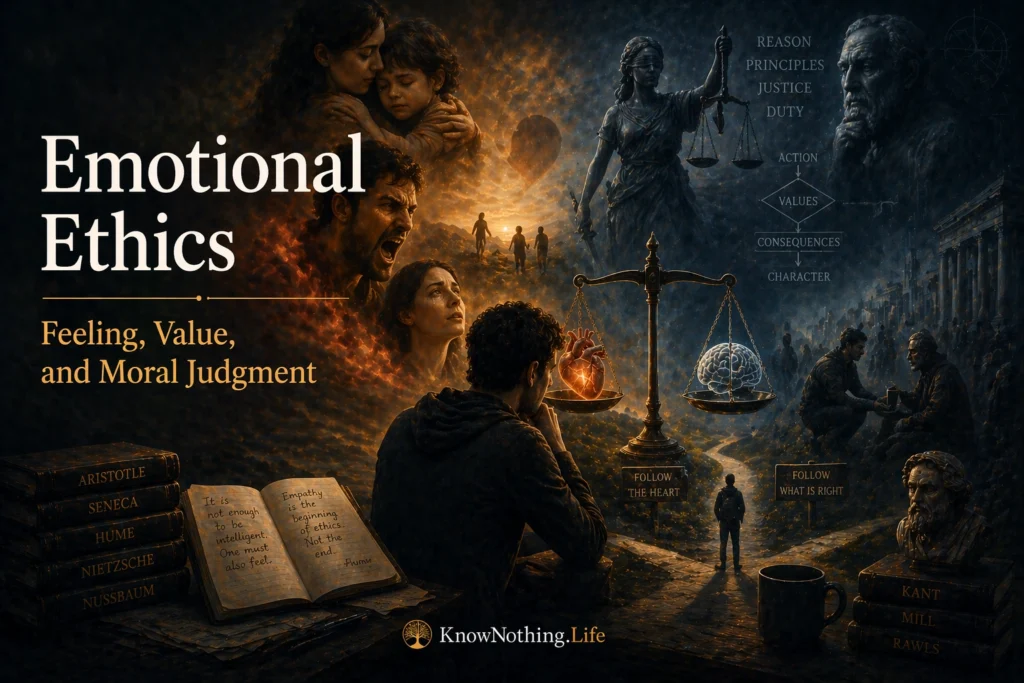
Ethics is often associated with principles, rules, and rational deliberation. Yet moral life is not lived in abstraction—it unfolds through lived experience, where emotions shape perception, motivation, and judgment. Emotional ethics examines the role of feeling in moral reasoning, asking whether emotions merely influence ethical decisions or whether they are essential to them. It challenges the assumption that morality must be detached from emotion, proposing instead that emotions can reveal moral truths and guide ethical action.
Emotions such as empathy, guilt, compassion, and indignation play a central role in how individuals respond to others. They inform judgments about right and wrong, influencing not only what people believe but how they act. The question is not whether emotions affect ethics—they clearly do—but whether they can be trusted as reliable guides. Emotional ethics seeks to understand the relationship between feeling and moral reasoning, exploring how emotions can both illuminate and distort ethical understanding.
Historical Perspectives on Emotion and Morality
Philosophical approaches to emotion and ethics have varied widely throughout history. In classical thought, Aristotle argued that emotions are integral to moral virtue. In his view, ethical behavior involves not only acting rightly but feeling appropriately. Virtue requires cultivating emotions so that they align with reason, enabling individuals to respond to situations with the right degree of feeling. This perspective treats emotions as essential components of ethical character.
In contrast, Immanuel Kant emphasized the primacy of reason in morality, arguing that ethical principles must be grounded in rational duty rather than emotional inclination. For Kant, actions motivated by emotion lack moral worth if they are not guided by rational principles. This view reflects a broader tradition that treats emotion with suspicion, seeing it as potentially unreliable and subjective.
Between these positions lies a range of intermediate views. David Hume argued that moral distinctions are derived from sentiment rather than reason, suggesting that emotions form the basis of ethical judgment. These differing perspectives highlight an enduring debate: whether morality is fundamentally rational, emotional, or a combination of both.
Emotions as Moral Perception
One of the central ideas in emotional ethics is that emotions function as forms of moral perception. Just as the senses provide information about the physical world, emotions can provide insight into moral values. Empathy, for example, allows individuals to perceive the suffering of others, while indignation highlights perceived injustices. These emotional responses draw attention to morally significant features of situations, shaping how individuals understand and evaluate them.
Philosophers such as Martha Nussbaum have argued that emotions are not merely reactions but judgments about what matters. According to this view, emotions reflect evaluations of value, expressing concerns about well-being, fairness, and human flourishing. This evaluative structure allows emotions to be assessed in terms of rationality and appropriateness.
However, the idea of emotions as moral perception raises important questions. If emotions are shaped by personal experience and cultural context, can they provide objective insight? While emotions can reveal moral significance, they can also be influenced by bias and prejudice. Emotional ethics must therefore address the challenge of distinguishing between reliable and distorted emotional responses.
Empathy, Compassion, and Moral Motivation
Empathy and compassion are among the most significant emotions in moral life. They enable individuals to understand and respond to the experiences of others, fostering concern and care. Without these emotions, moral reasoning would lack a crucial motivational component, as individuals might recognize ethical principles without feeling compelled to act on them.
Philosophers like Adam Smith emphasized the importance of sympathy in moral judgment, arguing that the ability to share in the feelings of others is foundational to ethical understanding. This capacity allows individuals to evaluate actions not only from their own perspective but from the perspective of those affected. Empathy thus bridges the gap between self and other, enabling a more comprehensive view of moral situations.
At the same time, empathy and compassion are not infallible. They can be selective, influenced by proximity, familiarity, and personal bias. Individuals may feel strong empathy for those close to them while remaining indifferent to distant suffering. Emotional ethics must therefore consider how to cultivate and extend these emotions in ways that support broader moral principles, ensuring that they contribute to fairness and justice.
Emotional Bias and Ethical Distortion
While emotions can enhance moral understanding, they can also introduce bias and distortion. Emotional responses are often shaped by unconscious influences, including cultural norms, personal experiences, and cognitive shortcuts. These influences can lead to ethical judgments that are inconsistent or unjust, reflecting emotional reactions rather than reasoned evaluation.
Philosophers have explored the ways in which emotions can mislead moral judgment. Baruch Spinoza argued that emotions can arise from inadequate understanding, leading individuals to act in ways that do not align with their true interests. Similarly, modern thinkers highlight the role of implicit bias in shaping emotional responses, suggesting that emotions can reinforce existing inequalities and prejudices.
Addressing emotional bias requires critical reflection and self-awareness. Individuals must examine their emotional responses, questioning whether they accurately reflect moral values or are influenced by irrelevant factors. Emotional ethics does not reject emotion but seeks to refine it, integrating feeling with reason to achieve more balanced and just judgments.
The Integration of Emotion and Reason
A central goal of emotional ethics is to understand how emotion and reason can be integrated in moral decision-making. Rather than viewing them as opposing forces, many philosophers argue that they are complementary. Emotions provide insight into value and motivation, while reason evaluates and organizes these insights, ensuring consistency and coherence.
Aristotle’s concept of virtue illustrates this integration. Virtue involves not only rational judgment but the cultivation of appropriate emotional responses. By aligning emotion with reason, individuals develop a stable and coherent moral character. This approach suggests that ethical development is not solely a matter of intellectual understanding but also of emotional cultivation.
Contemporary perspectives support this integrated view, emphasizing the importance of both cognitive and affective processes in moral reasoning. Emotional ethics thus involves a dynamic interplay between feeling and thought, where each informs and shapes the other. This integration allows for more nuanced and effective ethical decision-making, reflecting the complexity of real-world situations.
Emotional Ethics in Contemporary Contexts
In the modern world, emotional ethics has gained increased relevance as societies grapple with complex moral challenges. Issues such as social justice, global inequality, and technological change require not only rational analysis but also emotional engagement. Emotions can drive awareness and action, highlighting issues that might otherwise be overlooked.
At the same time, contemporary environments can amplify emotional responses in ways that complicate ethical reasoning. Media and technology often evoke strong emotions, sometimes leading to polarization and conflict. Navigating these dynamics requires a careful balance, ensuring that emotional responses are informed by reflection and guided by ethical principles.
The study of emotional ethics also intersects with fields such as psychology and neuroscience, which provide insights into how emotions function and how they can be regulated. These interdisciplinary approaches enrich philosophical inquiry, offering practical tools for cultivating ethical awareness and improving decision-making.
Conclusion
Emotional ethics reveals that morality is not solely a matter of abstract reasoning but is deeply rooted in human feeling. Emotions play a central role in shaping moral perception, motivation, and judgment, influencing how individuals understand and respond to ethical situations. While emotions can provide valuable insight into what matters, they are also susceptible to bias and distortion.
The challenge of emotional ethics lies in balancing these aspects, integrating emotion with reason to achieve more reliable and just outcomes. This requires cultivating emotional awareness, reflecting on biases, and aligning feelings with ethical principles. Rather than suppressing emotion, emotional ethics seeks to refine and guide it, recognizing its essential role in moral life.
Ultimately, the study of emotional ethics offers a deeper understanding of the human condition. It highlights the interplay between feeling and thought, showing that ethical life is not only about what we think but also about what we feel. By examining this relationship, we gain insight into how to live more thoughtfully, compassionately, and justly.