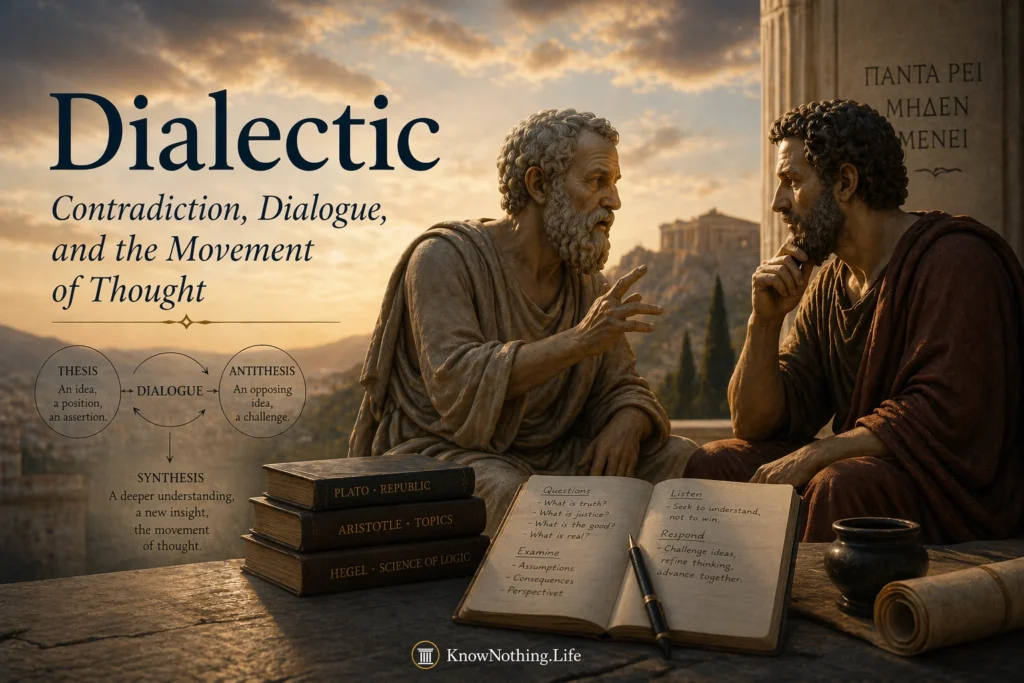
Dialectic is one of the most enduring and versatile methods in philosophy, centered on the idea that truth emerges through the tension and resolution of opposing ideas. Rather than treating contradiction as a failure of reasoning, dialectic views it as a driving force of intellectual progress. It is a method that unfolds through dialogue, critique, and transformation, revealing deeper insights by confronting conflicting perspectives.
From ancient philosophy to modern critical theory, dialectic has taken many forms, each reflecting different assumptions about knowledge, reality, and change. Whether understood as a method of questioning, a logical structure, or a dynamic process of development, dialectic offers a powerful framework for exploring complexity. It challenges static thinking, emphasizing that understanding evolves through engagement with difference and opposition.
Origins in Ancient Philosophy
The roots of dialectic can be traced to ancient Greek philosophy, particularly the work of Socrates. In Socratic dialogue, dialectic appears as a method of questioning aimed at uncovering contradictions in a person’s beliefs. By exposing inconsistencies, Socrates sought to guide his interlocutors toward clearer and more coherent understanding. This form of dialectic emphasizes critical inquiry and the refinement of ideas through conversation.
Later, Plato developed dialectic into a more systematic method for arriving at knowledge. In his dialogues, dialectic becomes a process of ascending from opinion to truth, moving through stages of questioning and reasoning. Plato viewed dialectic as the highest form of philosophical inquiry, capable of revealing the underlying structure of reality. These early formulations established dialectic as both a method of argument and a pathway to deeper insight.
Dialectic as Logical Method
In its classical form, dialectic is often associated with the interplay between opposing propositions. A commonly cited structure involves a thesis, an antithesis, and a synthesis, where the conflict between two ideas leads to a resolution that incorporates elements of both. While this formulation is often simplified, it captures the essence of dialectical thinking: progress occurs through the confrontation and integration of differences.
Dialectic as a logical method differs from formal logic, which seeks to avoid contradiction. Instead, it engages directly with contradiction, treating it as a source of insight rather than an obstacle. This approach allows philosophers to explore tensions within concepts, revealing complexities that might otherwise remain hidden. By embracing contradiction, dialectic provides a way of thinking that is dynamic and responsive to change.
Hegelian Dialectic
The most influential modern development of dialectic is found in the philosophy of G. W. F. Hegel. For Hegel, dialectic is not merely a method of argument but a fundamental process that governs reality itself. He argued that ideas and historical developments unfold through a dialectical movement, where contradictions within a system lead to its transformation and eventual resolution.
Hegel’s dialectic emphasizes development and progression, viewing history as a rational process in which freedom and self-awareness gradually emerge. Each stage of development contains internal tensions that drive it toward a higher level of integration. This perspective transforms dialectic from a tool of reasoning into a comprehensive framework for understanding change in thought, society, and history.
Marx and Materialist Dialectic
Karl Marx adapted Hegel’s dialectic into a materialist framework, focusing on economic and social conditions rather than abstract ideas. Marx argued that historical change is driven by conflicts between social classes, particularly between those who own the means of production and those who labor within them. This form of dialectic, often called dialectical materialism, emphasizes the role of material conditions in shaping human history.
In Marx’s view, contradictions within economic systems—such as the tension between capital and labor—generate social संघर्ष and transformation. Unlike Hegel’s emphasis on ideas, Marx grounded dialectic in concrete realities, linking philosophical concepts to social and political change. This adaptation demonstrates the flexibility of dialectic as a method, capable of addressing both abstract and practical concerns.
Dialectic and Dialogue
Beyond its role in logical and historical analysis, dialectic remains closely tied to dialogue. The exchange of ideas between individuals, each bringing different perspectives, mirrors the dialectical process. Through discussion, disagreement, and clarification, participants refine their understanding and move closer to insight.
This dialogical dimension highlights the social nature of knowledge. Dialectic is not only an individual process of reasoning but also a collective endeavor, where understanding emerges through interaction. It encourages openness to alternative viewpoints and a willingness to engage with opposing arguments, fostering a more inclusive and dynamic approach to inquiry.
Dialectic in Contemporary Thought
In contemporary philosophy and critical theory, dialectic continues to play a significant role. Thinkers have adapted and reinterpreted dialectical methods to address issues such as power, ideology, and cultural change. The work of Theodor Adorno, for example, emphasizes negative dialectics, which resists the idea of final synthesis and instead focuses on the persistence of contradiction.
This approach reflects a skepticism toward totalizing systems and highlights the importance of critical reflection. Dialectic becomes a tool for questioning assumptions, exposing contradictions, and resisting simplistic conclusions. In this way, it remains a vital method for engaging with complex and evolving social realities.
Strengths and Criticisms
Dialectic offers several strengths as a philosophical method. Its emphasis on contradiction and change allows it to address complexity in a way that static models cannot. By integrating opposing perspectives, it provides a framework for understanding development and transformation across different domains.
However, dialectic is not without criticism. Some argue that its reliance on broad conceptual movements can lead to ambiguity or overgeneralization. Others question whether the idea of synthesis adequately captures the persistence of conflict and difference. These critiques highlight the need for careful application and critical evaluation of dialectical reasoning, ensuring that it remains grounded and precise.
Dialectic and the Nature of Truth
Dialectic also raises important questions about the nature of truth. Rather than viewing truth as a fixed and isolated entity, dialectical approaches often see it as emerging through a process of engagement and development. Truth is not simply discovered but unfolds through the interaction of ideas, shaped by context and perspective.
This dynamic view of truth challenges traditional notions of certainty, suggesting that understanding is always provisional and open to revision. Dialectic thus aligns with broader philosophical perspectives that emphasize the evolving nature of knowledge, highlighting the importance of ongoing inquiry and critical reflection.
Conclusion
Dialectic is a powerful and multifaceted method that has shaped philosophical thought across centuries. From its origins in Socratic dialogue to its development in Hegelian and Marxist theory, it offers a framework for understanding contradiction, change, and the movement of ideas. By embracing opposition and transformation, dialectic provides a dynamic approach to inquiry that reflects the complexity of both thought and reality.
Ultimately, dialectic is more than a method; it is a way of thinking that recognizes the importance of engagement, critique, and development. It challenges us to move beyond static perspectives and to see understanding as an evolving process. In doing so, it remains a central and enduring tool for exploring the deepest questions of philosophy.