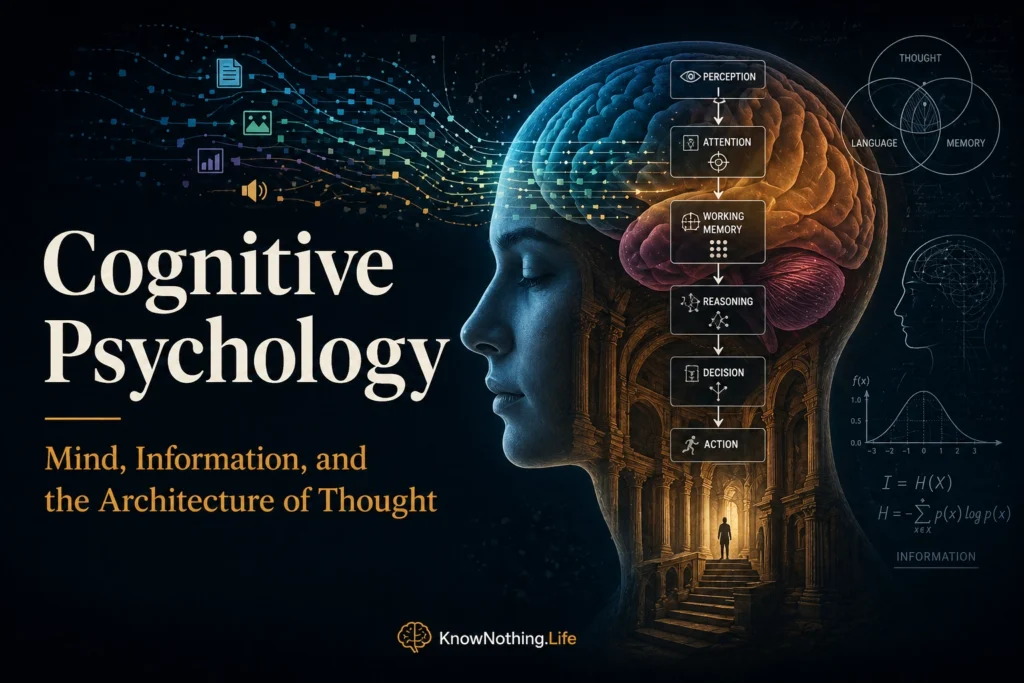
Cognitive psychology is the scientific study of how the mind processes information—how we perceive the world, attend to certain stimuli while ignoring others, store and retrieve memories, use language, solve problems, and make decisions. Emerging as a distinct discipline in the mid-20th century, it marked a decisive shift away from behaviorism’s exclusive focus on observable actions toward a deeper investigation of the invisible mental processes that generate behavior. Rather than treating the mind as a “black box,” cognitive psychology seeks to map its internal structure, identifying the mechanisms that transform sensory input into meaningful experience and purposeful action.
At its core, cognitive psychology treats the human mind as an active system that interprets, organizes, and transforms information. This perspective draws heavily on analogies to computing systems, where inputs are processed through layers of representation and transformation to produce outputs. Yet the mind is not merely a machine; it is shaped by biology, development, culture, and emotion. Modern cognitive psychology therefore integrates insights from neuroscience, artificial intelligence, linguistics, and philosophy to build a comprehensive model of thought. It is both an empirical science grounded in experimentation and a theoretical framework for understanding what it means to think, know, and be aware.
The Cognitive Revolution and Historical Foundations
The rise of cognitive psychology is often referred to as the “cognitive revolution,” a period in the 1950s and 1960s when researchers began to challenge the dominance of behaviorism. Behaviorists such as B. F. Skinner argued that psychology should concern itself only with observable behavior, dismissing mental processes as speculative or unscientific. However, this approach struggled to explain complex phenomena such as language acquisition, reasoning, and problem-solving. The limitations of behaviorism created an intellectual opening for a new paradigm.
Key figures in this transformation included Ulric Neisser, who formally defined cognitive psychology in his 1967 book Cognitive Psychology, and George A. Miller, whose research on memory capacity revealed the limits of human information processing. Linguist Noam Chomsky played a pivotal role by criticizing behaviorist accounts of language, arguing that humans possess innate cognitive structures that enable language learning. Together, these thinkers helped reorient psychology toward the study of internal mental representations and processes.
The cognitive revolution was also fueled by advances in computer science and information theory. Early computers provided a powerful metaphor for understanding the mind as an information-processing system, while developments in neuroscience offered new tools for investigating the brain’s role in cognition. Over time, cognitive psychology evolved into a central pillar of modern psychology, influencing fields as diverse as education, artificial intelligence, clinical psychology, and human-computer interaction.
Perception and Attention: Constructing Reality
Perception is not a passive recording of the external world but an active process of interpretation. The brain receives fragmented and often ambiguous sensory data, which it organizes into coherent representations of objects, events, and environments. Cognitive psychologists study how this transformation occurs, exploring how prior knowledge, expectations, and context shape what we perceive. Visual illusions, for example, reveal that perception is guided by assumptions the brain makes about the world, sometimes leading to systematic errors.
Attention operates as a selective filter within this perceptual system, determining which information is processed deeply and which is ignored. Given the overwhelming amount of sensory input we encounter at any moment, attention allows us to focus on what is relevant to our goals while suppressing distractions. Research on attention has identified mechanisms such as selective attention, divided attention, and sustained attention, each of which plays a critical role in everyday functioning. Failures of attention, such as inattentional blindness, demonstrate how easily important information can be missed when it falls outside our focus.
The interaction between perception and attention underscores a central insight of cognitive psychology: reality, as we experience it, is constructed. What we see, hear, and feel is shaped not only by the external world but also by the internal processes that interpret it. This has profound implications for understanding everything from eyewitness testimony to aesthetic experience, highlighting the active role of the mind in shaping perception.
Memory Systems: Encoding, Storage, and Retrieval
Memory is one of the most extensively studied domains in cognitive psychology, encompassing the processes by which information is encoded, stored, and retrieved. Rather than being a single system, memory is composed of multiple subsystems, each with distinct characteristics and functions. Sensory memory briefly holds incoming information, while short-term or working memory allows for the temporary manipulation of information needed for tasks such as reasoning and comprehension. Long-term memory stores information over extended periods, ranging from minutes to a lifetime.
Within long-term memory, cognitive psychologists distinguish between explicit and implicit forms. Explicit memory involves conscious recall of facts and events, while implicit memory influences behavior without conscious awareness, as seen in skills and habits. Episodic memory allows individuals to recall specific experiences, whereas semantic memory stores general knowledge about the world. These distinctions reveal the complexity of memory and challenge the intuitive notion of memory as a simple recording device.
Memory is also reconstructive rather than reproductive. When we recall an event, we do not retrieve a perfect copy of the original experience; instead, we reconstruct it using fragments of stored information, guided by schemas—mental frameworks that organize knowledge. This reconstructive nature makes memory susceptible to distortion, as demonstrated by research on false memories. Understanding how memory works has significant implications for education, therapy, and the legal system, where the reliability of memory is often taken for granted.
Language and Thought: The Structure of Meaning
Language is one of the most distinctive features of human cognition, enabling complex communication and abstract thought. Cognitive psychologists investigate how language is acquired, processed, and represented in the mind. Research has shown that language comprehension involves multiple levels of processing, from recognizing sounds and words to interpreting syntax and meaning. This process occurs rapidly and largely automatically, reflecting the efficiency of the cognitive systems involved.
The relationship between language and thought has been a subject of enduring debate. Some theorists argue that language shapes thought, a view associated with linguistic relativity, while others maintain that thought is fundamentally independent of language. Evidence suggests that the relationship is nuanced: language can influence how we categorize and remember information, but many forms of cognition, such as visual thinking and problem-solving, can occur without linguistic mediation.
Language also provides a window into the structure of the mind. The ability of children to acquire language rapidly and with limited input supports the idea that humans possess innate cognitive capacities. At the same time, cultural and social factors play a crucial role in shaping language use and development. By studying language, cognitive psychology reveals the interplay between biological endowment and environmental influence in shaping human cognition.
Thinking, Problem-Solving, and Decision-Making
Thinking encompasses a wide range of cognitive activities, including reasoning, problem-solving, and decision-making. Cognitive psychologists examine how individuals represent problems, generate solutions, and evaluate outcomes. Research has identified strategies such as algorithms, which guarantee a correct solution but may be time-consuming, and heuristics, which provide efficient shortcuts but can lead to errors. These strategies reflect the mind’s attempt to balance accuracy and efficiency in processing information.
Decision-making research has revealed that human reasoning is often influenced by biases and heuristics. For example, individuals may rely on the availability heuristic, judging the likelihood of events based on how easily examples come to mind, or the representativeness heuristic, assessing similarity rather than probability. These cognitive shortcuts can be useful but also lead to systematic errors, particularly in complex or uncertain situations.
The study of thinking and decision-making has practical applications in fields such as economics, public policy, and medicine. Understanding how people make decisions can inform interventions designed to improve judgment and reduce bias. It also challenges the assumption that humans are fully rational actors, highlighting the ways in which cognition is shaped by limitations, context, and emotion.
Cognitive Neuroscience: Bridging Mind and Brain
Cognitive neuroscience represents the integration of cognitive psychology with neuroscience, aiming to understand how mental processes are implemented in the brain. Advances in brain imaging techniques, such as functional magnetic resonance imaging (fMRI) and electroencephalography (EEG), have made it possible to observe neural activity associated with specific cognitive functions. These tools have provided valuable insights into the neural basis of perception, memory, language, and decision-making.
Research in cognitive neuroscience has identified specialized brain regions associated with different cognitive functions, while also emphasizing the distributed nature of neural processing. For example, memory involves interactions between the hippocampus and various cortical areas, while language processing engages networks across multiple regions of the brain. This perspective challenges simplistic notions of localization, highlighting the complexity of brain organization.
The integration of cognitive psychology and neuroscience has also led to new approaches to understanding and treating cognitive disorders. Conditions such as Alzheimer’s disease, attention deficit hyperactivity disorder (ADHD), and traumatic brain injury can be studied in terms of both their cognitive and neural components. This interdisciplinary approach enhances our ability to develop effective interventions and deepens our understanding of the relationship between mind and brain.
Applications and Future Directions
Cognitive psychology has far-reaching applications across a wide range of domains. In education, insights into memory and learning have informed teaching strategies that enhance retention and comprehension. In clinical psychology, cognitive approaches have led to therapies that address maladaptive thought patterns, such as cognitive-behavioral therapy (CBT). In technology, principles of human cognition guide the design of user interfaces, making them more intuitive and efficient.
The field continues to evolve, incorporating new methods and perspectives. Advances in artificial intelligence have created opportunities for modeling cognitive processes, while big data and computational approaches allow for more sophisticated analyses of behavior. At the same time, there is growing recognition of the importance of context, culture, and embodiment in shaping cognition, leading to more holistic models of the mind.
Future research in cognitive psychology is likely to focus on integrating multiple levels of analysis, from neural mechanisms to social and cultural influences. As our understanding of the mind deepens, cognitive psychology will continue to play a central role in addressing fundamental questions about human nature, intelligence, and consciousness. It remains a dynamic and evolving field, driven by the enduring quest to understand how we think, learn, and experience the world.