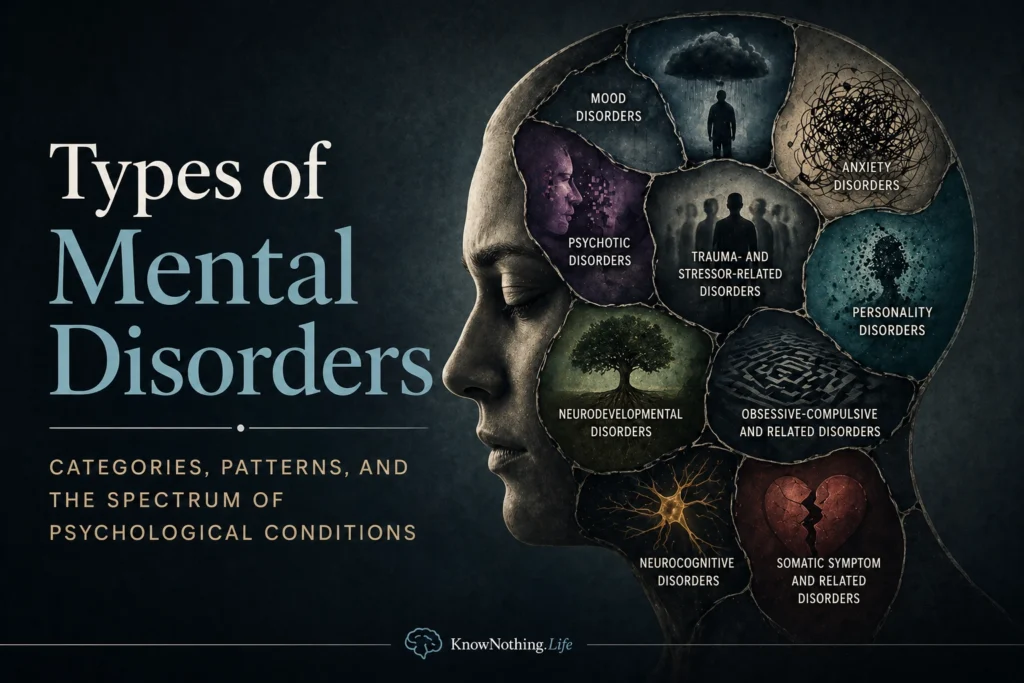
Mental disorders encompass a wide range of conditions that affect thinking, emotion, and behavior. They vary in severity, duration, and impact, but all involve patterns of experience that cause distress or impair functioning. Understanding the types of mental disorders is a central task of abnormal psychology, providing a framework for diagnosis, research, and treatment.
Modern classification systems, such as the Diagnostic and Statistical Manual of Mental Disorders developed by the American Psychiatric Association, organize disorders into categories based on shared features. While these categories are useful for clinical practice, they also reflect evolving scientific knowledge and cultural perspectives. As psychiatrist Emil Kraepelin emphasized, classification is essential for understanding mental illness, but it must be continually refined as new evidence emerges.
Anxiety Disorders
Anxiety disorders are among the most common mental health conditions, characterized by excessive fear, worry, and physiological arousal. These disorders include generalized anxiety disorder, panic disorder, and specific phobias, each involving different patterns of anxiety but sharing a core feature of heightened sensitivity to perceived threats.
Individuals with anxiety disorders often experience persistent worry that is difficult to control, along with physical symptoms such as increased heart rate, muscle tension, and restlessness. Panic disorder involves sudden episodes of intense fear, known as panic attacks, which can occur without warning and lead to avoidance behaviors. Phobias, on the other hand, are focused fears of specific objects or situations, such as heights or social interactions.
Psychologist Joseph LeDoux has shown that the amygdala plays a key role in fear processing, highlighting the biological basis of anxiety. His research suggests that anxiety disorders involve heightened activation of neural circuits associated with threat detection, illustrating the interplay between brain function and emotional experience.
Mood Disorders
Mood disorders involve disturbances in emotional state, affecting how individuals feel over extended periods. The most well-known mood disorders are depression and bipolar disorder. Depression is characterized by persistent sadness, loss of interest, and changes in cognition and behavior, while bipolar disorder involves alternating periods of depression and elevated mood, known as mania.
Depression can affect every aspect of life, including sleep, appetite, and energy levels. It is often accompanied by negative thought patterns, such as feelings of worthlessness or hopelessness. Bipolar disorder, in contrast, includes episodes of heightened energy, impulsivity, and euphoria, which can be followed by severe depressive episodes.
Psychiatrist Aaron T. Beck developed cognitive theories of depression, suggesting that negative thought patterns play a central role in the disorder. His work has influenced therapeutic approaches, particularly cognitive-behavioral therapy, which aims to modify these patterns and improve mood.
Psychotic Disorders
Psychotic disorders involve disruptions in perception and thought, often including hallucinations and delusions. Schizophrenia is the most well-known example, characterized by symptoms such as disorganized thinking, impaired functioning, and a loss of contact with reality.
Hallucinations involve perceiving stimuli that are not present, such as hearing voices, while delusions are strongly held beliefs that are not based in reality. These symptoms can significantly impair an individual’s ability to function, affecting relationships, work, and daily activities.
Neuroscientist Eric R. Kandel has emphasized the biological basis of mental disorders, noting that “all mental processes are biological processes.” In the context of psychotic disorders, this perspective highlights the role of brain structure and neurotransmitter systems in shaping perception and thought.
Personality Disorders
Personality disorders are characterized by enduring patterns of behavior, cognition, and inner experience that deviate from cultural expectations and cause distress or impairment. These patterns are typically inflexible and pervasive, affecting multiple areas of life.
Examples include borderline personality disorder, which involves instability in relationships and self-image, and antisocial personality disorder, characterized by disregard for the rights of others. Unlike many other disorders, personality disorders are often deeply ingrained, making them more challenging to treat.
Psychologist Theodore Millon contributed significantly to the classification of personality disorders, emphasizing the role of personality structure in understanding these conditions. His work highlights the complexity of personality and its influence on behavior.
Neurodevelopmental Disorders
Neurodevelopmental disorders are conditions that emerge during early development and affect cognitive, social, and behavioral functioning. These include autism spectrum disorder (ASD), attention-deficit/hyperactivity disorder (ADHD), and learning disorders.
ASD is characterized by difficulties in social communication and restricted or repetitive behaviors. ADHD involves patterns of inattention, hyperactivity, and impulsivity that interfere with functioning. Learning disorders affect specific academic skills, such as reading or mathematics.
Developmental psychologist Jean Piaget emphasized the importance of early development in shaping cognitive and behavioral outcomes. Neurodevelopmental disorders illustrate how variations in development can lead to distinct patterns of functioning, highlighting the role of both biological and environmental factors.
Trauma- and Stress-Related Disorders
Trauma– and stress-related disorders arise from exposure to significant stressors or traumatic events. Post-traumatic stress disorder (PTSD) is a primary example, involving symptoms such as intrusive memories, avoidance, and heightened arousal following trauma.
These disorders reflect the impact of extreme stress on the brain and behavior. Individuals may experience persistent fear, difficulty regulating emotions, and changes in cognition, such as negative beliefs about themselves or the world.
Psychiatrist Bessel van der Kolk has explored the effects of trauma on the body and mind, arguing in The Body Keeps the Score that trauma is stored not only in memory but also in physiological processes. This perspective highlights the deep and lasting impact of traumatic experiences.
Substance-Related and Addictive Disorders
Substance-related and addictive disorders involve the misuse of substances such as alcohol or drugs, as well as behavioral addictions such as gambling. These disorders are characterized by compulsive use despite negative consequences, reflecting changes in the brain’s reward system.
Addiction is associated with alterations in dopamine pathways, which reinforce behaviors that produce pleasure. Over time, these changes can lead to tolerance, dependence, and withdrawal, making it difficult for individuals to stop using substances.
Neuroscientist Nora D. Volkow has emphasized that addiction is a brain disorder, involving changes in neural circuits related to reward, motivation, and self-control. This perspective has influenced approaches to treatment, emphasizing both biological and behavioral interventions.
Conclusion
The classification of mental disorders provides a framework for understanding the diverse ways in which psychological functioning can be disrupted. From anxiety and mood disorders to neurodevelopmental and substance-related conditions, each category reflects distinct patterns of experience and underlying mechanisms.
While these categories are useful for diagnosis and treatment, they also highlight the complexity of mental health. Disorders often overlap, and individuals may experience multiple conditions simultaneously. As research continues to advance, the understanding of mental disorders will evolve, integrating biological, psychological, and social perspectives.
Ultimately, the study of mental disorders underscores the diversity of human experience, challenging us to develop compassionate and effective approaches to care. By recognizing the patterns and processes that underlie these conditions, psychology contributes to improving the lives of those affected and advancing our understanding of the human mind.