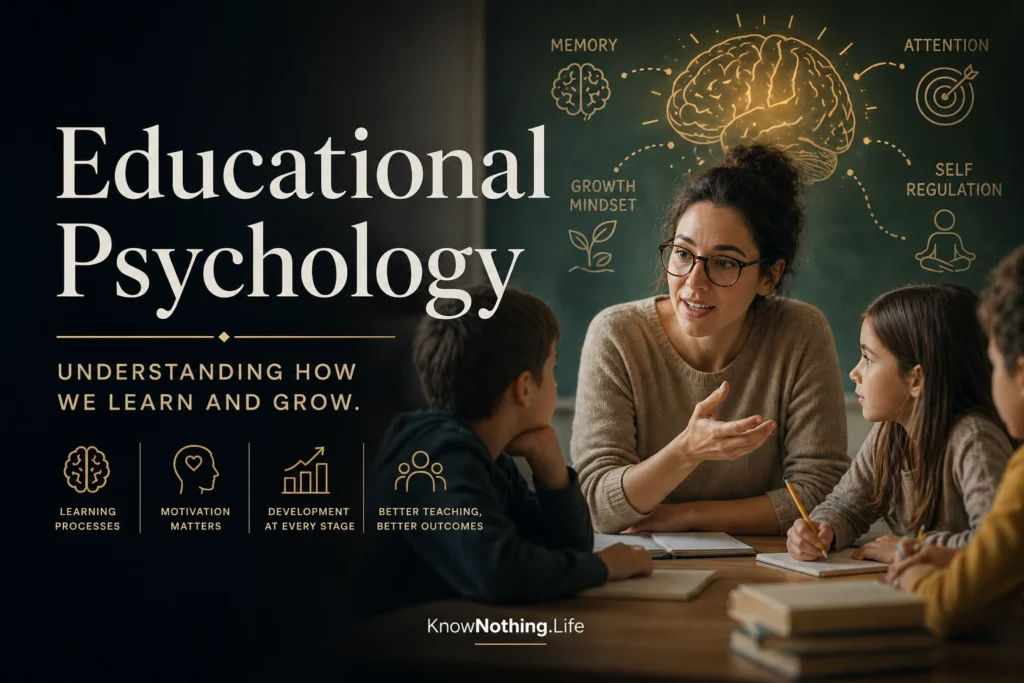
Educational psychology is the scientific study of how people learn and how teaching can be optimized to support that learning. It bridges psychology and education, drawing on cognitive, developmental, social, and behavioral sciences to understand how knowledge is acquired, retained, and applied. At its core, educational psychology seeks to answer practical and theoretical questions: What conditions foster effective learning? How do students differ in their abilities and motivations? And how can educators design environments that promote deep understanding rather than superficial memorization?
The field has evolved alongside broader developments in psychology, moving from early behaviorist models of conditioning to more complex views emphasizing cognition, social interaction, and cultural context. As Jean Piaget famously argued, “The principal goal of education is to create men and women who are capable of doing new things, not simply repeating what other generations have done.” This statement captures the central mission of educational psychology: to cultivate not only knowledge but also creativity, critical thinking, and adaptability.
Historical Foundations and Major Theories
The origins of educational psychology can be traced to the late 19th and early 20th centuries, when psychologists began applying scientific methods to the study of learning. Early figures such as Edward Thorndike emphasized the role of stimulus-response associations, proposing the “law of effect,” which states that behaviors followed by satisfying outcomes are more likely to be repeated. Thorndike’s work laid the foundation for behaviorist approaches to education, which focus on reinforcement and practice.
Behaviorism reached its peak with B. F. Skinner, who developed the concept of operant conditioning. In The Technology of Teaching, Skinner argued that “education is what survives when what has been learned has been forgotten,” highlighting the importance of lasting behavioral change. While behaviorist methods proved effective for certain types of learning, they were later complemented by cognitive theories that emphasized internal mental processes. These shifts marked a transition from viewing learners as passive recipients of information to active participants in constructing knowledge.
Cognitive Development and Learning
Cognitive development is a central concern in educational psychology, as it shapes how learners perceive, process, and understand information. Piaget’s theory of cognitive development proposed that children progress through distinct stages—sensorimotor, preoperational, concrete operational, and formal operational—each characterized by different ways of thinking. According to Piaget, learning occurs through processes of assimilation and accommodation, as individuals integrate new information into existing mental frameworks.
Building on and challenging Piaget’s work, Lev Vygotsky emphasized the social and cultural dimensions of learning. His concept of the “zone of proximal development” (ZPD) describes the range of tasks that learners can perform with guidance but not yet independently. Vygotsky argued that “learning awakens a variety of internal developmental processes,” suggesting that instruction plays a crucial role in shaping cognitive growth. The idea of scaffolding—providing temporary support to facilitate learning—has become a cornerstone of modern educational practice.
Motivation and Engagement
Motivation is a key determinant of learning, influencing the effort, persistence, and strategies that students employ. Educational psychologists distinguish between intrinsic motivation, which arises from genuine interest or enjoyment, and extrinsic motivation, which is driven by external rewards or pressures. Both forms can influence learning, but intrinsic motivation is generally associated with deeper engagement and long-term retention.
The work of Carol Dweck on mindset has had a significant impact on understanding motivation in education. Dweck distinguishes between a fixed mindset, in which individuals believe their abilities are static, and a growth mindset, in which they view abilities as developable through effort. She writes, “Becoming is better than being,” emphasizing that the process of learning is more important than the outcome. Similarly, self-determination theory, developed by Edward Deci and Richard Ryan, highlights the importance of autonomy, competence, and relatedness in fostering motivation. These insights underscore that effective education must address not only cognitive processes but also emotional and motivational factors.
Learning Processes and Memory
Understanding how information is encoded, stored, and retrieved is essential for effective teaching. Cognitive psychology has provided valuable insights into memory processes, including the distinction between working memory and long-term memory. Working memory has limited capacity, which means that instructional design must avoid cognitive overload by presenting information in manageable chunks.
Research by George A. Miller, particularly his concept of the “magical number seven, plus or minus two,” highlighted the limitations of short-term memory. More recent work by John Sweller on cognitive load theory has expanded this understanding, emphasizing that learning is most effective when instructional materials are designed to align with the brain’s processing capabilities. Techniques such as spaced repetition, retrieval practice, and elaborative rehearsal have been shown to enhance memory and retention. These findings demonstrate that effective learning depends not only on what is taught but also on how it is presented.
Individual Differences and Diversity
Educational psychology recognizes that learners differ in their abilities, backgrounds, and experiences, which influence how they learn. Factors such as intelligence, prior knowledge, cultural context, and learning preferences all play a role in shaping educational outcomes. Understanding these differences is essential for creating inclusive and effective learning environments.
The concept of multiple intelligences, proposed by Howard Gardner, challenged traditional views of intelligence by suggesting that individuals possess different types of cognitive strengths, such as linguistic, logical-mathematical, spatial, and interpersonal abilities. While this theory has been debated, it has encouraged educators to adopt more diverse teaching methods. Additionally, research on culturally responsive teaching emphasizes the importance of aligning instruction with students’ cultural backgrounds and experiences. As educator Gloria Ladson-Billings has argued, “Students must experience academic success, develop cultural competence, and cultivate a critical consciousness,” highlighting the need for education that is both inclusive and empowering.
Assessment and Feedback
Assessment is a critical component of education, providing information about student learning and guiding instructional decisions. Educational psychology distinguishes between formative assessment, which is used to monitor progress and provide feedback during learning, and summative assessment, which evaluates outcomes at the end of a learning period. Effective assessment practices are aligned with learning objectives and provide meaningful insights into student understanding.
Feedback, in particular, plays a vital role in learning. Research by John Hattie has shown that feedback is one of the most powerful influences on student achievement. In Visible Learning, Hattie notes, “The most powerful single modification that enhances achievement is feedback.” However, not all feedback is equally effective; it must be timely, specific, and focused on improvement rather than simply evaluation. These principles highlight the importance of using assessment not as a tool for judgment, but as a means of supporting learning.
Technology and Modern Learning Environments
The integration of technology into education has transformed how learning occurs, creating new opportunities and challenges. Digital tools, online platforms, and interactive media have expanded access to information and enabled new forms of engagement. Educational psychology plays a crucial role in understanding how these technologies can be used effectively to enhance learning.
Research on multimedia learning, particularly by Richard E. Mayer, has shown that combining visual and verbal information can improve understanding when designed appropriately. Mayer’s cognitive theory of multimedia learning emphasizes that learners must actively process information to construct meaningful knowledge. At the same time, concerns about distraction, information overload, and digital inequality highlight the need for thoughtful integration of technology. As Mayer states, “People learn more deeply from words and pictures than from words alone,” provided that the design aligns with cognitive principles.
Future Directions in Educational Psychology
As education continues to evolve, educational psychology is expanding to address new challenges and opportunities. Topics such as personalized learning, artificial intelligence, and global education are reshaping how knowledge is delivered and assessed. Advances in neuroscience are also providing insights into brain development and learning processes, offering potential for more targeted and effective interventions.
There is also growing emphasis on social-emotional learning, which focuses on skills such as empathy, self-regulation, and collaboration. These competencies are increasingly recognized as essential for success in both academic and real-world contexts. As Daniel Goleman has argued, “In a very real sense we have two minds, one that thinks and one that feels,” suggesting that education must address both cognitive and emotional dimensions. The future of educational psychology lies in integrating these perspectives to create more holistic and adaptive learning environments.
Conclusion
Educational psychology provides a comprehensive framework for understanding how people learn and how teaching can be improved. By integrating insights from cognitive, developmental, and social psychology, it offers practical strategies for enhancing learning outcomes and addressing individual differences. From foundational theories to modern innovations, the field continues to evolve in response to changing educational needs.
Ultimately, educational psychology underscores that learning is not a passive process but an active and dynamic interaction between the learner and their environment. By applying its principles, educators can create environments that foster curiosity, resilience, and lifelong learning, preparing individuals to navigate an increasingly complex world.