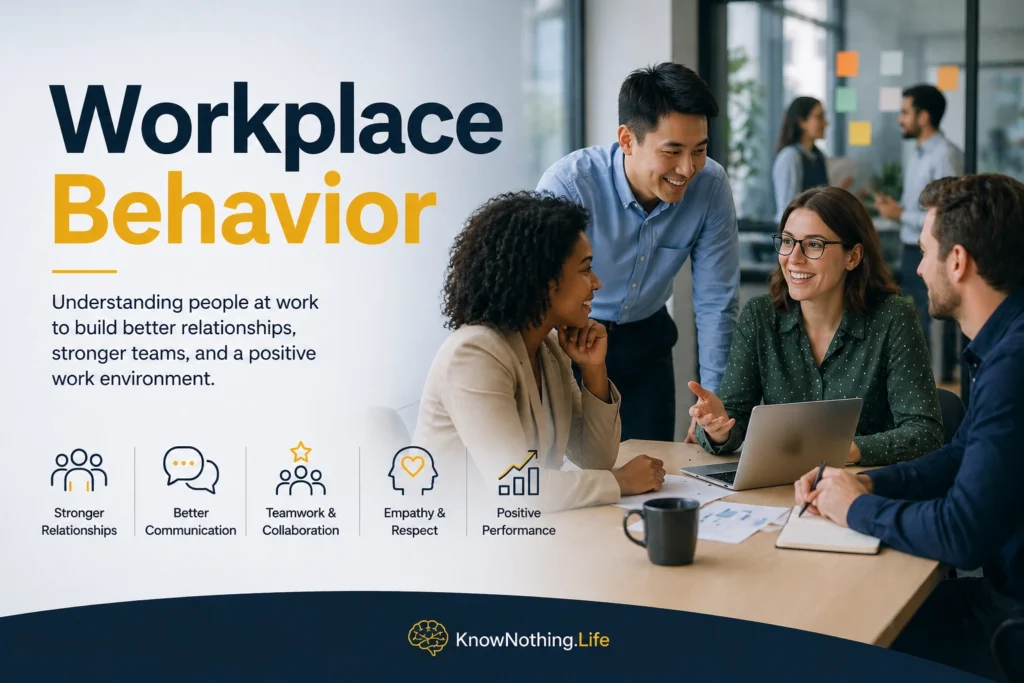
Workplace behavior refers to the patterns of action, interaction, and decision-making exhibited by individuals and groups within organizational settings. It encompasses a wide range of phenomena, from task performance and communication to leadership, ethics, and organizational culture. Understanding workplace behavior is essential for improving productivity, fostering collaboration, and promoting employee well-being. As organizations become more complex and interconnected, the study of behavior at work has become a central focus of industrial-organizational psychology.
The significance of workplace behavior lies in its impact on both individual and organizational outcomes. Employees’ attitudes, motivations, and interactions shape not only their own performance but also the effectiveness of teams and the success of organizations as a whole. As management theorist Peter Drucker observed, “Culture eats strategy for breakfast,” emphasizing that human behavior and organizational culture often determine whether strategic plans succeed or fail. This insight underscores the importance of understanding the psychological and social dynamics that drive behavior in the workplace.
Individual Behavior and Personality
At the individual level, workplace behavior is influenced by personality, values, attitudes, and cognitive processes. Personality traits, such as those described in the Five-Factor Model—openness, conscientiousness, extraversion, agreeableness, and neuroticism—play a significant role in shaping how individuals approach tasks and interact with others. For example, conscientious individuals tend to be organized and reliable, while extraverted individuals may excel in roles requiring social interaction.
Research by Lewis Goldberg and others has demonstrated the predictive value of personality traits in job performance and organizational behavior. However, personality is only one part of the equation; attitudes and perceptions also play a crucial role. Job satisfaction, organizational commitment, and perceived fairness influence how employees behave and respond to challenges. As psychologist Edwin A. Locke noted, “Job satisfaction results from the perception that one’s job fulfills or allows the fulfillment of one’s important job values,” highlighting the importance of alignment between individual and organizational goals.
Motivation and Performance
Motivation is a key driver of workplace behavior, influencing the direction, intensity, and persistence of effort. Employees who are motivated are more likely to engage in their work, pursue goals, and overcome obstacles. Theories of motivation provide insight into what drives behavior and how organizations can foster engagement.
One influential framework is self-determination theory, developed by Edward Deci and Richard Ryan, which emphasizes the importance of autonomy, competence, and relatedness. According to this theory, individuals are most motivated when they feel a sense of control over their work, believe they are capable of success, and experience meaningful connections with others. Similarly, goal-setting theory, developed by Edwin A. Locke and Gary Latham, highlights the role of clear and challenging goals in enhancing performance. Locke and Latham argued that “specific and challenging goals lead to higher performance than easy or vague goals,” emphasizing the importance of direction and feedback.
Group Dynamics and Team Behavior
Workplace behavior is not limited to individuals; it also involves the dynamics of groups and teams. Team behavior is shaped by factors such as communication, trust, cohesion, and leadership. Effective teams are characterized by clear roles, shared goals, and open communication, enabling members to collaborate and solve problems effectively.
Research by Bruce Tuckman introduced the stages of group development—forming, storming, norming, and performing—providing a framework for understanding how teams evolve over time. Tuckman’s model highlights that conflict and adjustment are natural parts of team development, leading to greater cohesion and effectiveness. Additionally, the concept of psychological safety, popularized by Amy Edmondson, emphasizes the importance of creating an environment where individuals feel safe to express ideas and take risks. Edmondson notes, “Psychological safety is not about being nice; it is about giving candid feedback, openly admitting mistakes, and learning from each other,” underscoring its role in fostering innovation and collaboration.
Leadership and Influence
Leadership plays a central role in shaping workplace behavior, influencing how individuals and teams function within organizations. Effective leaders not only direct and coordinate activities but also inspire, motivate, and support their employees. Different leadership styles can have varying effects on behavior, depending on the context and the needs of the organization.
Transformational leadership, developed by Bernard Bass and building on the work of James MacGregor Burns, focuses on inspiring and empowering employees to achieve higher levels of performance. Bass argued that transformational leaders “motivate followers to do more than they originally expected to do,” highlighting the power of vision and inspiration. In contrast, transactional leadership emphasizes structure, rewards, and performance management. Both approaches can be effective, but transformational leadership is often associated with greater engagement and innovation.
Organizational Culture and Climate
Organizational culture refers to the shared values, beliefs, and norms that shape behavior within an organization. It influences how employees interact, make decisions, and respond to challenges. Culture is often described as the “personality” of an organization, reflecting its identity and guiding principles.
Research by Edgar Schein has been instrumental in understanding culture, which he defines as “a pattern of shared basic assumptions learned by a group.” Organizational climate, on the other hand, reflects employees’ perceptions of their work environment, including factors such as support, fairness, and communication. A positive culture and climate can enhance motivation, satisfaction, and performance, while a negative environment can lead to conflict and disengagement. Understanding and shaping culture is therefore a key responsibility for leaders and organizations.
Workplace Ethics and Behavior
Ethical behavior is a critical aspect of workplace behavior, influencing trust, reputation, and organizational integrity. Employees are often faced with ethical dilemmas, requiring them to balance personal values with organizational expectations. Ethical behavior is shaped by individual factors, such as moral reasoning, as well as organizational factors, such as culture and leadership.
Research by Lawrence Kohlberg on moral development provides insight into how individuals make ethical decisions, suggesting that moral reasoning evolves through stages. Organizations can promote ethical behavior by establishing clear policies, fostering a culture of integrity, and providing ethical leadership. As philosopher Immanuel Kant argued, “Act only according to that maxim whereby you can, at the same time, will that it should become a universal law,” emphasizing the importance of principled decision-making.
Stress, Well-Being, and Work-Life Balance
Workplace behavior is closely linked to employee well-being, as stress and work demands can significantly impact health and performance. Chronic stress can lead to burnout, reduced productivity, and negative health outcomes, making it a major concern for organizations. Understanding how employees cope with stress and maintain balance is essential for promoting well-being.
Research by Christina Maslach has identified burnout as a response to chronic workplace stress, characterized by emotional exhaustion, depersonalization, and reduced personal accomplishment. Maslach notes, “Burnout is not a problem of people, but of the social environment in which people work,” highlighting the role of organizational factors. Strategies such as flexible work arrangements, supportive leadership, and wellness programs can help mitigate stress and promote a healthier work environment.
Technology and Modern Workplace Behavior
The rise of technology has transformed workplace behavior, introducing new ways of working and interacting. Remote work, digital communication, and automation have reshaped organizational dynamics, creating both opportunities and challenges. Technology can enhance productivity and flexibility, but it can also lead to issues such as isolation, communication breakdowns, and information overload.
Understanding how technology influences behavior is an emerging area of research in I-O psychology. Organizations must adapt their practices to support effective communication, collaboration, and well-being in digital environments. As technology continues to evolve, the ability to manage its impact on behavior will be critical for organizational success.
Future Directions in Workplace Behavior
The future of workplace behavior research is likely to focus on the integration of psychological, technological, and social perspectives. Topics such as diversity and inclusion, remote work, and artificial intelligence are reshaping how organizations operate and how employees interact. These changes require new approaches to leadership, communication, and performance management.
There is also growing emphasis on creating workplaces that are not only productive but also meaningful and fulfilling. Employees increasingly seek purpose and alignment with organizational values, making it important for organizations to address these needs. As workplace behavior continues to evolve, the insights of psychology will remain essential in understanding and guiding human interaction in organizations.
Conclusion
Workplace behavior is a complex and multifaceted phenomenon that influences both individual and organizational outcomes. By examining the factors that shape behavior—such as personality, motivation, leadership, and culture—organizations can create environments that support performance, collaboration, and well-being.
Ultimately, understanding workplace behavior is not only about improving efficiency but also about fostering a positive and sustainable work environment. As organizations navigate the challenges of a rapidly changing world, the study of workplace behavior will continue to play a vital role in shaping the future of work.