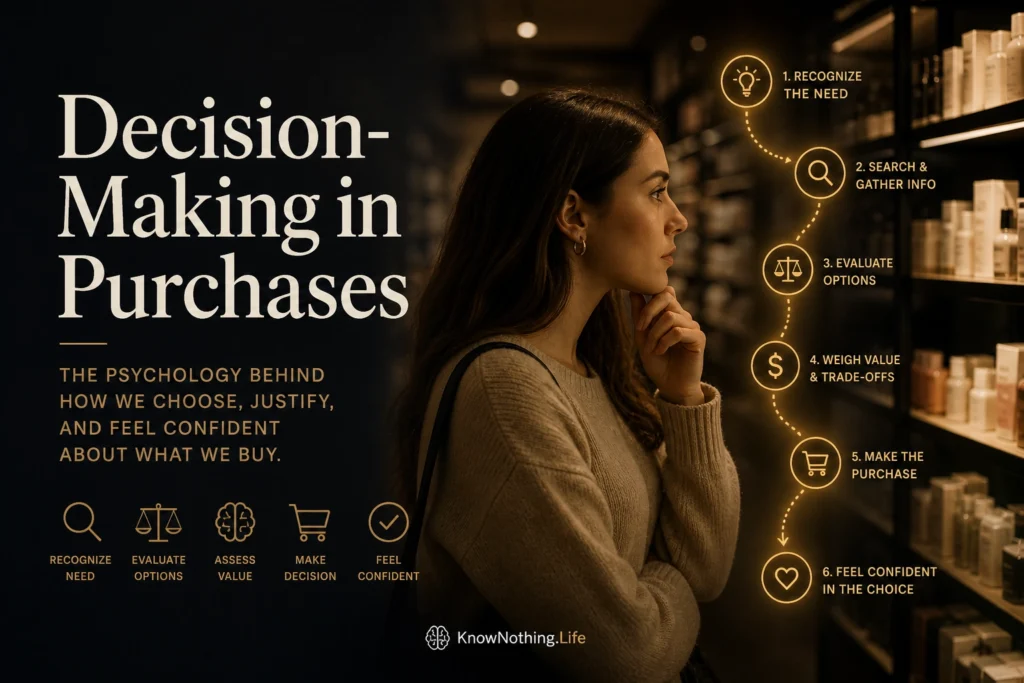
Decision-making in purchases is the psychological process through which consumers recognize a need, evaluate options, judge value, manage risk, and choose whether or not to buy. On the surface, purchase decisions may appear straightforward: a person wants something, compares prices and features, and selects the best option. In reality, buying decisions are shaped by a complex mixture of reason, emotion, habit, memory, social influence, identity, timing, and environment. Consumers do think, but they do not think like perfect calculators. They make decisions with limited attention, incomplete information, emotional pressure, and marketplace cues designed to guide perception.
The study of purchase decision-making draws from consumer psychology, behavioral economics, marketing, and social psychology. Herbert Simon’s theory of “bounded rationality,” Daniel Kahneman and Amos Tversky’s work on heuristics and biases, Robert Cialdini’s principles of persuasion, Philip Kotler’s marketing theory, and Leon Festinger’s theory of cognitive dissonance all help explain why people buy what they buy. Kahneman wrote in Thinking, Fast and Slow that “a reliable way to make people believe in falsehoods is frequent repetition,” a line that applies powerfully to branding and advertising. Purchase decisions are not made in a vacuum. They are shaped by repeated exposure, emotional framing, social proof, perceived value, and the consumer’s own desire to make a choice that feels both useful and meaningful.
Need Recognition and the Beginning of Choice
Every purchase decision begins with some form of need recognition. The consumer becomes aware of a gap between the current state and a desired state. This gap may be practical, such as needing food, transportation, clothing, or technology. It may also be emotional or symbolic, such as wanting to feel attractive, secure, successful, modern, respected, or in control. A person may buy a winter coat because they are cold, but they may choose a particular coat because it expresses taste, status, identity, or belonging. The first stage of purchase decision-making is therefore not merely about need, but about how need is interpreted.
Abraham Maslow’s “A Theory of Human Motivation” remains useful because it shows that human needs range from physiological survival to safety, belonging, esteem, and self-actualization. Consumer decisions often connect ordinary goods to these deeper psychological motives. A home security system speaks to safety; a luxury product may speak to esteem; a course, book, or fitness program may speak to self-improvement. Ernest Dichter, in The Strategy of Desire, argued that products often carry hidden meanings beneath their practical uses. This insight is crucial: consumers frequently believe they are buying a product, when psychologically they are also buying a feeling, a role, or a possible version of themselves.
Information Search and Limited Attention
After recognizing a need, consumers may search for information. This search may be internal, drawing on memory, past experience, and familiar brands, or external pressures, involving reviews, advertisements, search engines, friends, influencers, comparison sites, and expert recommendations. The amount of searching depends on the importance of the purchase, the cost, the perceived risk, and the consumer’s confidence. A person buying a house, car, or medical product may search extensively, while someone buying toothpaste or coffee may rely on habit and familiarity.
Herbert Simon’s work is especially important here. In Administrative Behavior, Simon argued that human beings do not have unlimited time or cognitive capacity. His concept of “bounded rationality” explains why consumers rarely evaluate every possible option. Simon later observed that “a wealth of information creates a poverty of attention,” a statement that captures the modern shopping environment perfectly. Consumers have access to more information than ever, but more information does not always produce better decisions. Too many reviews, too many product variations, and too many competing claims can create confusion, fatigue, and avoidance. Decision-making in purchases is therefore shaped as much by attention limits as by available information.
Evaluation of Alternatives
Once consumers gather information, they compare alternatives. They may consider price, quality, convenience, brand reputation, aesthetics, reviews, warranties, delivery speed, ethical values, and personal fit. However, consumers do not weigh these factors in a perfectly objective way. They often use mental shortcuts to simplify the decision. A familiar brand may feel safer. A higher price may suggest better quality. A product with many positive reviews may seem more trustworthy. An attractive package may imply superior performance, even before the product is used.
Daniel Kahneman and Amos Tversky’s research on heuristics and biases explains why evaluation can be efficient yet imperfect. In Thinking, Fast and Slow, Kahneman distinguished between fast, intuitive thinking and slower, more analytical thinking. Many purchase decisions begin with a quick impression: “this looks reliable,” “this feels cheap,” “this brand seems like me,” or “this offer feels urgent.” Only afterward do consumers justify the decision rationally. Kahneman’s observation that “what you see is all there is” describes a common consumer problem: people judge based on the information most available to them, even when important missing information would change the decision.
Emotion and the Purchase Moment
Emotion strongly influences purchase decisions. Consumers may buy because they feel excitement, anxiety, relief, nostalgia, envy, pride, fear, or hope. Emotional states can shift preferences quickly. A person under stress may value convenience more than price. A person feeling insecure may be more receptive to beauty, status, or self-improvement appeals. A person celebrating may spend more freely than they would under normal circumstances. Purchase decisions are therefore not only shaped by stable preferences, but by temporary moods and emotional contexts.
George Loewenstein’s work on visceral factors helps explain this pattern. He argued that “hot” emotional states can reshape judgment, causing people to make choices that their cooler future selves may not endorse. This is why impulse purchases often feel compelling in the moment and questionable later. Digital shopping intensifies this effect by reducing the time between desire and action. One-click purchasing, saved payment information, countdown timers, and personalized recommendations make it easier for emotion to become transaction before reflection intervenes.
Social Proof and Group Influence
Purchase decisions are deeply social. Consumers often rely on other people to determine what is valuable, fashionable, trustworthy, or safe. Reviews, ratings, testimonials, influencers, friends, family, experts, and visible popularity all shape choice. Robert Cialdini’s Influence: The Psychology of Persuasion identifies social proof as one of the strongest principles of persuasion. When people are uncertain, they look to the behavior of others as evidence. A product with thousands of positive reviews appears safer than one with none, even if the consumer has not personally verified its quality.
Cialdini also emphasized authority, liking, scarcity, reciprocity, and commitment. These principles shape buying decisions in everyday ways. A dentist recommending toothpaste, a celebrity endorsing sneakers, an influencer reviewing skincare, or a limited-time offer can all alter perceived value. Social proof does not mean consumers are irrational followers. It means they use social information to reduce uncertainty. In crowded markets, other people’s choices become shortcuts. The danger is that social proof can be manufactured or distorted through fake reviews, paid endorsements, popularity signals, and algorithmic amplification.
Price, Anchoring, and Perceived Value
Price is one of the most important factors in purchase decision-making, but its meaning is psychological as well as economic. Consumers use price to judge affordability, quality, fairness, status, and urgency. A high price can discourage purchase, but it can also signal exclusivity or superior quality. A low price can attract buyers, but it can also raise suspicion if the product seems too cheap. Price is never interpreted alone; it is interpreted through context.
Anchoring, one of the biases studied by Kahneman and Tversky, is especially relevant to pricing. When consumers see an initial number, such as a “regular price,” that number can shape how they judge a later price. A product marked down from $200 to $99 may feel like a strong deal even if the consumer would not have valued it at $200 independently. Marketers also use tiered pricing to steer decisions. A middle option may seem reasonable when placed between a cheap basic version and an expensive premium version. Purchase decisions often depend less on absolute value than on comparative framing.
Risk, Trust, and Brand Familiarity
Consumers often make purchases under uncertainty. They may wonder whether a product will work, whether the seller is honest, whether the quality will last, whether the price is fair, or whether the decision will be regretted later. Perceived risk is especially high for expensive, unfamiliar, technical, health-related, or identity-relevant purchases. To manage risk, consumers rely on trust signals such as brand familiarity, warranties, return policies, expert endorsements, reviews, certifications, and customer service reputation.
Kevin Lane Keller’s work on customer-based brand equity helps explain why strong brands reduce perceived risk. Brand power exists in what consumers have learned, felt, seen, and heard about the brand over time. Familiarity creates mental ease, and mental ease often feels like trust. A consumer may choose a known brand not because it is objectively the best, but because it reduces uncertainty. In decision-making, trust has practical value: it shortens search time, lowers anxiety, and makes action feel safer.
Identity and Symbolic Decision-Making
Many purchase decisions are also identity decisions. Consumers choose products that reflect who they are, who they want to be, or how they want others to see them. Russell Belk’s essay “Possessions and the Extended Self” argued that objects can become part of personal identity. His famous phrase “we are what we have” captures the psychological importance of ownership. A person’s clothing, phone, car, books, home décor, fitness equipment, or food choices can function as symbols of taste, class, lifestyle, morality, or belonging.
This symbolic dimension helps explain why consumers sometimes pay more for brands with meanings that align with their self-image. A sustainable product may allow someone to feel responsible. A luxury product may communicate achievement. A minimalist brand may express discipline and refinement. A niche product may signal insider identity. Purchase decisions often involve a hidden question: “What does choosing this say about me?” When a product answers that question clearly, it becomes more psychologically powerful than its functional features alone.
Habit, Routine, and Low-Involvement Purchases
Not all purchase decisions involve active thought. Many are habitual. Consumers often buy the same groceries, toiletries, coffee, cleaning products, apps, or subscriptions because those choices are familiar and require little mental effort. Habit simplifies life. Once a product works well enough, the consumer may continue buying it automatically unless a disruption occurs. This is why brands invest heavily in repeat purchase, packaging recognition, shelf placement, and subscription models.
Charles Duhigg’s The Power of Habit describes habit as a loop involving cue, routine, and reward. In purchasing, a cue may be running out of a product, passing a store, receiving a notification, or feeling a familiar need. The routine is the purchase, and the reward may be convenience, comfort, pleasure, or relief. Habitual decision-making is not necessarily irrational. It is efficient. However, it can also keep consumers locked into choices they no longer evaluate. A habit may continue long after the original reason for the purchase has disappeared.
Post-Purchase Evaluation and Cognitive Dissonance
The decision-making process continues after the purchase. Consumers evaluate whether the product met expectations, whether the price felt justified, and whether they made the right choice. Satisfaction depends not only on product performance but on expectation, emotional investment, social feedback, and comparison with alternatives. A product may disappoint if advertising created unrealistic expectations, while a modest product may satisfy if it performs better than expected.
Leon Festinger’s theory of cognitive dissonance is especially relevant to post-purchase behavior. In A Theory of Cognitive Dissonance, Festinger argued that people experience psychological discomfort when their beliefs, choices, or actions conflict. After a major purchase, consumers may seek reassurance that they chose correctly. They may read positive reviews, avoid negative information, defend the brand, or focus on the product’s strengths. Marketers often support this stage through confirmation messages, onboarding, loyalty programs, and customer service. A purchase decision is not complete when money changes hands; it continues as the buyer interprets the meaning and wisdom of the choice.
Digital Choice Architecture
Digital marketplaces have transformed purchase decision-making. Consumers now encounter algorithmic recommendations, personalized ads, retargeting, reviews, comparison tools, limited-time offers, subscriptions, buy-now-pay-later options, and one-click checkout. These systems can make shopping more convenient, but they also shape decisions in subtle ways. The digital environment is not neutral; it is designed. Buttons, defaults, page layouts, rankings, filters, and notifications all influence what consumers notice and choose.
Richard Thaler and Cass Sunstein’s Nudge popularized the concept of choice architecture, showing that the way options are presented can influence decisions without eliminating freedom of choice. In digital purchasing, choice architecture can help consumers find relevant products, but it can also encourage impulsive spending or obscure better alternatives. Defaults are especially powerful. A preselected shipping option, subscription renewal, or recommended bundle can guide behavior because many consumers accept what is easiest. Decision-making in purchases increasingly requires understanding not only the consumer’s mind, but the design of the environment in which the mind is choosing.
Ethics and Better Purchase Decisions
Because purchase decisions can be influenced by emotion, framing, scarcity, social proof, and design, ethical concerns are unavoidable. Businesses can use consumer psychology to clarify value, reduce confusion, and help people choose products that genuinely fit their needs. They can also use the same knowledge to exploit insecurity, urgency, fear, or impulsivity. Dark patterns, hidden fees, fake scarcity, misleading reviews, and manipulative advertising undermine consumer autonomy by making decisions less informed and less reflective.
Better purchase decisions require both ethical marketing and consumer awareness. Ethical businesses should present accurate information, respect attention, avoid deception, and align promises with actual value. Consumers can improve their choices by pausing before emotional purchases, comparing total costs, checking independent reviews, recognizing anchoring, questioning urgency, and asking whether the purchase serves a real need or a temporary impulse. The goal is not to remove emotion from buying, but to understand emotion’s role and prevent it from being exploited.
Conclusion
Decision-making in purchases is a layered process involving need recognition, attention, information search, evaluation, emotion, social influence, price perception, trust, identity, habit, and post-purchase reflection. Consumers are neither perfectly rational calculators nor helpless targets of persuasion. They are human decision-makers navigating complex environments with limited attention, emotional needs, social pressures, and imperfect information.
The study of purchase decision-making reveals why buying can feel practical, emotional, symbolic, and social all at once. A purchase may solve a problem, express identity, reduce uncertainty, create satisfaction, or produce regret. As marketplaces become more digital and psychologically sophisticated, understanding how purchase decisions are shaped becomes increasingly important. It helps businesses communicate responsibly and helps consumers choose with greater clarity. In the end, every purchase decision is more than a transaction; it is a small act of judgment about value, meaning, and the kind of life a person is trying to build.