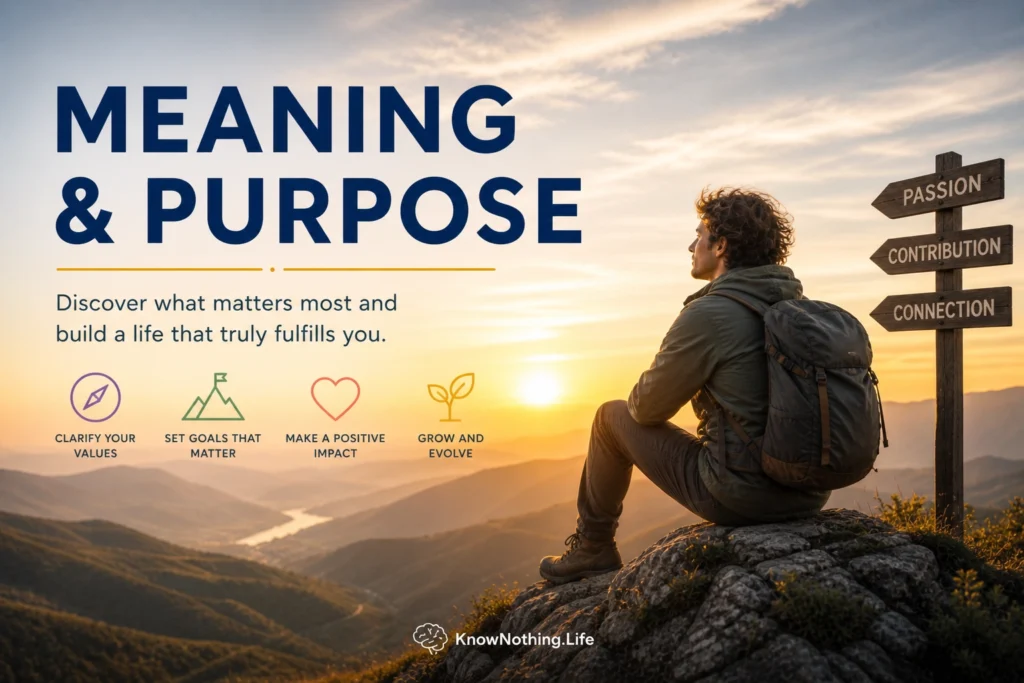
Meaning and purpose are among the most enduring questions in human life, shaping how individuals understand their existence, make decisions, and endure hardship. While often used interchangeably, meaning and purpose refer to distinct yet interconnected aspects of psychological well-being. Meaning involves the sense that life is coherent, significant, and comprehensible, while purpose refers to the direction and goals that organize behavior over time. Together, they provide a framework through which individuals interpret experience and orient themselves toward the future.
The scientific study of meaning and purpose has gained prominence within psychology, particularly through the work of Viktor Frankl, whose experiences during the Holocaust profoundly shaped his theory of logotherapy. In Man’s Search for Meaning (1946), Frankl argued that the primary human motivation is the “will to meaning,” stating that “life is never made unbearable by circumstances, but only by lack of meaning and purpose.” His work laid the foundation for understanding how individuals can find significance even in the most adverse conditions.
Today, meaning and purpose are recognized as central components of well-being, influencing mental health, resilience, and life satisfaction. Research across psychology, philosophy, and neuroscience has sought to identify how meaning is constructed, how purpose is pursued, and how both contribute to a fulfilling life. This article explores the theoretical foundations, psychological mechanisms, and practical implications of meaning and purpose, offering a comprehensive view of their role in human flourishing.
Philosophical Foundations
The pursuit of meaning and purpose has deep roots in philosophical thought, long preceding its formal study in psychology. Ancient philosophers such as Aristotle emphasized the concept of eudaimonia, or flourishing, as the ultimate goal of human life. In Nicomachean Ethics, Aristotle argued that true fulfillment arises from living in accordance with virtue and realizing one’s potential. He famously wrote that “the good for man is an activity of the soul in accordance with virtue,” highlighting the importance of purposeful action.
Later philosophical traditions expanded on these ideas, exploring the nature of meaning in relation to existence, morality, and freedom. Existentialist thinkers, including Jean-Paul Sartre, argued that meaning is not inherent in the world but must be created through individual choice and action. Sartre’s assertion that “existence precedes essence” reflects the idea that individuals are responsible for defining their own purpose in an otherwise indifferent universe.
These philosophical perspectives continue to influence contemporary psychology, which seeks to bridge abstract concepts with empirical research. By examining how individuals construct meaning and pursue purpose, psychology provides tools for understanding how these philosophical ideas manifest in everyday life. The integration of philosophical insight and scientific inquiry offers a rich framework for exploring the human search for significance.
Psychological Models of Meaning
Psychologists have developed various models to explain how individuals experience and construct meaning. One influential framework is the tripartite model proposed by Michael Steger, which identifies three core components of meaning: coherence, purpose, and significance. Coherence refers to the sense that life makes sense and is understandable, purpose involves having goals and direction, and significance reflects the belief that one’s life has value.
This model highlights the multidimensional nature of meaning, emphasizing that it is not a single construct but a combination of cognitive and emotional processes. Individuals may experience meaning through different pathways, such as relationships, work, spirituality, or personal growth. The diversity of these sources reflects the complexity of human experience and the flexibility of meaning as a psychological construct.
Research has also shown that meaning is closely linked to well-being. Individuals who report a strong sense of meaning tend to experience higher levels of life satisfaction, resilience, and mental health. Conversely, a lack of meaning is associated with feelings of emptiness and distress. As Steger noted, “Meaning in life is a central organizing concept in human psychology,” underscoring its importance in shaping behavior and experience.
Purpose and Goal-Directed Behavior
Purpose provides direction and structure to human life, guiding decisions and motivating action. It involves the pursuit of long-term goals that are personally meaningful and often extend beyond the self. Purposeful individuals tend to have a clear sense of direction, which helps them navigate challenges and maintain motivation over time.
The role of purpose in motivation has been explored in various psychological theories, including self-determination theory by Edward Deci and Richard Ryan. This theory emphasizes the importance of autonomy, competence, and relatedness in fostering intrinsic motivation. When individuals pursue goals that align with their values and interests, they are more likely to experience a sense of purpose and fulfillment.
Purpose is also associated with persistence and resilience. Individuals with a strong sense of purpose are more likely to persevere in the face of obstacles, as their goals provide a reason to continue. This connection between purpose and resilience highlights the adaptive value of goal-directed behavior. By organizing life around meaningful objectives, individuals can create a sense of continuity and direction that supports long-term well-being.
Meaning, Suffering, and Resilience
One of the most profound aspects of meaning is its role in helping individuals cope with suffering. Adversity often challenges existing beliefs and disrupts one’s sense of coherence, prompting a search for new meaning. The ability to find meaning in difficult experiences is a key component of resilience, allowing individuals to integrate hardship into a broader life narrative.
The work of Viktor Frankl provides a powerful illustration of this process. Frankl argued that even in the most extreme circumstances, individuals can find meaning through their attitudes and choices. He wrote, “When we are no longer able to change a situation, we are challenged to change ourselves.” This perspective emphasizes the role of meaning as a source of psychological strength.
Modern research supports the idea that meaning-making can facilitate recovery and growth. Individuals who are able to reinterpret adversity in a meaningful way often experience post-traumatic growth, including increased appreciation for life, stronger relationships, and a deeper sense of purpose. By transforming suffering into a source of insight, meaning becomes a powerful tool for adaptation and resilience.
Social and Cultural Dimensions
Meaning and purpose are not solely individual constructs; they are shaped by social and cultural contexts. Relationships, community involvement, and cultural values all influence how individuals understand their lives and pursue their goals. Social connections provide a sense of belonging and contribute to the perception that one’s life has significance.
Cultural frameworks offer narratives and symbols that help individuals interpret their experiences. For example, religious and spiritual traditions often provide a sense of ultimate purpose, while cultural norms shape expectations about success, responsibility, and fulfillment. These influences highlight the importance of considering context when studying meaning and purpose.
The social dimension of meaning also extends to contributions beyond the self. Many individuals find purpose in helping others, engaging in community activities, or working toward broader societal goals. This outward orientation reflects the interconnected nature of human life and underscores the role of purpose in fostering social cohesion and collective well-being.
Neuroscience of Meaning and Purpose
Advances in neuroscience have begun to explore the biological basis of meaning and purpose. Brain regions associated with reward, motivation, and self-referential processing play key roles in how individuals experience purpose and significance. The prefrontal cortex, for example, is involved in goal-setting and decision-making, while the default mode network is associated with self-reflection and narrative construction.
Research by neuroscientists such as Richard Davidson suggests that meaningful engagement can influence brain activity and emotional regulation. Experiences that align with personal values and goals are associated with increased activation in reward-related regions, reinforcing motivation and well-being. Davidson noted that “well-being is a skill,” highlighting the potential for cultivating meaning through intentional practices.
The concept of neuroplasticity further supports the idea that meaning and purpose can be developed over time. Repeated engagement in meaningful activities can strengthen neural pathways associated with motivation and satisfaction, contributing to lasting changes in how individuals experience their lives. These findings provide a biological foundation for understanding the transformative power of meaning and purpose.
Applications and Practical Implications
The study of meaning and purpose has important applications in various domains, including education, healthcare, and organizational settings. Interventions aimed at enhancing meaning often focus on helping individuals clarify their values, set meaningful goals, and reflect on their experiences. Practices such as journaling, narrative therapy, and mindfulness can facilitate the process of meaning-making.
In clinical contexts, fostering a sense of purpose can improve mental health outcomes. Therapies that emphasize meaning, such as logotherapy, help individuals reframe challenges and identify sources of significance in their lives. These approaches are particularly effective in addressing issues such as depression and existential distress, where a lack of meaning is a central concern.
At a societal level, promoting opportunities for meaningful engagement can enhance collective well-being. Education systems that encourage exploration and purpose-driven learning, workplaces that align tasks with values, and communities that foster connection all contribute to a sense of meaning. By recognizing the importance of purpose, individuals and institutions can create environments that support flourishing.
Conclusion
Meaning and purpose are fundamental to human existence, shaping how individuals understand their lives and navigate the world. By providing coherence, direction, and significance, they form the foundation of well-being and resilience. The work of thinkers such as Viktor Frankl, Michael Steger, and Aristotle has deepened our understanding of these concepts, bridging philosophical insight and scientific research.
Ultimately, the pursuit of meaning and purpose is a deeply personal yet universally shared endeavor. It reflects the human capacity to create significance, to strive toward goals, and to find value in both joy and suffering. As research continues to evolve, the study of meaning and purpose offers valuable guidance for individuals seeking to live more fulfilling and meaningful lives.