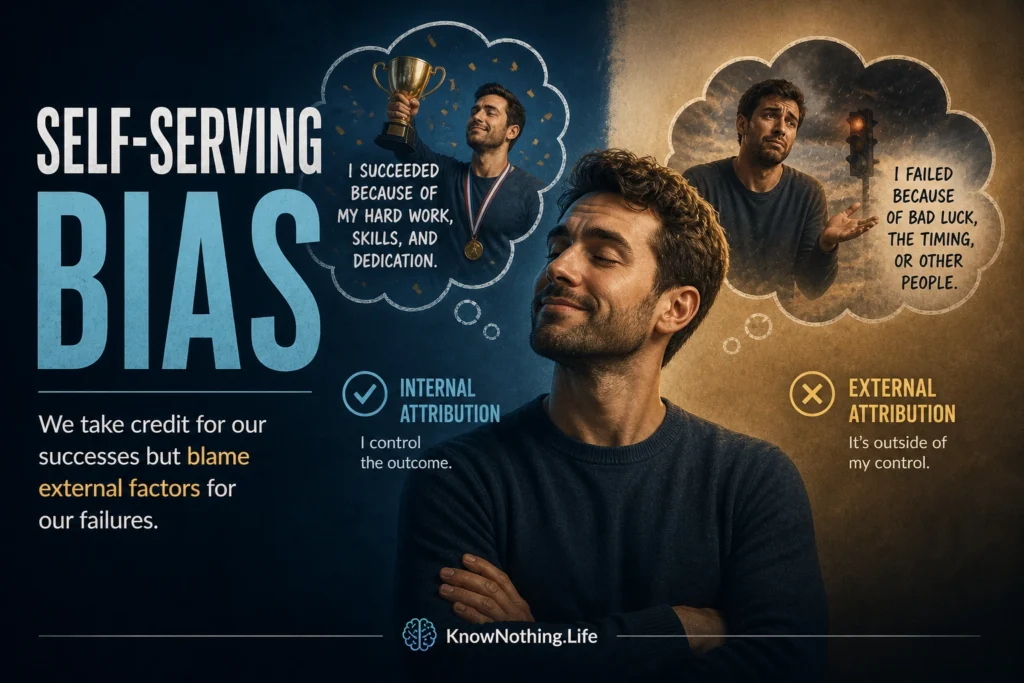
Self-serving bias is a pervasive cognitive tendency in which individuals attribute successes to internal factors—such as ability, effort, or intelligence—while attributing failures to external factors, such as luck, circumstance, or other people. This pattern of attribution allows individuals to maintain a positive self-image, protect self-esteem, and preserve a sense of control over their lives. Although often subtle, self-serving bias plays a powerful role in shaping how people interpret outcomes and evaluate their own behavior.
The concept of attribution, central to understanding self-serving bias, was developed in part by Fritz Heider, who argued in The Psychology of Interpersonal Relations (1958) that individuals act as “naïve psychologists,” constantly trying to explain the causes of events. Building on this foundation, later researchers identified systematic patterns in how people assign responsibility. The self-serving bias emerged as one of the most robust findings in attribution theory, illustrating how explanations of success and failure are often skewed in favor of the self.
While self-serving bias can promote confidence and resilience, it can also distort reality and hinder personal growth. By examining the mechanisms and consequences of this bias, psychologists have gained insight into how individuals balance self-protection with accurate self-assessment. This article explores the cognitive and emotional foundations of self-serving bias, its manifestations in various domains, and its implications for behavior and well-being.
Attribution Theory and Cognitive Foundations
Self-serving bias is grounded in attribution theory, which seeks to explain how individuals interpret the causes of events. Attributions can be categorized along several dimensions, including internal versus external causes and stable versus unstable factors. When individuals succeed, they are more likely to attribute the outcome to internal, stable factors such as ability. When they fail, they often attribute the outcome to external or unstable factors, such as bad luck or situational constraints.
Research by Bernard Weiner expanded on these ideas, emphasizing the role of attribution in motivation and emotion. Weiner’s model suggested that the way individuals explain outcomes influences their expectations for future success and their emotional responses. For example, attributing failure to lack of effort (an internal, controllable factor) may motivate improvement, while attributing it to external circumstances may reduce feelings of personal responsibility.
The self-serving bias arises from the interplay between cognitive processes and motivational needs. Cognitively, individuals seek explanations that are coherent and consistent with their beliefs. Motivationally, they are driven to maintain a positive self-concept. As Roy Baumeister has argued, “people are strongly motivated to maintain high self-esteem,” and attributional biases serve this purpose by protecting the self from negative evaluations. This dual influence helps explain why self-serving bias is both widespread and persistent.
Emotional and Motivational Functions
One of the primary functions of self-serving bias is to regulate emotion and protect self-esteem. By attributing success to internal factors, individuals reinforce their sense of competence and worth. Conversely, by attributing failure to external factors, they reduce feelings of guilt, shame, or inadequacy. This pattern helps individuals maintain emotional stability, particularly in the face of setbacks.
Self-serving bias also contributes to motivation. Positive attributions for success can enhance confidence and encourage individuals to pursue future goals. Believing that one’s achievements are the result of personal ability fosters a sense of control and efficacy. This aligns with the concept of self-efficacy developed by Albert Bandura, who emphasized the importance of belief in one’s capabilities. Bandura noted that “people’s beliefs about their abilities have a profound effect on those abilities,” highlighting the motivational impact of positive self-perceptions.
However, the emotional benefits of self-serving bias can come at a cost. By externalizing failure, individuals may miss opportunities for learning and growth. Over time, this can lead to a distorted understanding of one’s strengths and weaknesses. The balance between self-protection and self-awareness is therefore a critical aspect of how self-serving bias influences behavior.
Self-Serving Bias in Social Contexts
Self-serving bias extends beyond individual cognition to influence social interactions and relationships. In group settings, individuals may attribute collective successes to their own contributions while attributing failures to others. This can create tension and conflict, as different members of a group may have competing interpretations of the same outcome.
In interpersonal relationships, self-serving bias can affect how individuals perceive and respond to conflict. For example, one partner may attribute relationship problems to the other person’s behavior while viewing their own actions more favorably. This asymmetry can hinder communication and resolution, as each individual maintains a biased perspective. As a result, self-serving bias can contribute to misunderstandings and reduce the quality of relationships.
The bias also plays a role in social identity and group dynamics. Individuals often attribute positive outcomes of their group to internal qualities while attributing negative outcomes to external factors. This pattern, known as the ultimate attribution error, reinforces group cohesion and identity but can also contribute to prejudice and intergroup conflict. Understanding these social dimensions highlights the broader impact of self-serving bias beyond the individual level.
Cultural Variations
While self-serving bias is widely observed, its expression can vary across cultures. In individualistic societies, where personal achievement and independence are emphasized, self-serving bias tends to be more pronounced. Individuals in these cultures are more likely to attribute success to internal factors and to emphasize personal responsibility for outcomes.
In contrast, collectivist cultures, which prioritize group harmony and interdependence, may exhibit different patterns of attribution. Individuals in these cultures are often more likely to attribute success to external factors, such as the support of others, and to take greater responsibility for failures. This reflects cultural values that emphasize humility and social cohesion.
Research by Hazel Markus and Shinobu Kitayama has highlighted these cultural differences, showing that self-concept and attribution are shaped by social context. Their work suggests that self-serving bias is not a universal constant but a flexible pattern influenced by cultural norms and values. This perspective underscores the importance of considering context when studying cognitive biases.
Real-World Implications
The influence of self-serving bias can be seen in a wide range of real-world contexts, including education, work, and health. In academic settings, students may attribute good grades to their abilities while blaming poor performance on external factors such as unfair exams. This can affect learning outcomes, as students may fail to identify areas for improvement.
In organizational contexts, self-serving bias can influence performance evaluations and leadership decisions. Managers may take credit for successes while attributing failures to subordinates or external conditions. This can undermine accountability and hinder organizational effectiveness. Similarly, employees may overestimate their contributions, leading to conflicts and reduced collaboration.
In health-related behaviors, self-serving bias can affect how individuals interpret risks and outcomes. For example, individuals may attribute positive health outcomes to their own actions while attributing negative outcomes to external factors. This can influence behavior and decision-making, highlighting the importance of accurate self-assessment in promoting well-being.
Reducing Self-Serving Bias
While self-serving bias serves important psychological functions, it is possible to mitigate its effects through awareness and deliberate effort. One approach is to encourage balanced attributions, where individuals consider both internal and external factors when evaluating outcomes. This can promote a more accurate understanding of performance and foster personal growth.
Feedback and reflection are also important tools for reducing bias. Constructive feedback from others can provide alternative perspectives, helping individuals recognize discrepancies in their self-assessments. Reflective practices, such as journaling or self-evaluation, can further enhance awareness of attribution patterns.
Developing a growth mindset, as proposed by Carol Dweck, can also counteract self-serving bias. By viewing abilities as malleable rather than fixed, individuals are more likely to interpret failures as opportunities for learning rather than as threats to self-esteem. This shift in perspective encourages adaptive responses to challenges and supports long-term development.
Conclusion
Self-serving bias is a fundamental aspect of human cognition, reflecting the interplay between cognitive processes and motivational needs. By shaping how individuals interpret success and failure, it plays a crucial role in maintaining self-esteem and guiding behavior. The work of scholars such as Fritz Heider, Bernard Weiner, and Albert Bandura has deepened our understanding of this bias and its implications.
While self-serving bias can promote confidence and resilience, it also introduces distortions that can hinder learning and relationships. Recognizing and addressing these distortions is essential for achieving a balance between self-protection and self-awareness. By cultivating more accurate and balanced attributions, individuals can enhance both their personal development and their interactions with others.
Ultimately, self-serving bias highlights the complexity of human thought, revealing how the desire to maintain a positive self-concept shapes perception and judgment. Understanding this bias provides valuable insight into the nature of self-evaluation and the challenges of achieving objectivity in a world shaped by personal experience.