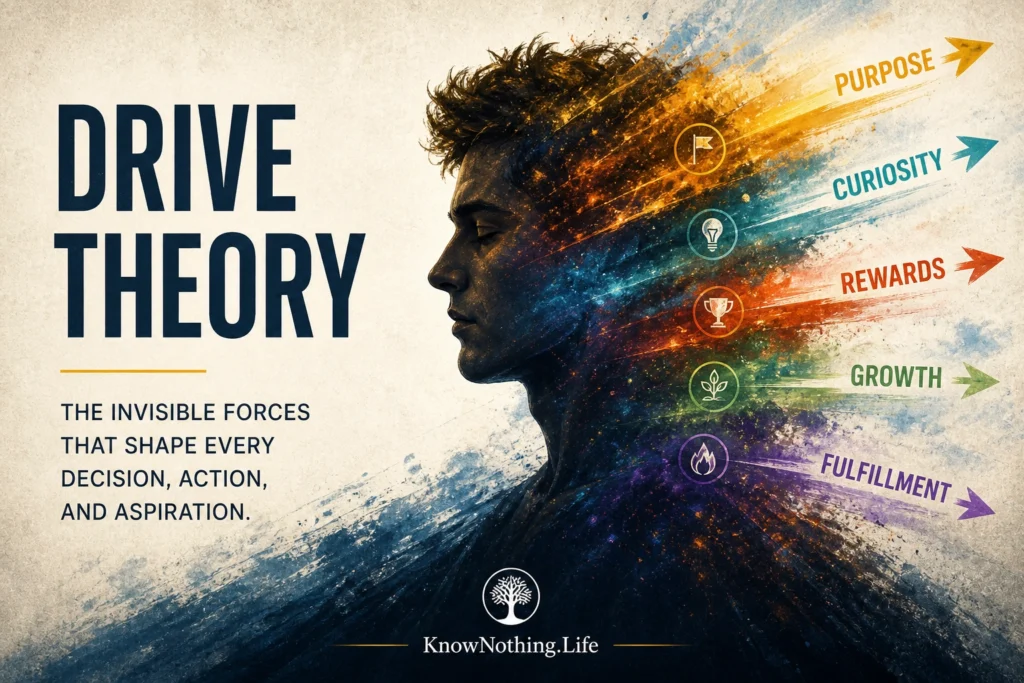
Drive theory is one of the earliest systematic attempts to explain motivation in terms of biological needs and internal states. At its core, drive theory proposes that behavior is motivated by the desire to reduce internal tension caused by unmet physiological needs. Hunger, thirst, and the need for warmth create uncomfortable states—“drives”—that push the organism toward actions that restore balance. This framework places motivation within the body, linking behavior directly to survival and homeostasis.
The modern formulation of drive theory is most closely associated with Clark L. Hull, whose work in the mid-20th century sought to establish psychology as a rigorous, quantitative science. In Principles of Behavior (1943), Hull proposed that behavior could be predicted through mathematical relationships involving drive, habit strength, and incentive. His ambition was to reduce complex human behavior to lawful, measurable principles grounded in biology and learning.
While later theories have expanded and, in some cases, challenged drive theory, its core insight remains influential: behavior is often energized by internal states of need. By examining how organisms respond to deprivation and seek equilibrium, drive theory provides a foundational account of motivation that continues to inform contemporary research in psychology and neuroscience.
Biological Foundations and Homeostasis
At the heart of drive theory lies the concept of homeostasis—the body’s tendency to maintain stable internal conditions. This idea was developed by Walter Cannon, who described how physiological systems regulate variables such as temperature, glucose levels, and hydration. When these variables deviate from their optimal range, the body generates signals that create a sense of discomfort, motivating corrective action.
For example, a drop in blood glucose levels produces the sensation of hunger, prompting the organism to seek food. Once the need is satisfied, the drive is reduced, and equilibrium is restored. This cycle of imbalance and restoration forms the basis of drive theory’s explanation of behavior. It suggests that much of what organisms do is oriented toward maintaining internal stability, making motivation a fundamentally biological process.
This perspective aligns with evolutionary principles, emphasizing the role of survival in shaping behavior. Organisms that effectively respond to internal drives are more likely to survive and reproduce, reinforcing these mechanisms over time. While drive theory focuses primarily on immediate physiological needs, it also provides a framework for understanding how more complex behaviors may originate from basic biological imperatives.
Hull’s Drive Reduction Model
Clark L. Hull expanded the concept of drive into a formal theory of learning and behavior. According to Hull, behavior is determined by the interaction of drive and habit strength. Habit strength is developed through reinforcement, while drive provides the energy that activates behavior. In this model, learning occurs when responses that reduce drive are reinforced, increasing the likelihood that they will be repeated in similar situations.
Hull attempted to express these relationships mathematically, proposing equations in which behavior (or “reaction potential”) was a function of drive, habit, and incentive. While these equations were ultimately too simplistic to capture the full complexity of human behavior, they represented an important step toward a scientific understanding of motivation. Hull’s work emphasized that motivation is not merely about desire but about measurable processes that can be studied experimentally.
A key feature of Hull’s theory is the concept of drive reduction as reinforcement. Behaviors that reduce physiological tension are inherently rewarding because they restore balance. This idea helped bridge the gap between biological and behavioral approaches, linking internal states with observable actions. However, it also raised questions about behaviors that do not appear to reduce drive, such as curiosity or exploration, which later theorists sought to address.
Extensions and Modifications of Drive Theory
Although drive theory provided a powerful framework, it soon became clear that it could not account for all forms of motivation. One major limitation was its focus on physiological needs, which left little room for behaviors driven by curiosity, creativity, or intrinsic interest. To address this gap, psychologists began to expand the concept of motivation beyond simple drive reduction.
Kenneth Spence extended Hull’s work by incorporating the role of incentives and environmental factors. Spence argued that external stimuli could enhance or diminish the strength of a response, suggesting that motivation is influenced not only by internal drives but also by the perceived value of outcomes. This shift moved the theory closer to modern incentive-based approaches.
Another important development came from Abraham Maslow, who proposed a hierarchy of needs that included not only physiological drives but also psychological and self-actualizing motivations. Maslow’s model suggested that once basic needs are satisfied, individuals are motivated by higher-level goals such as belonging, esteem, and personal growth. This perspective broadened the scope of motivation, highlighting the limitations of a purely drive-based approach.
Critiques and Limitations
Despite its historical significance, drive theory has faced substantial criticism. One of the most prominent critiques is that it cannot adequately explain behaviors that increase rather than decrease arousal. For example, individuals often seek out novel or challenging experiences, even when they are not driven by physiological need. Activities such as exploration, play, and artistic creation do not fit easily within a framework based on drive reduction.
Research by Harry Harlow provided compelling evidence against a purely drive-based model. In his studies with monkeys, Harlow found that the animals engaged in problem-solving tasks without any external reward, suggesting that intrinsic motivation can exist independently of drive reduction. These findings challenged the assumption that all behavior is driven by the need to reduce tension.
Additionally, drive theory does not fully account for the role of cognition in motivation. Modern theories emphasize that individuals interpret and evaluate their needs and goals, rather than responding automatically to physiological signals. This cognitive dimension introduces a level of complexity that extends beyond the mechanistic assumptions of early drive theory.
Integration with Modern Motivation Theories
Although drive theory has been largely superseded by more comprehensive models, its core concepts continue to influence contemporary psychology. Modern theories often integrate biological, cognitive, and social factors, recognizing that motivation arises from multiple sources. Drive reduction remains relevant in explaining basic physiological behaviors, while other frameworks address higher-level motivations.
For instance, self-determination theory, developed by Edward Deci and Richard Ryan, emphasizes intrinsic motivation and psychological needs such as autonomy and competence. While this approach differs from drive theory, it retains the idea that unmet needs create motivational states, extending the concept from physical to psychological domains.
Neuroscience has also contributed to a more nuanced understanding of motivation, identifying brain systems involved in reward, decision-making, and emotional regulation. These findings suggest that motivation is not governed by a single mechanism but by a network of processes that interact dynamically. In this context, drive theory can be seen as an early step toward a more integrated understanding of behavior.
Drive Theory in Everyday Life
Despite its limitations, drive theory provides a useful framework for understanding many everyday behaviors. Actions such as eating, drinking, and seeking rest are clearly motivated by physiological drives, illustrating the theory’s relevance to basic aspects of life. Even in more complex contexts, elements of drive reduction can be observed, such as the relief experienced after completing a stressful task.
The concept of drive also has implications for understanding habits and addictions. In these cases, repeated behaviors may become associated with the reduction of psychological or physiological tension, reinforcing their occurrence. This perspective helps explain why certain behaviors can be difficult to change, as they are linked to powerful internal states.
At the same time, the limitations of drive theory remind us that human behavior cannot be fully explained by biological needs alone. Social, cognitive, and emotional factors all contribute to motivation, creating a rich and multifaceted system. Recognizing this complexity allows for a more comprehensive understanding of behavior and its underlying causes.
Conclusion
Drive theory represents a foundational moment in the scientific study of motivation, offering a clear and biologically grounded explanation of behavior. Through the work of Clark L. Hull and others, it established the idea that internal states of need play a central role in guiding action. This insight continues to inform contemporary research, particularly in understanding basic physiological behaviors.
At the same time, the evolution of motivational theory has revealed the limitations of a purely drive-based approach. The contributions of researchers such as Harry Harlow and Abraham Maslow have expanded the scope of motivation to include intrinsic and higher-order processes, reflecting the complexity of human experience.
Ultimately, drive theory remains an essential part of the broader framework of psychology. It highlights the importance of biological needs while pointing toward the need for more comprehensive models that integrate multiple dimensions of motivation. In doing so, it provides both a foundation and a point of departure for understanding the forces that shape human behavior.