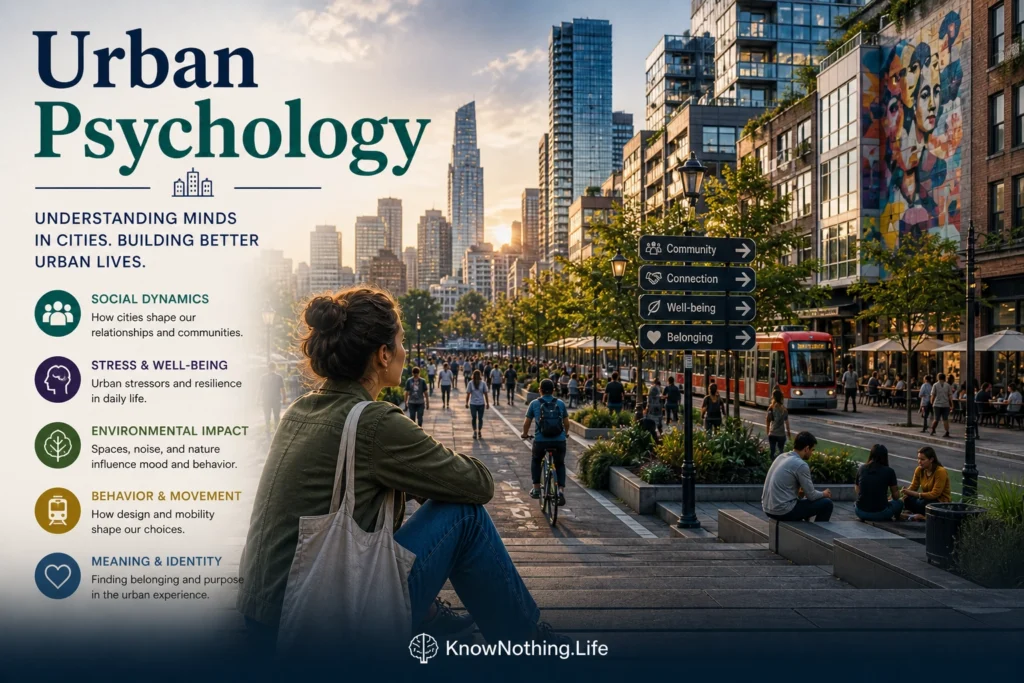
Urban psychology examines how life in cities shapes human thought, emotion, and behavior. As more than half of the world’s population now lives in urban areas, the psychological consequences of city life have become central to understanding modern human experience. Cities are dense, complex environments characterized by constant sensory input, diverse populations, rapid social interaction, and built structures that influence how people move and relate to one another. These conditions create both opportunities and challenges, fostering creativity and connection while also contributing to stress, anonymity, and social fragmentation.
The field draws from psychology, sociology, urban planning, and environmental studies. Early insights from Georg Simmel, particularly in his essay The Metropolis and Mental Life, laid the groundwork for understanding the psychological impact of urban environments. Simmel argued that city life produces a “blasé attitude,” a form of emotional detachment developed as a defense against sensory overload. Later contributions from Stanley Milgram, Jane Jacobs, and Kevin Lynch expanded the field, exploring how urban environments shape social behavior, perception, and well-being. Together, these perspectives reveal that cities are not just physical spaces but psychological landscapes that profoundly influence human life.
The Psychological Experience of Urban Density
One of the defining features of urban environments is density—the concentration of people within limited space. High density can facilitate social interaction, economic activity, and cultural exchange, but it can also lead to crowding, a psychological experience of having insufficient space. Crowding is not simply a matter of physical proximity; it depends on how individuals perceive and interpret their environment. Two spaces with similar density may be experienced differently depending on factors such as design, control, and cultural expectations.
Stanley Milgram’s concept of “stimulus overload” helps explain how individuals cope with the intensity of urban life. In his work on urban behavior, Milgram suggested that the constant barrage of sensory and social stimuli in cities leads individuals to filter information, often by ignoring others or limiting interaction. This adaptation allows people to function in complex environments but can also result in reduced social engagement. As Milgram noted, city dwellers may adopt a “don’t get involved” attitude as a way of managing the demands of urban living. This dynamic illustrates the trade-off between efficiency and social connection that characterizes many urban experiences.
Anonymity, Social Interaction, and Community
Cities are often associated with anonymity, a condition in which individuals are surrounded by others yet remain largely unknown to them. This anonymity can be both liberating and isolating. On one hand, it allows individuals greater freedom to express themselves without the constraints of close-knit social monitoring. On the other hand, it can lead to feelings of disconnection and a lack of social support. Urban psychology seeks to understand how individuals navigate this tension and how urban design can influence social interaction.
Jane Jacobs, in The Death and Life of Great American Cities, challenged the idea that cities inevitably produce alienation. She argued that well-designed urban neighborhoods can foster strong social networks through features such as mixed-use spaces, walkable streets, and what she famously called “eyes on the street.” These elements encourage casual interaction and mutual surveillance, creating a sense of safety and community. Jacobs’ work highlights that social outcomes in cities are not predetermined but shaped by the design and organization of urban space.
Perception and Navigation of Urban Space
Urban environments are complex and often overwhelming, requiring individuals to develop cognitive maps to navigate them effectively. Kevin Lynch explored this process in The Image of the City, where he introduced the concept of legibility—the ease with which a city can be understood and navigated. Lynch identified key elements such as paths, edges, districts, nodes, and landmarks that help individuals form mental representations of urban space.
These cognitive maps influence not only navigation but also emotional experience. A city that is easy to understand can feel welcoming and manageable, while one that is confusing or disorganized may induce anxiety and disorientation. Environmental cues such as signage, architecture, and spatial layout play a crucial role in shaping perception. Urban psychology emphasizes that design is not merely aesthetic but functional, affecting how individuals experience and interact with their surroundings.
Stress, Noise, and Environmental Demands
Urban environments expose individuals to a range of environmental stressors, including noise, pollution, crowding, and rapid pace of life. These factors can have significant effects on psychological well-being, contributing to stress, fatigue, and reduced cognitive performance. Noise, in particular, has been shown to impair concentration and increase irritability, while chronic exposure to pollution can affect both physical and mental health.
The psychological impact of these stressors depends on both objective conditions and subjective perception. Individuals who feel a sense of control over their environment are better able to cope with stress, while those who perceive themselves as overwhelmed may experience greater negative effects. Research in environmental psychology suggests that design interventions—such as incorporating green spaces, reducing noise levels, and improving accessibility—can mitigate these stressors. By addressing the environmental sources of stress, urban psychology aims to enhance the quality of life in cities.
Nature in the Urban Environment
The integration of natural elements into urban environments has emerged as a key focus in urban psychology. Access to green spaces, parks, and natural views has been linked to improved mental health, reduced stress, and enhanced cognitive functioning. Rachel Kaplan and Stephen Kaplan developed Attention Restoration Theory, which suggests that natural environments help restore mental resources depleted by urban demands.
Roger Ulrich’s research further supports the benefits of nature, demonstrating that even brief exposure to natural scenes can reduce physiological stress. In urban contexts, this has led to the development of strategies such as urban parks, green roofs, and tree-lined streets. These interventions not only improve environmental quality but also provide psychological benefits, creating spaces where individuals can relax and recover from the pressures of city life. The presence of nature within cities highlights the importance of balancing built and natural environments.
Diversity, Culture, and Urban Identity
Cities are often characterized by cultural diversity, bringing together individuals from different backgrounds, traditions, and perspectives. This diversity can enrich urban life by fostering creativity, innovation, and cross-cultural exchange. At the same time, it can present challenges related to social cohesion, inequality, and cultural conflict. Urban psychology examines how individuals navigate diverse environments and how cultural differences influence behavior and interaction.
Georg Simmel observed that urban life encourages individuality, as people differentiate themselves within a crowded social landscape. This process contributes to the development of diverse identities and lifestyles. However, it also raises questions about inclusion and belonging. Urban environments must balance diversity with cohesion, creating spaces that accommodate different cultural practices while promoting shared experiences. Understanding these dynamics is essential for building inclusive and resilient cities.
Urban Design and Psychological Well-Being
Urban design plays a critical role in shaping psychological outcomes. The layout of streets, the availability of public spaces, the design of buildings, and the accessibility of resources all influence how individuals experience the city. Well-designed environments can promote social interaction, physical activity, and a sense of belonging, while poorly designed spaces can contribute to isolation, stress, and disengagement.
Urban psychology emphasizes the importance of human-centered design, which considers the needs and experiences of individuals in planning and development. This approach aligns with the work of scholars such as Jan Gehl, who advocates for designing cities at a human scale to encourage walking, social interaction, and community life. By prioritizing psychological well-being, urban design can create environments that support both individual and collective flourishing.
Conclusion
Urban psychology provides a framework for understanding the complex relationship between individuals and the environments in which they live. Cities are dynamic systems that shape behavior, perception, and well-being in profound ways. From density and anonymity to stress and diversity, the psychological effects of urban life are multifaceted and interconnected.
As urbanization continues to accelerate, the insights of urban psychology become increasingly important. By integrating knowledge from psychology, sociology, and urban planning, the field offers practical solutions for creating healthier, more livable cities. Ultimately, urban psychology reminds us that the design of our environments is inseparable from the quality of our lives, and that thoughtful planning can transform cities into spaces that support human well-being and social connection.