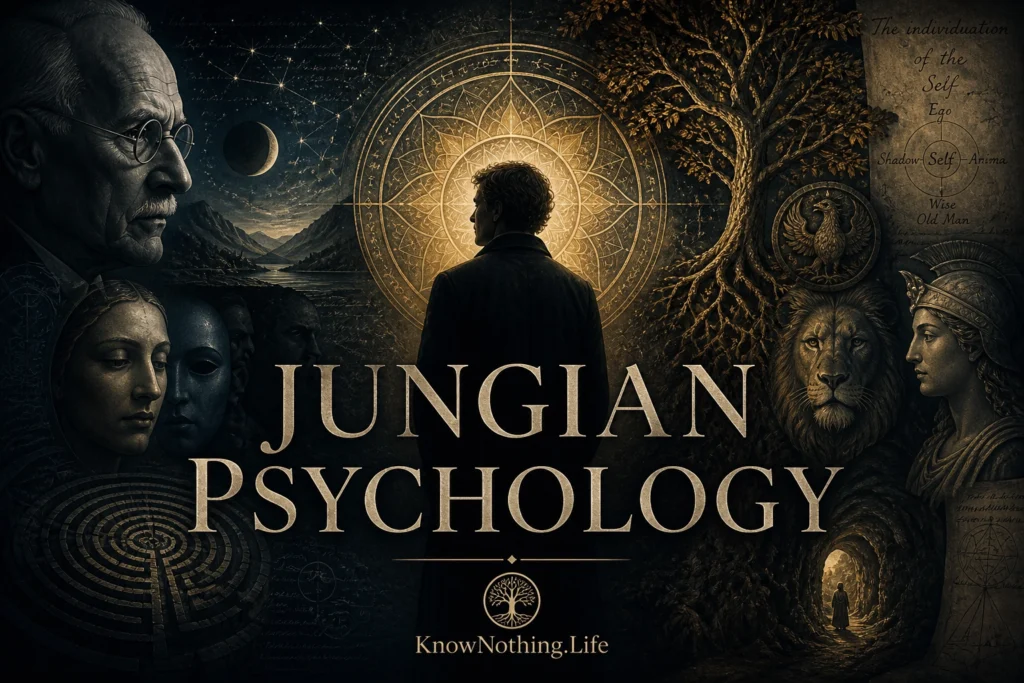
Jungian psychology, also known as analytical psychology, is the school of depth psychology founded by Swiss psychiatrist Carl Gustav Jung. It studies the human mind not only as a system of memories, instincts, conflicts, and behaviors, but as a symbolic, meaning-making reality shaped by dreams, myths, imagination, archetypes, and the lifelong search for wholeness. Where some psychological theories focus mainly on symptoms, adaptation, or observable behavior, Jungian psychology asks a deeper question: what is the psyche trying to become? For Jung, the unconscious was not merely a container of repressed material. It was a living source of images, conflicts, compensations, and possibilities that could guide the individual toward a fuller form of being.
Jung’s thought emerged from the early psychoanalytic movement, especially through his relationship with Sigmund Freud, but it developed into a distinct vision of the psyche. Freud emphasized sexuality, repression, infantile conflict, and the dynamics of the ego, id, and superego. Jung accepted the importance of unconscious conflict but believed Freud’s model was too narrow. In Memories, Dreams, Reflections, Jung wrote, “My life is a story of the self-realization of the unconscious,” a sentence that captures the spiritual and psychological seriousness of his project. Jungian psychology is ultimately a psychology of integration: the effort to bring unconscious life into conscious relationship so that the person becomes less divided, less possessed by hidden forces, and more capable of living with depth, meaning, and responsibility.
Carl Jung and the Birth of Analytical Psychology
Jung began his career as a psychiatrist at the Burghölzli clinic in Zurich, where he worked under Eugen Bleuler, the psychiatrist who introduced the term schizophrenia. Jung’s early research on word association tests brought him international attention because it showed how emotionally charged unconscious “complexes” could interrupt ordinary thought. In Studies in Word Association, Jung demonstrated that delayed responses, mistakes, or unusual reactions could reveal hidden psychological material. This early work placed him firmly within the emerging world of depth psychology, where the conscious mind was no longer treated as the whole of the person.
Jung’s collaboration with Freud was intense but unstable. Freud saw Jung as a major ally and possible successor, while Jung admired Freud’s courage in opening the study of the unconscious. Their break came partly because Jung refused to reduce psychic life to sexuality alone. In Symbols of Transformation, Jung argued that libido should be understood more broadly as psychic energy rather than merely sexual energy. This disagreement marked the beginning of analytical psychology. Jung began to develop a wider theory of symbols, myths, religious images, dreams, personality types, and individuation, placing personal suffering inside a larger symbolic and archetypal framework.
The Structure of the Psyche
Jungian psychology divides the psyche into several major dimensions: the ego, the personal unconscious, the collective unconscious, and the Self. The ego is the center of consciousness, the part of the personality that says “I,” makes decisions, remembers, plans, and maintains a coherent identity. Yet Jung did not believe the ego was the true center of the whole psyche. The ego is only the center of conscious awareness, while the full psyche is much larger, deeper, and more mysterious than conscious identity can grasp.
The personal unconscious contains forgotten memories, repressed emotions, unresolved conflicts, and complexes formed through lived experience. The collective unconscious, one of Jung’s most famous and controversial concepts, refers to inherited patterns of psychic life that appear across cultures in myths, dreams, symbols, and religious imagery. In The Archetypes and the Collective Unconscious, Jung wrote that the collective unconscious consists of “forms or images of a collective nature which occur practically all over the earth.” These forms are not inherited ideas in a simple literal sense; rather, they are inherited tendencies to organize experience in recurring symbolic patterns.
Archetypes and the Collective Unconscious
Archetypes are deep symbolic patterns in the psyche. They are not fixed images but underlying structures that give rise to recurring images, stories, roles, and emotional patterns. The mother, father, child, hero, trickster, wise old man, great mother, shadow, anima, animus, and Self are among the most discussed Jungian archetypes. They appear in dreams, fairy tales, myths, religions, films, fantasies, and personal relationships. For Jung, archetypes help explain why very different cultures repeatedly produce similar symbolic forms: descent into the underworld, battles with monsters, miraculous births, sacred trees, world floods, divine children, and journeys of transformation.
The archetypal idea was expanded by later Jungian thinkers such as Marie-Louise von Franz, Erich Neumann, and Joseph Campbell. Von Franz explored fairy tales as symbolic maps of psychic development in works such as The Interpretation of Fairy Tales. Neumann, in The Origins and History of Consciousness, described human psychological development through mythic stages of emergence from unconscious unity toward conscious individuality. Campbell, though not strictly a clinical Jungian, popularized archetypal patterns in The Hero with a Thousand Faces, where he wrote, “The cave you fear to enter holds the treasure you seek.” That famous line reflects a deeply Jungian theme: transformation requires entering the feared, unknown, or rejected depths of the psyche.
The Persona and the Shadow
Two of Jung’s most important concepts are the persona and the shadow. The persona is the social mask, the identity one presents to the world in order to function within family, work, culture, and community. It is not inherently false; everyone needs roles, manners, and forms of adaptation. The danger comes when a person identifies too completely with the persona and mistakes it for the whole self. Someone may become the perfect professional, the obedient child, the spiritual person, the intellectual, the helper, the rebel, or the moral authority while pushing contradictory qualities into the unconscious.
The shadow is the hidden side of the personality, made up of traits, desires, fears, impulses, and potentials the ego does not want to recognize. In Aion, Jung wrote, “Everyone carries a shadow,” and in Psychology and Religion he called the shadow “a moral problem that challenges the whole ego-personality.” The shadow may contain selfishness, envy, aggression, shame, or resentment, but it can also contain vitality, creativity, assertiveness, sensuality, and courage that were rejected because they conflicted with the person’s approved identity. Jungian psychology does not aim to destroy the shadow. It seeks to make it conscious, because what is denied often returns through projection, compulsive behavior, emotional overreaction, and unconscious sabotage.
Anima, Animus, and Inner Otherness
Jung used the terms anima and animus to describe inner contrasexual figures within the psyche: the anima as the inner feminine image in a man and the animus as the inner masculine image in a woman. These terms reflect Jung’s historical context and can sound overly gendered today, but their deeper psychological meaning remains influential. They point to the inner “other” that mediates between consciousness and the unconscious. The anima or animus often appears in dreams, fantasies, attractions, projections, and creative inspiration, carrying qualities the conscious personality has not yet integrated.
In modern Jungian practice, many analysts interpret anima and animus less rigidly, seeing them as symbolic images of otherness, relational depth, emotional life, eros, logos, imagination, agency, or the unknown dimensions of the self. In Aion and The Archetypes and the Collective Unconscious, Jung emphasized that these figures often appear projected onto romantic partners, teachers, enemies, celebrities, or spiritual ideals. This helps explain why love, fascination, obsession, and disappointment can feel so overwhelming: the person is not only encountering another human being, but also an inner image awakened by them. Jungian psychology asks the individual to withdraw these projections gradually, not by becoming cold or detached, but by recognizing the unconscious meaning carried by intense relationships.
Dreams, Symbols, and Active Imagination
Dreams occupy a central place in Jungian psychology. Jung believed dreams are not random mental noise, nor merely disguised wish fulfillments, as Freud often suggested. Instead, dreams are symbolic communications from the unconscious. They may compensate for one-sided conscious attitudes, reveal hidden conflicts, anticipate future psychological developments, or dramatize the process of transformation. In Man and His Symbols, Jung wrote, “The dream is the small hidden door in the deepest and most intimate sanctum of the soul,” emphasizing that dreams can open access to aspects of the psyche unavailable to ordinary rational control.
Jung also developed the practice of active imagination, a method of entering into dialogue with unconscious images, figures, and fantasies. Rather than analyzing an image from a distance, the person allows it to unfold and responds to it consciously through writing, drawing, inner dialogue, movement, or symbolic reflection. This method appears throughout Jung’s own inner work, especially in The Red Book, where he recorded visionary encounters that shaped his later psychology. Active imagination is not escapist fantasy; in Jungian terms, it is a disciplined encounter between ego and unconscious. Its purpose is to create a living relationship with symbolic material rather than either repressing it or being overwhelmed by it.
Individuation and the Search for Wholeness
The central goal of Jungian psychology is individuation, the lifelong process of becoming a more whole, integrated, and authentic person. Individuation does not mean individualism in the shallow sense of self-expression without responsibility. It means the gradual differentiation of the person from unconscious identifications, collective expectations, inherited roles, and one-sided self-images. The individual becomes more capable of relating to the shadow, withdrawing projections, integrating inner opposites, and living in alignment with the deeper Self.
The Self is perhaps Jung’s most profound concept. It represents the totality of the psyche and the organizing center of psychic wholeness. The Self is not identical with the ego; it is larger than ego-consciousness and often appears symbolically as a mandala, divine child, wise figure, sacred center, stone, tree, circle, or image of divine unity. In Psychology and Alchemy, Jung wrote, “One does not become enlightened by imagining figures of light, but by making the darkness conscious.” This sentence captures the moral realism of individuation. Wholeness is not achieved by pretending to be pure, spiritual, or ideal. It is achieved by facing what has been denied and bringing it into conscious relationship.
Religion, Myth, and Meaning
Jungian psychology is unusual among modern psychological schools because it takes religion and myth seriously as expressions of the psyche. Jung did not simply ask whether religious claims were objectively true or false; he asked what psychic realities they expressed. In Psychology and Religion, Answer to Job, and Aion, he explored religious symbols as living images through which human beings encounter fear, guilt, transformation, sacrifice, evil, redemption, and the mystery of the Self. This made Jung controversial among both theologians and scientific psychologists, yet it also made his work deeply influential in comparative religion, literature, art, and cultural studies.
For Jung, modern people often suffer not only from neurosis in a narrow clinical sense, but from loss of meaning. He argued that many psychological problems are intensified when individuals are cut off from symbolic life, ritual, myth, community, and a sense of participation in something larger than the ego. This does not mean Jungian psychology requires religious belief. It means that the psyche naturally produces symbols of depth, value, and transcendence. When these symbols are ignored, people may seek substitutes through ideology, consumerism, status, addiction, or projection onto political and cultural movements.
Influence and Criticism
Jungian psychology has influenced psychotherapy, literature, religious studies, mythology, film criticism, personality theory, art therapy, and popular culture. Jung’s theory of psychological types contributed to later personality models, including the Myers-Briggs Type Indicator, although that instrument is not identical to Jung’s original theory. His concepts of the shadow, archetypes, individuation, and collective unconscious have shaped how many people understand dreams, creativity, myth, and self-development. Authors such as James Hillman, founder of archetypal psychology, pushed Jung’s ideas further by emphasizing imagination, soul, and the autonomy of images in works like Re-Visioning Psychology.
At the same time, Jungian psychology has faced serious criticism. Many academic psychologists argue that archetypes and the collective unconscious are difficult to test scientifically. Others criticize Jung’s writings for ambiguity, cultural generalization, gender essentialism, or speculative interpretation. These critiques matter. Jungian psychology is strongest when it is used as a symbolic, clinical, and interpretive framework rather than as a rigid scientific system that explains everything. Its value lies less in laboratory precision than in its ability to illuminate dreams, identity, inner conflict, mythic imagination, projection, and the human search for meaning.
Final Thoughts on Jungian Psychology
Jungian psychology remains compelling because it speaks to dimensions of human life that purely behavioral or mechanistic models often leave underexplored. It recognizes that people are not only problem-solving organisms or bundles of symptoms. They are symbolic beings haunted by dreams, shaped by stories, moved by images, divided by unconscious conflicts, and drawn toward wholeness. Jung’s psychology gives language to the hidden architecture of the inner life: persona and shadow, ego and Self, archetype and complex, projection and integration, dream and myth.
The enduring power of Jungian psychology lies in its central demand: become conscious of what lives within you. This demand is neither easy nor sentimental. It requires honesty, patience, humility, and courage. The person must confront the shadow, question the mask, listen to dreams, withdraw projections, and discover a deeper center than the ego alone. Jungian psychology does not promise a life free from suffering. It offers something more difficult and more valuable: a path toward meaning, integration, and psychological wholeness.