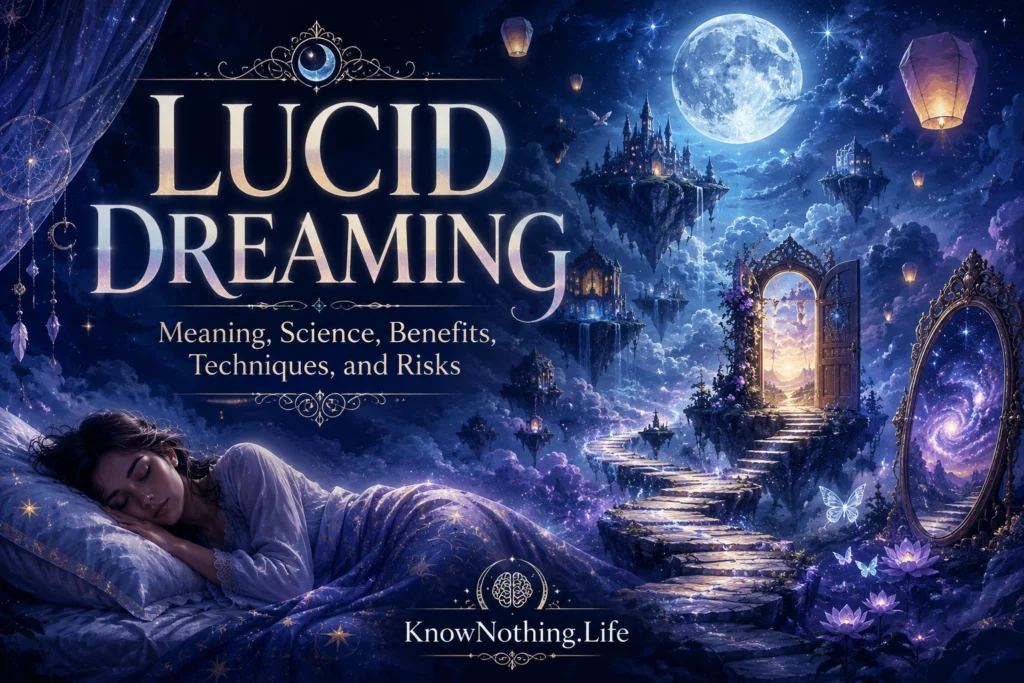
Lucid dreaming is the experience of becoming aware that one is dreaming while the dream is still happening. In an ordinary dream, the dreamer accepts the world of the dream as real, no matter how strange it becomes. In a lucid dream, consciousness bends back on itself: the dreamer recognizes, “This is a dream.” Sometimes lucidity is faint and brief; the person simply notices the dream state before waking. At other times, lucidity is vivid and stable, allowing the dreamer to make choices, examine the dream environment, speak to dream figures, fly, rehearse skills, confront nightmares, or experiment with the limits of imagination. Lucid dreaming is therefore one of the most fascinating bridges between sleep science, consciousness studies, creativity, and self-awareness.
The topic has long attracted philosophers, psychologists, mystics, and neuroscientists because it challenges simple divisions between waking and sleeping. Aristotle mentioned dream awareness in On Dreams, observing that sometimes “something in the soul” tells us we are dreaming. Tibetan Buddhist dream yoga developed sophisticated practices for maintaining awareness in dreams as part of spiritual training. In modern psychology, Frederik van Eeden introduced the term “lucid dream” in his 1913 paper “A Study of Dreams,” using “lucid” to mean mentally clear rather than visually bright. The modern scientific breakthrough came when researchers showed that lucid dreamers could signal from inside REM sleep using prearranged eye movements, proving that lucidity was not merely a memory error after waking but a real state occurring during sleep. Stephen LaBerge and colleagues helped establish this method at Stanford, while earlier work by Keith Hearne with lucid dreamer Alan Worsley also contributed to laboratory verification of lucid dreaming.
The Scientific Verification of Lucid Dreams
For much of the twentieth century, lucid dreaming was treated with skepticism. Reports of dream awareness sounded intriguing, but scientists needed objective evidence. The difficulty was obvious: if a person is asleep and dreaming, how can they tell researchers what is happening without waking up? The answer came from REM sleep physiology. During REM sleep, most voluntary muscles are inhibited, but eye movements remain possible. Researchers trained lucid dreamers to move their eyes in a specific left-right-left-right pattern as soon as they realized they were dreaming. These eye signals could be recorded on sleep-lab equipment while EEG and other measures confirmed that the person remained in REM sleep. LaBerge later summarized the approach by explaining that dreamers were instructed to make a left-right-left-right eye signal once they became lucid, allowing the signal to appear directly in the physiological record.
This discovery was important because it made lucid dreaming scientifically respectable. The dreamer’s subjective report could now be linked to objective sleep data. LaBerge, Howard Rheingold, and others later popularized lucid dreaming through books such as Lucid Dreaming and Exploring the World of Lucid Dreaming, but the foundation was experimental: lucid dreams could be located in time during REM sleep. In 2022, research by Benjamin Baird and colleagues further supported the connection between lucid dreams and activated REM sleep, finding that lucid dreams are associated with higher-than-average physiological activation during REM sleep. This suggests that lucid dreaming is not simply ordinary dreaming plus a thought, but a distinctive hybrid-like state in which dreaming continues while reflective awareness partially returns.
Consciousness Inside the Dream
Lucid dreaming is valuable because it shows that consciousness is not all-or-nothing. A person can be asleep, disconnected from ordinary sensory surroundings, immersed in a dream world, and yet capable of metacognition—the awareness of one’s own mental state. This makes lucid dreaming central to the psychology of consciousness. In waking life, people usually know they are awake; in ordinary dreams, they usually mistake the dream for reality; in lucid dreams, they recognize the dream as a mental construction while still experiencing it from within. This creates a rare condition in which the mind can observe its own world-building process.
Philosophers have long used dreams to question reality. René Descartes, in Meditations on First Philosophy, famously noted that there are “no certain indications by which we may clearly distinguish wakefulness from sleep,” using dreams to motivate radical doubt. Lucid dreaming complicates that problem. The lucid dreamer does distinguish sleep from waking, but from inside the dream rather than outside it. This does not solve all philosophical skepticism, but it demonstrates that reflective awareness can emerge even in a hallucinatory world. Psychologically, lucidity is a form of metacognitive awakening: the dream continues, but the dreamer’s relation to it changes.
How Lucid Dreams Occur
Lucid dreams often begin when something in the dream violates expectation. A person may see a dead relative, breathe underwater, read impossible text, fly, walk through a wall, or notice that time behaves strangely. This oddity triggers the thought: “This cannot be waking reality.” Other lucid dreams arise from habit. People who practice “reality testing” during the day may eventually perform the same check in a dream. If they look at their hands, reread a sentence, test gravity, or ask whether they are dreaming, the inconsistency of the dream may reveal itself. Dream journaling also helps because it improves dream recall and makes recurring dream patterns easier to recognize.
Stephen LaBerge developed the mnemonic induction of lucid dreams, commonly known as MILD. The method involves waking after a dream, remembering it clearly, and forming the intention to recognize dreaming the next time it occurs. The dreamer rehearses the idea: “Next time I’m dreaming, I will remember that I’m dreaming.” This approach treats lucidity as a trainable prospective memory skill. Wake-back-to-bed methods, in which a person wakes during the night and returns to sleep with lucid intention, are also widely used because REM periods become longer later in the sleep cycle. These practices are not guaranteed, but they show that lucid dreaming is not merely random. It can often be cultivated through attention, memory, intention, and sleep timing.
University Studies and Two-Way Dream Communication
One of the most remarkable recent developments in lucid dreaming research is real-time communication with dreamers. In a 2021 Current Biology study led by Karen Konkoly and involving research teams from Northwestern University and other international laboratories, scientists demonstrated “two-way communication” with people during lucid dreams. Dreamers were able to perceive questions or stimuli from researchers while asleep, then answer using eye movements or facial muscle contractions. According to Northwestern’s report, participants could follow instructions, answer yes-or-no questions, solve simple math problems, and distinguish sensory stimuli while remaining in the dream state.
This study changed the imagination of dream science. Traditionally, researchers had to wait until a person woke up and then ask for a report, which meant dream data was filtered through memory. Interactive dreaming opens the possibility of asking questions during the dream itself. Northwestern researcher Ken Paller described this as a step toward “real-time dialogue” with a dreaming person, and later commentary emphasized that such communication could allow researchers to ask follow-up questions about dream experience while it is happening. The practical applications are still early, but the scientific importance is clear: dreams are no longer completely sealed off from waking communication.
Lucid Dreaming, Nightmares, and Mental Health
Lucid dreaming has attracted clinical interest because it may help some people with recurring nightmares. If a person realizes during a nightmare that they are dreaming, they may be able to change the dream, confront the threatening figure, call for help, fly away, or simply reduce fear by recognizing that the danger is not physically real. This is why lucid dreaming has been explored alongside imagery rehearsal therapy and other nightmare treatments. In some cases, lucidity can transform the emotional meaning of a nightmare from helpless terror into agency and mastery.
Research remains cautious, however. A 2022 study on lucid dreaming, nightmares, and sleep-related experiences reported that lucid dreams can end nightmares and prevent recurrence, but they can also produce dysphoric or frightening lucid experiences in some cases. Other clinical reviews have noted possible links between lucid dreaming, dissociation, sleep paralysis, nightmare disorder, anxiety, depression, and psychosis-related vulnerabilities, while emphasizing that more research is needed. This means lucid dreaming should not be advertised as a simple cure. For many people, it is harmless or beneficial; for others, especially those with sleep instability or dissociative symptoms, aggressive induction practices may require caution.
Creativity, Problem-Solving, and Skill Practice
Lucid dreaming is also associated with creativity because dreams loosen ordinary constraints. Artists, writers, musicians, scientists, and inventors have often valued dreams as sources of imagery and association. Mary Shelley’s Frankenstein was famously connected to a dreamlike vision, and Salvador Dalí deliberately explored hypnagogic imagery. Lucid dreaming adds another possibility: instead of passively receiving dream material, the dreamer may actively explore it. A lucid dreamer can ask a dream figure for an idea, enter an imagined landscape, practice a musical phrase, rehearse public speaking, or experiment with symbolic scenes.
Recent research on dream incubation and problem-solving suggests both promise and complexity. A 2026 report on a study published in Neuroscience of Consciousness described experiments in which researchers used audio cues connected to unsolved puzzles during REM sleep. Participants were more likely to solve puzzles that appeared in their dreams the next day, though the findings were mixed and did not prove a simple causal effect. Interestingly, the report noted that non-lucid dreams about the puzzles appeared more helpful than lucid dreams in that study, suggesting that full control may sometimes interfere with the free-associative creativity of dreaming. This is an important point: lucid dreaming may support creativity, but not always by making the dream more controlled. Sometimes the mind’s wildness is the gift.
Risks, Misconceptions, and Responsible Practice
Lucid dreaming is often surrounded by exaggerated claims. Some online communities present it as unlimited wish fulfillment, instant therapy, paranormal travel, or a guaranteed path to hidden knowledge. A responsible view is more grounded. Lucid dreams can feel vivid, meaningful, and transformative, but they are still dreams produced by the sleeping mind. They may reveal emotional concerns, symbolic patterns, fears, desires, and creative material, but they should not be treated as infallible messages from a supernatural source or as replacements for waking action. The value of lucid dreaming lies in consciousness, experimentation, and self-reflection, not fantasy without limits.
There are also practical risks. Some lucid dream induction methods involve sleep interruption, and repeated sleep disruption can harm mood, focus, and health. A 2020 Frontiers in Neuroscience opinion article asked whether researchers have focused too heavily on possible benefits without enough attention to risks. Sleep Foundation’s 2025 review similarly notes that the main concerns include disrupted sleep and possible mental health issues, especially when people overpractice techniques or become preoccupied with dream control. The safest approach is moderate: keep a dream journal, practice gentle reality testing, protect sleep quality, and avoid turning lucid dreaming into an obsession.
Final Thoughts on Lucid Dreaming
Lucid dreaming matters because it reveals the mind’s ability to awaken inside its own illusions. It shows that sleep is not merely unconscious blankness and that dreams are not merely random images. In lucid dreaming, the mind becomes both author and witness, both world-maker and explorer. The dreamer stands inside a private reality and recognizes it as a creation of consciousness. That makes lucid dreaming one of the most intriguing phenomena in psychology: a natural experiment in metacognition, imagination, emotion, and self-awareness.
The major thinkers and researchers on lucid dreaming show why the subject deserves serious attention. Aristotle noticed dream awareness; Descartes used dreams to question certainty; van Eeden named lucid dreaming; Hearne, Worsley, LaBerge, and Stanford sleep-lab research helped verify it scientifically; LaBerge’s eye-signal method made the sleeping dreamer experimentally reachable; Paller, Konkoly, and international university teams showed that two-way dream communication is possible; modern clinical researchers are investigating both therapeutic benefits and risks. Lucid dreaming is not magic, but it is extraordinary. It is the rare state in which the sleeping mind realizes it is dreaming and, for a moment, becomes conscious within the theater of itself.