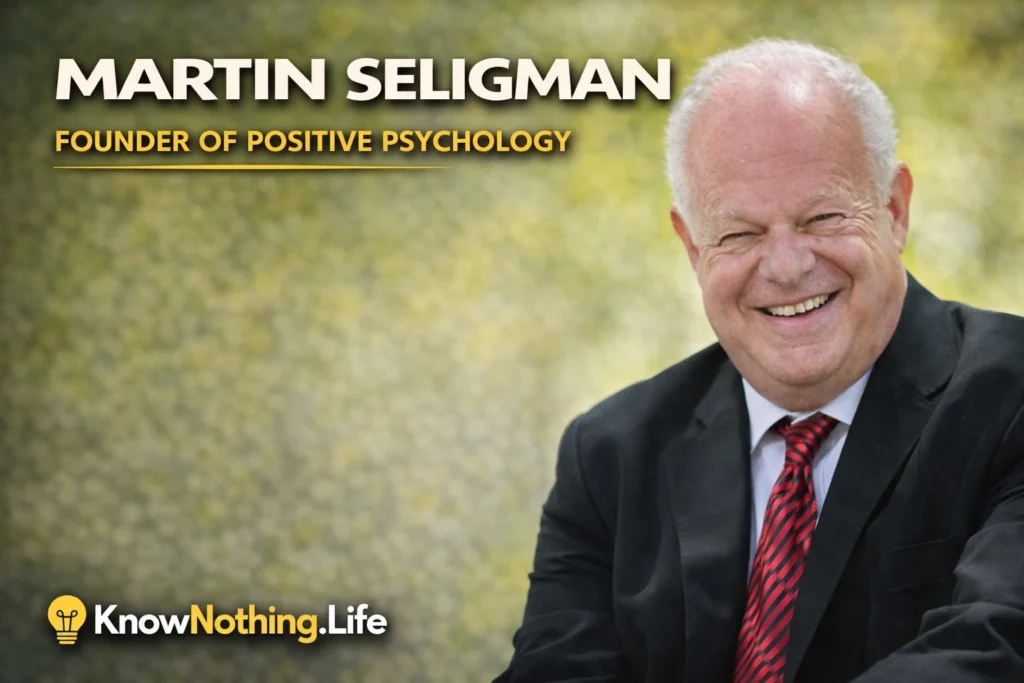
Martin E. P. Seligman was born on August 12, 1942, in Albany, New York, and became one of the most influential psychologists of the late twentieth and early twenty-first centuries. His work is unusual because it spans two emotional poles of human life: helplessness and flourishing. Early in his career, he became known for studying why people and animals sometimes stop trying when they believe their actions no longer matter. Later, he became one of the central architects of positive psychology, a movement that asked psychology to study not only disorder and suffering, but also strength, meaning, optimism, resilience, and well-being.
Seligman studied philosophy at Princeton University, graduating summa cum laude in 1964, before earning his Ph.D. in psychology from the University of Pennsylvania in 1967. That combination of philosophy and psychology shaped his entire career. He was not content to ask only how symptoms develop; he wanted to understand agency, choice, pessimism, courage, and the conditions that make life worth living. At the University of Pennsylvania, where he became Zellerbach Family Professor of Psychology and director of the Positive Psychology Center, Seligman built a career that joined laboratory research, clinical practice, public education, and large-scale institutional reform.
Learned Helplessness and the Study of Depression
Seligman’s first great contribution was the theory of learned helplessness. In experiments conducted with colleagues in the 1960s and 1970s, he observed that animals exposed to uncontrollable aversive events could later fail to escape even when escape became possible. The finding challenged simple behaviorist assumptions. The problem was not merely the stimulus or punishment itself; it was what the organism learned about control. When action seemed useless, passivity could become learned. This idea became central to later theories of depression, trauma, motivation, and resilience.
In Helplessness: On Depression, Development, and Death, published in 1975, Seligman developed the theory into a broader account of human suffering. The importance of the work came from its bridge between experiment and everyday life. People who repeatedly experience failure, rejection, abuse, or uncontrollable adversity may begin to believe that effort is pointless. Seligman’s later work on explanatory style added another layer: people are more vulnerable to helplessness when they explain bad events as permanent, pervasive, and personal. This moved psychology toward a cognitive understanding of depression, where the meaning a person gives to events can shape emotional life as powerfully as the events themselves.
Learned Optimism and the Possibility of Change
Seligman did not remain a theorist of helplessness. One of the defining turns of his career was the argument that pessimism itself could be studied, challenged, and changed. In Learned Optimism, published in 1991, he proposed that optimism is not shallow cheerfulness or denial. It is a disciplined explanatory style. Optimistic people are more likely to see setbacks as temporary, specific, and changeable, while pessimistic people are more likely to see them as permanent, universal, and self-defining. This distinction gave clinicians, teachers, parents, and individuals a practical way to understand resilience.
One of Seligman’s most quoted ideas is that “habits of thinking need not be forever.” That sentence captures the bridge between his early and later work. If helplessness can be learned, then more adaptive patterns can also be learned. In this sense, Seligman’s psychology is not naïve optimism; it is a psychology of agency. His goal was not to pretend that suffering disappears when people think differently. Instead, he argued that human beings can become more skilled in how they interpret adversity, dispute catastrophic beliefs, and recover a sense of influence over their own lives.
Positive Psychology and a New Mission for the Field
Seligman’s public identity changed dramatically when he became president of the American Psychological Association in 1998. During that presidency, he used his platform to argue that psychology had become too narrowly focused on pathology. The field had made enormous progress in diagnosing and treating mental illness, but Seligman believed it had neglected the scientific study of what makes life good. His famous declaration summarized the shift: “Psychology is not just the study of weakness and damage; it is also the study of strength and virtue.” Treatment, he argued, should not only repair what is broken, but also nurture what is best.
This vision helped launch positive psychology as a major scientific movement. Seligman did not invent every idea in the field; he drew from older traditions in philosophy, humanistic psychology, virtue ethics, motivation research, and the work of figures such as Abraham Maslow, Carl Rogers, Ed Diener, and Mihaly Csikszentmihalyi. His distinctive role was organizational and scientific. He gave the field a name, a research agenda, institutions, conferences, graduate programs, public tools, and a language that connected academic psychology to ordinary human questions. What are strengths? What is meaning? Why do some people thrive after adversity? How can schools, workplaces, families, and communities cultivate well-being?
Major Works and the Science of Flourishing
Seligman’s major works show the evolution of his thought. Helplessness gave psychology a theory of passivity and depression. Learned Optimism taught readers how explanatory habits influence achievement, health, and mood. The Optimistic Child applied those ideas to parenting and education. What You Can Change and What You Can’t explored the limits and possibilities of psychological change. With David Rosenhan, he coauthored editions of Abnormal Psychology, a widely used textbook. With Christopher Peterson, he helped create Character Strengths and Virtues: A Handbook and Classification, an ambitious attempt to classify human strengths such as wisdom, courage, humanity, justice, temperance, and transcendence.
In Authentic Happiness, published in 2002, Seligman argued that happiness involves more than pleasure. The good life, he wrote, is found in using one’s “signature strengths” to create authentic gratification. In Flourish, published in 2011, he revised his earlier happiness theory into a broader theory of well-being known by the acronym PERMA: positive emotion, engagement, relationships, meaning, and accomplishment. The change mattered because it moved the goal beyond feeling good. As Seligman put it, “Well-being cannot exist just in your own head.” A flourishing life involves connection, purpose, achievement, and participation in something larger than momentary mood.
Legacy, Criticism, and Lasting Importance
Seligman’s influence is enormous, but it has not been without criticism. Some critics argue that positive psychology can be oversimplified in popular culture, reduced to cheerful slogans, gratitude exercises, or corporate wellness language. Others have questioned whether the movement gives enough attention to inequality, trauma, poverty, and social conditions that shape well-being. These criticisms are important because they reveal the danger of turning a serious research program into a self-help brand. At its best, however, Seligman’s work does not deny suffering. It begins with helplessness, depression, and adversity, then asks what science can say about recovery, meaning, and strength.
Martin Seligman’s lasting importance lies in the arc of his career. He began by studying what happens when organisms lose the expectation of control, and he went on to help build a science of hope, resilience, and flourishing. He changed clinical psychology by showing how explanatory style shapes helplessness and depression. He changed education by encouraging schools to teach resilience and character alongside achievement. He changed public psychology by arguing that mental health is not merely the absence of disorder. His legacy is not the claim that happiness is easy. It is the deeper claim that human beings can study, practice, and build the conditions under which life becomes more meaningful, more resilient, and more fully lived.