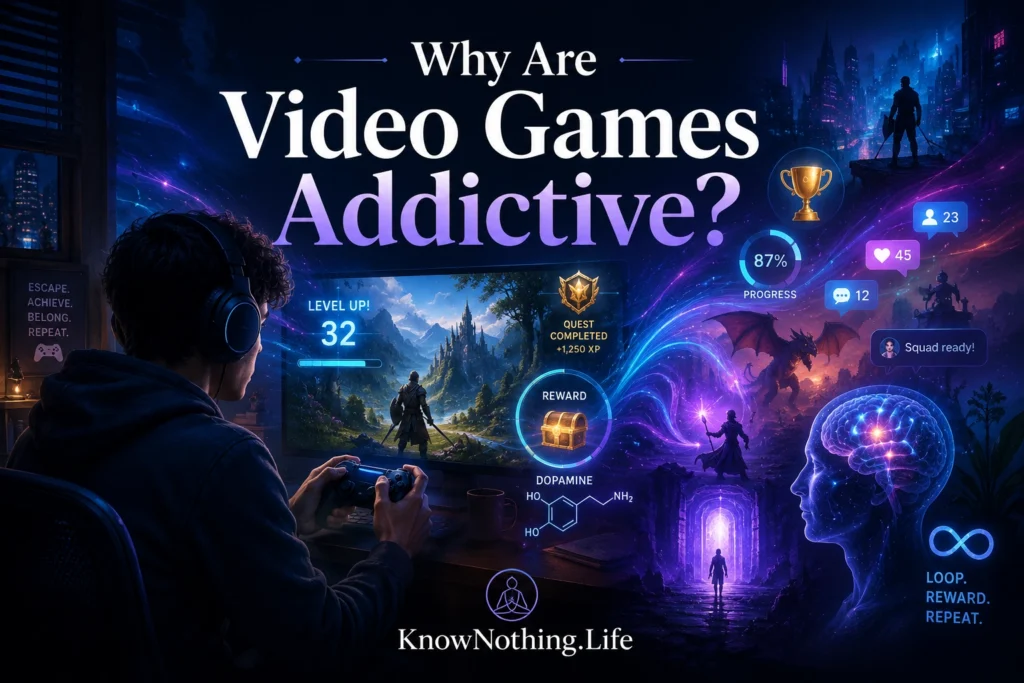
Video games are addictive for some people because they combine reward, challenge, identity, social belonging, progress, escape, and control into an experience that the brain finds unusually compelling. Unlike many passive forms of entertainment, games respond to the player. They give feedback, set goals, measure progress, reward improvement, and create worlds where effort produces visible results. For many players, games are simply fun, social, creative, and relaxing. But for a smaller group, gaming can become difficult to control, continuing even when it damages sleep, school, work, relationships, health, or emotional stability.
The important point is that video games are not addictive only because they are entertaining. They are addictive because they can satisfy powerful psychological needs in concentrated form. A game can make a person feel competent, autonomous, socially connected, admired, safe, powerful, or absorbed. It can offer structure when real life feels chaotic, achievement when real life feels stagnant, and belonging when real life feels lonely. The same features that make games meaningful can also make them hard to leave.
Gaming Disorder and Internet Gaming Disorder
Not all heavy gaming is addiction. A person can play many hours because they enjoy games, compete professionally, socialize online, or use gaming as a hobby. Addiction becomes a concern when control is impaired and gaming continues despite serious negative consequences. The World Health Organization recognizes “gaming disorder” in the ICD-11, describing it through impaired control over gaming, increasing priority given to gaming over other activities, and continuation despite negative consequences.
The American Psychiatric Association includes “Internet Gaming Disorder” in the DSM-5 and DSM-5-TR as a condition for further study, not as a fully settled official diagnosis in the same way as substance use disorders. The DSM framework emphasizes significant impairment or distress and includes symptoms such as preoccupation, withdrawal-like feelings, tolerance, unsuccessful attempts to reduce gaming, loss of interest in other activities, deception, escape, and continued use despite problems. This distinction matters because the goal is not to demonize games. It is to identify when gaming shifts from recreation into compulsive behavior.
The Reward System and the Pull of Progress
Video games activate the brain’s reward system by offering frequent feedback and meaningful progress. Points, levels, unlocks, achievements, rare items, rankings, victories, and completed missions all function as signals of advancement. The player is not merely watching a story unfold; they are causing things to happen. This creates a strong loop: action, feedback, reward, improvement, and renewed motivation.
Psychologist B. F. Skinner’s work on reinforcement helps explain this loop. Behavior becomes more persistent when rewards are predictable enough to feel fair but variable enough to stay exciting. Many games use variable reward schedules: sometimes a player receives a common item, sometimes a rare one; sometimes a match is easy, sometimes thrillingly close; sometimes a boss drops the desired reward, sometimes not. This unpredictability can keep players engaged because the next attempt may be the one that finally pays off. The same principle helps explain why gambling machines can become compulsive, though video games usually involve more skill, narrative, and social meaning.
Wanting, Liking, and Dopamine
Modern neuroscience distinguishes between wanting and liking. Neuroscientist Kent Berridge has shown that the brain systems involved in incentive motivation are not identical to the systems involved in pleasure. A person can strongly want to keep doing something even when they are no longer enjoying it very much. This distinction helps explain why addictive gaming can feel strange from the inside. The player may say, “I do not even know if I am having fun anymore,” yet still feel pulled toward another match, another quest, another rank, another reward.
In gaming, dopamine is often misunderstood as a simple “pleasure chemical.” More accurately, dopamine is deeply involved in motivation, anticipation, learning, and reward prediction. Games are powerful because they constantly create anticipated rewards. The next level, the next unlock, the next win, the next social reaction, the next improvement—all keep the wanting system active. The brain learns that the game is a place where effort reliably produces stimulation.
Competence, Autonomy, and Self-Determination
One reason games are so engaging is that they satisfy basic psychological needs. Richard Ryan, C. Scott Rigby, and Andrew Przybylski applied self-determination theory to video games in “The Motivational Pull of Video Games.” Their research showed that games are especially motivating when they support competence, autonomy, and relatedness. Competence means the player feels effective and improving. Autonomy means the player feels choice and control. Relatedness means the player feels connected to others or to meaningful characters and worlds.
This helps explain why games can feel better than real life for some people. In life, progress is often slow, feedback is unclear, and effort does not always produce reward. In games, goals are visible, rules are understandable, and improvement is measurable. A player may feel clumsy, overlooked, or powerless offline but skilled, respected, and purposeful online. When a game consistently supplies needs that real life does not, the attachment to the game can deepen.
Flow and Total Absorption
Games are also addictive because they can produce flow, a state described by psychologist Mihaly Csikszentmihalyi in Flow: The Psychology of Optimal Experience. Flow occurs when challenge and skill are balanced, attention is fully absorbed, and self-consciousness fades. Good games are carefully designed to produce this state. If a game is too easy, it becomes boring. If it is too hard, it becomes frustrating. The best games constantly adjust challenge so the player remains engaged at the edge of ability.
Flow is not unhealthy by itself. Athletes, musicians, artists, writers, and scientists also experience flow. But games can make flow unusually accessible. A person can enter a flow state within minutes, repeat it daily, and extend it for hours. For someone who feels anxious, lonely, depressed, or overwhelmed, that absorption can become a refuge. The game temporarily silences self-doubt and replaces emotional pain with focused action.
Social Belonging and Online Identity
Many addictive games are not solitary experiences. Multiplayer games create teams, guilds, clans, rankings, voice chats, shared missions, rivalries, and long-term communities. Nick Yee’s research on motivations for online play identified major motivation clusters including achievement, social interaction, and immersion. For many players, the social world of the game becomes as important as the mechanics.
This social dimension can be healthy. Friendships formed through games can be real, supportive, and meaningful. But social obligation can also make games harder to leave. A player may feel responsible to teammates, afraid of falling behind, or anxious about losing status. Online identity can become emotionally powerful: the person is not merely playing a character; they are known as a skilled healer, leader, strategist, builder, collector, or competitor. Leaving the game may feel like losing a community and a self.
Escape, Mood Regulation, and Emotional Relief
Games can become addictive when they function as emotional regulation. A person may play to avoid sadness, anxiety, boredom, shame, loneliness, anger, or stress. The DSM criteria for Internet Gaming Disorder include using games to escape or relieve negative mood. This does not mean every form of escape is unhealthy. Entertainment often helps people rest. The danger appears when gaming becomes the main or only way a person manages emotional life.
Douglas Gentile and colleagues, including researchers connected to Iowa State University, studied pathological video game use among youth in a two-year longitudinal study. Their research found that problematic gaming can be associated with emotional, social, and academic difficulties, and that risk factors such as impulsivity and lower social competence may matter. These findings suggest that gaming problems often interact with broader life problems. Games may not be the original cause of distress, but they can become the place where distress is avoided rather than addressed.
Design, Infinite Play, and the End of Natural Stopping Points
Older games often had clearer endings. Modern games frequently use design structures that reduce natural stopping points. Battle passes, daily quests, loot systems, seasonal events, ranking ladders, infinite matchmaking, open worlds, social streaks, timed rewards, and limited-time cosmetics all create reasons to return. The game does not simply wait for the player; it keeps generating urgency.
This is especially powerful because humans are sensitive to loss. Missing a reward can feel worse than gaining one feels good. Limited-time events create fear of missing out. Ranking systems make stopping feel like falling behind. Daily rewards turn play into habit. These features do not automatically create addiction, but they can exploit psychological vulnerabilities, especially in younger players or people already struggling with loneliness, stress, depression, ADHD, or poor impulse control.
Why Some People Are More Vulnerable
Not everyone is equally vulnerable to addictive gaming. Risk can be shaped by personality, age, mental health, family environment, sleep patterns, social support, and life satisfaction. Adolescents may be especially vulnerable because self-control systems are still developing while reward sensitivity is high. People with depression, anxiety, ADHD, social isolation, or low self-esteem may also be more likely to use games as emotional escape or identity replacement.
This is why simplistic claims are unhelpful. Saying “video games are addictive” ignores the fact that most players do not develop gaming disorder. Saying “games are harmless” ignores the real suffering of people who lose control. A serious view recognizes both truths: games can be healthy, creative, educational, and social; they can also become compulsive when they dominate life and crowd out sleep, relationships, work, school, physical health, and offline meaning.
Oxford Studies and the Importance of Quality
Recent research from the Oxford Internet Institute has complicated the idea that time spent gaming automatically predicts poor well-being. Studies by researchers such as Niklas Johannes, Matti Vuorre, Andrew Przybylski, and colleagues have used player data and well-being measures to show that the quality and motivation of play may matter more than raw hours alone. Playing because it is enjoyable, social, or satisfying may differ from playing because one feels pressured, compulsive, or emotionally dependent.
This is an important corrective. Addiction is not simply a stopwatch problem. Ten hours of gaming in one week may be harmless for one person and damaging for another, depending on context. The key questions are control, consequences, motivation, and balance. Does the person choose to play freely, or feel unable to stop? Does gaming support life, or replace life? Does it bring connection and enjoyment, or does it become the only escape from distress?
Final Thoughts
Video games are addictive because they are psychologically powerful. They offer reward, progress, challenge, identity, social belonging, emotional escape, and measurable success. They can satisfy needs for competence, autonomy, and relatedness more efficiently than many real-life environments. They can produce flow, reduce stress, and create communities. But when these experiences become the main source of meaning or emotional regulation, gaming can shift from play into compulsion.
The healthiest view is balanced. Games are not evil machines designed only to addict people, and most players are not addicted. But games are built around systems that strongly engage motivation and reward. For vulnerable people, especially those facing anxiety, depression, loneliness, impulsivity, or lack of offline fulfillment, those systems can become difficult to control.
The deeper question is not only why games are addictive, but what they provide that real life sometimes fails to provide. Many people do not become attached to games because they are weak. They become attached because games offer competence, community, structure, escape, and progress. Understanding that makes the problem clearer. The solution is not merely less gaming; it is building a life where the needs met by gaming can also be met outside the screen.