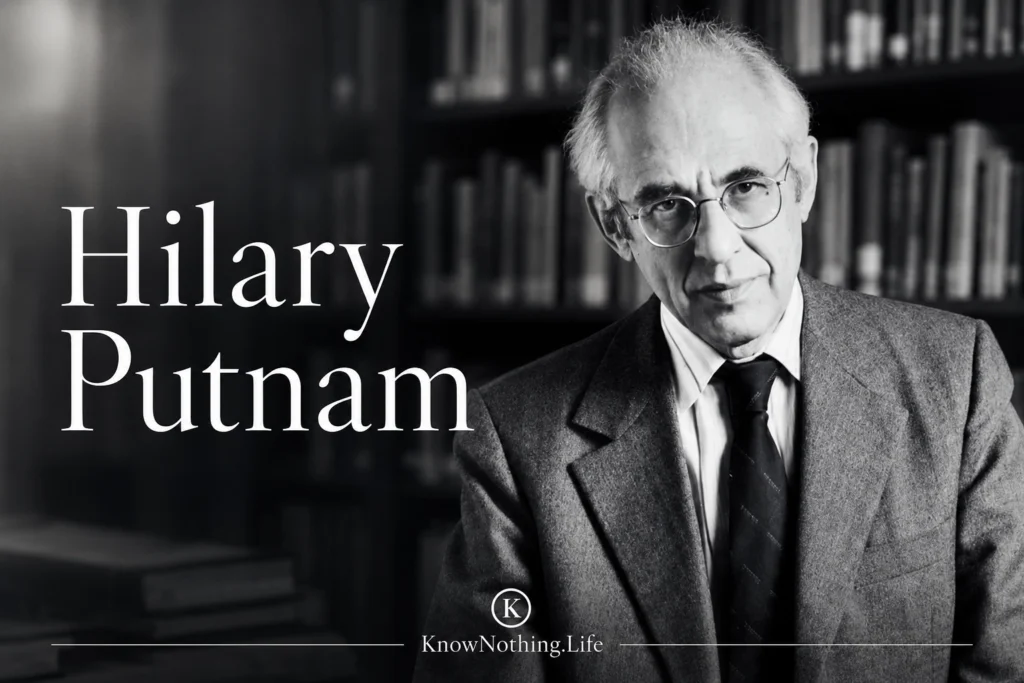
Hilary Whitehall Putnam was born on July 31, 1926, in Chicago, Illinois, and became one of the most influential analytic philosophers of the twentieth century. His father, Samuel Putnam, was a writer and translator, and Hilary grew up in a world shaped by books, argument, politics, and intellectual ambition. He studied at the University of Pennsylvania, then completed graduate work at Harvard and UCLA, earning his Ph.D. under Hans Reichenbach. That background placed him near the center of logical empiricism, mathematical logic, and the scientific style of philosophy that dominated mid-century analytic thought.
Putnam’s career took him through Northwestern, Princeton, MIT, and finally Harvard, where he joined the faculty in 1965 and remained for decades. He was not a philosopher who stayed inside one narrow specialty. He wrote on mathematics, logic, physics, language, mind, metaphysics, epistemology, ethics, pragmatism, religion, and politics. What made him unusual was not merely range, but intellectual restlessness. Putnam changed his mind repeatedly and publicly. He treated philosophy not as a monument to one’s earlier opinions, but as an ongoing discipline of correction.
Logic, Mathematics, and Early Scientific Philosophy
Putnam’s early work was deeply shaped by logic and mathematics. He contributed to the study of Hilbert’s Tenth Problem, working in the tradition that eventually led to the Davis–Putnam–Robinson–Matiyasevich theorem. This placed him among philosophers who were not merely commenting on mathematics from the outside, but actively participating in technical developments. His early writings also challenged logical empiricist views of science, especially the idea that scientific theories could be neatly divided into observational and theoretical parts.
In works later collected in Mathematics, Matter and Method, Putnam argued that science is more realistic, complex, and historically flexible than older positivist models allowed. Scientific theories do not simply summarize observations; they introduce terms, structures, and entities that help explain the world. Putnam became an important defender of scientific realism, especially the idea that the success of science would be miraculous if its theories were not at least approximately true. This became known as the “no miracles” argument, one of the most discussed arguments for realism in twentieth-century philosophy.
Philosophy of Mind and Functionalism
Putnam also helped transform philosophy of mind. In the 1960s, he became one of the major defenders of functionalism, the view that mental states are defined not by the material they are made of, but by the roles they play in a system. Pain, belief, desire, or memory should not be identified simply with a specific brain state, because the same mental function might be realized in different physical systems. This idea became known as multiple realizability.
The importance of this argument was enormous. If minds are understood functionally, then mental states may be studied in humans, animals, machines, or possible beings with different physical structures. Functionalism became one of the central theories of mind in cognitive science and artificial intelligence. Yet Putnam later criticized and revised aspects of functionalism, especially when he thought it encouraged an overly computational picture of human understanding. This pattern was characteristic of his career. He helped create a theory, then became one of its sharpest critics when he saw its limits.
Meaning, Twin Earth, and Semantic Externalism
Putnam’s 1975 essay “The Meaning of ‘Meaning’” changed philosophy of language. In it, he introduced the famous Twin Earth thought experiment. Imagine a planet just like Earth, except that the clear, drinkable liquid called “water” is not H2O but a different chemical substance, often called XYZ. A person on Earth and a physically identical counterpart on Twin Earth may have the same internal mental states when they say “water,” yet their words refer to different substances. The conclusion was radical: meaning is not determined only by what is inside the speaker’s head.
Putnam summarized the lesson in one of his most famous lines: “Meanings just ain’t in the head.” This slogan became central to semantic externalism, the view that meaning depends partly on the external world and the social-linguistic community. We do not privately manufacture reference from inner images alone. Words are connected to the world through causal history, expert knowledge, shared practice, and environment. This insight influenced philosophy of mind, language, epistemology, cognitive science, and debates about mental content. Putnam made the ordinary act of naming something philosophically strange again.
Brains in a Vat and the Limits of Skepticism
In Reason, Truth and History, published in 1981, Putnam developed another famous thought experiment: the brain in a vat. The scenario imagines a brain removed from the body, kept alive in a vat, and fed experiences by a powerful computer. At first, it appears to revive Descartes’ skeptical worry: how do we know we are not radically deceived about the external world? Putnam’s response was surprising. He argued that if we had always been brains in vats, our words could not refer to real brains and real vats in the way the skeptical hypothesis requires.
The argument depended on his externalist theory of reference. A permanently envatted brain would not have the right causal contact with actual brains, vats, or laboratories to mean what we mean by those words. Therefore, the statement “I am a brain in a vat,” if uttered under the imagined conditions, would undermine itself. Putnam was not offering a simple proof that ordinary reality exists. He was showing that skepticism depends on assumptions about meaning that it cannot easily justify. In his hands, a science-fiction image became a weapon against a very old philosophical anxiety.
Realism, Truth, and Pragmatism
Putnam’s middle and later philosophy wrestled with realism. He rejected both crude metaphysical realism and easy relativism. He did not think truth was simply whatever a culture accepts, but he also resisted the idea that truth could be described from a God’s-eye view outside all human practices. In Reason, Truth and History, The Many Faces of Realism, and Realism with a Human Face, he developed and revised views often associated with internal realism, conceptual relativity, and pragmatic realism.
His philosophical development was marked by a return to American pragmatism, especially the work of William James, Charles Sanders Peirce, and John Dewey. Putnam increasingly argued that fact, value, inquiry, and human practice cannot be sealed off from one another as cleanly as many philosophers supposed. He believed philosophy should be rigorous, but also humane. Truth matters because inquiry matters, and inquiry matters because human beings must live, judge, cooperate, suffer, and act in the world.
Ethics, Religion, and Later Thought
In his later career, Putnam wrote more directly about ethics, religion, and Jewish thought. Books such as Renewing Philosophy, Words and Life, The Collapse of the Fact/Value Dichotomy, Ethics Without Ontology, and Jewish Philosophy as a Guide to Life show a thinker moving beyond the older boundaries of analytic philosophy. He rejected the idea that ethical claims are merely subjective preferences or emotional expressions. For Putnam, values are not detached from reason; they are woven into the ways human beings describe, evaluate, and respond to the world.
This later work did not abandon rigor. It challenged philosophy to become less narrow. Putnam believed that philosophical clarity should serve life rather than shrink it. He criticized scientism, reductionism, and the fantasy that one vocabulary—physics, logic, computation, or economics—could replace all others. Human reality requires many forms of understanding. The language of science is indispensable, but it does not exhaust morality, meaning, interpretation, or religious seriousness. Putnam’s later philosophy became a defense of pluralism without laziness and realism without dogmatism.
Major Works and Lasting Legacy
Putnam’s major works include Philosophy of Logic, Mathematics, Matter and Method, Mind, Language and Reality, Meaning and the Moral Sciences, Reason, Truth and History, Realism and Reason, The Many Faces of Realism, Representation and Reality, Realism with a Human Face, Renewing Philosophy, Words and Life, The Collapse of the Fact/Value Dichotomy, Ethics Without Ontology, and Jewish Philosophy as a Guide to Life. Across these works, he helped shape debates about scientific realism, functionalism, reference, meaning, skepticism, truth, value, and pragmatism.
Hilary Putnam died on March 13, 2016, at the age of eighty-nine. His legacy is not a single doctrine, because he revised too many doctrines to be captured that way. His legacy is a philosophical temperament: bold, technical, self-critical, morally serious, and unwilling to confuse clarity with finality. He showed that changing one’s mind can be a form of intellectual courage. Putnam remains essential because he made philosophy answerable both to science and to human life. He asked what words mean, what minds are, what truth requires, and how reason can remain responsible in a world too complex for simple answers.